Families making one shared batch of smoothies
If you’re making several smoothies for one meal using the same yoghurt base, choose a container size that suits your recipe. Manufacturers offer containers in a range of sizes.


For several smoothies made from the same yoghurt base, a large container is handy if you plan to portion it out yourself; individual jars are a better fit if you want to chill and serve separate portions. Manufacturers specify, for example, a 1.2-litre container for the Rommelsbacher JG 80 and a 2-litre glass container for the Luvele Pure Plus. These figures don’t tell you how many finished smoothies you’ll get. Programmes and temperature settings are most useful if you want to try different recipes – check the instructions for the specific model.
If you’re making several smoothies for one meal using the same yoghurt base, choose a container size that suits your recipe. Manufacturers offer containers in a range of sizes.
If you want to chill yoghurt in individual jars and serve it as needed, check how many jars are included and how much each holds. This varies from model to model.
If you want to experiment with different ingredients, check that the appliance’s settings are suitable for your recipe. A programme doesn’t guarantee a particular result.
| Buying priority | What to check | Who it matters most to |
|---|---|---|
| Enough for a shared meal | Compare the amount of yoghurt your recipe needs for everyone with the container capacity per batch. Remember to allow room in the fridge, too. | If I’m preparing one base for everyone’s smoothies, I want the recipe to fit into a single batch if possible. That’s why around 36% of consumers put batch size first. |
| Separate portions | Check the number and capacity of the jars, their lids and how much room you’ll need to store the finished portions. | If family members want to serve their yoghurt separately, individual containers are handy for me. Around 29% of consumers prioritise separate portions. |
| Different recipes | Check the programmes and settings against the instructions for the milk or plant-based alternative you plan to use, as well as the cultures. | If I want to try different yoghurt recipes, the available settings need to suit the instructions for each one. This flexibility is the top priority for around 21% of consumers. |
| Easy to use and store | Check the fermentation time and automatic shut-off on the specific model. Also consider how many parts you’ll need to clean and chill afterwards. | If I want to keep things simple and chill all the containers easily afterwards, I look at the controls, cleaning and storage space. Around 14% of consumers prioritise ease of use. |
The size of the container doesn’t tell you how many smoothies you can make: the amount of yoghurt you need depends on your recipe.
Work out how much yoghurt you’ll need for everyone and compare it with the manufacturer’s stated container capacity. Remember to allow space for chilling, too.
A programme like this doesn’t prove that every combination of plant-based milk and cultures will work.
Before choosing a recipe, check the instructions for the specific appliance and the guidance for the cultures you plan to use.
Every jar and lid needs handling, and the finished portions will also need to be kept chilled.
Before you buy, consider whether you can clean all the jars and fit them in your fridge. Check whether replacement jars are available for the exact model, too.
The manufacturer describes the JM 2 as having twelve 0.2-litre jars and a timer with automatic shut-off. It could be a good option if you want separate portions for the family.
According to the manufacturer, the JG 80 combines a glass container with smaller ceramic pots and preset programmes. It’s worth considering if you want to switch between making one batch and preparing smaller portions.
According to the manufacturer, the JG 3518 is an easy-to-use yoghurt maker with seven 150 ml portion jars.
Depending on the model, the manufacturer’s specifications for the Pure range include either one large glass container or several ceramic containers, as well as temperature settings and a timer.
The manufacturer’s specification sheet for the Yogurella 0621/10 describes two 1-litre containers and a filter basket for strained yoghurt.
The selection includes yoghurt makers for individual portions and shared batches. The key is choosing the right container size and features for the model you’re considering.
 No image available
The inner pot and individual jars give you different container options when preparing a family meal.
1.6 L inner pot; 9 borosilicate glass jars; temperature control, timer and OLED display.
 No image available
The eight jars are a good fit if you want to prepare several individual portions in one batch.
8 jars with a combined capacity of 1,440 ml; digital temperature settings and 48-hour timer.
 No image available
The two container sizes give you options for different recipe quantities. Choose a batch size to suit your smoothie recipe.
Glass containers with capacities of 2,000 ml and 1,400 ml.
 No image available
The stated capacity can help you plan a shared batch. Compare it with the amount your recipe calls for to feed everyone.
1.5 litres; 20 W; strainer and lid; according to the product name, designed for 3–5 people and for natural and Greek yoghurt.
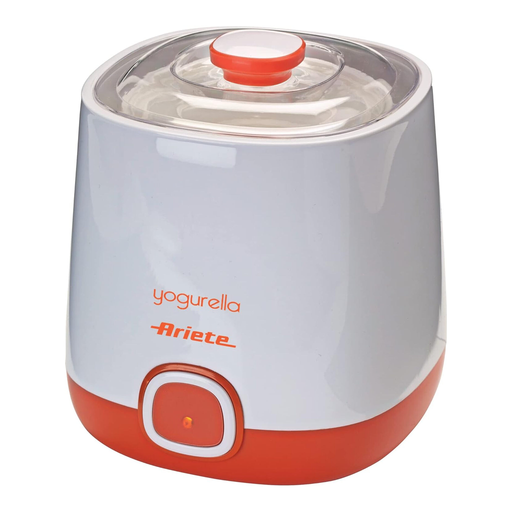 No image available
The stated capacity gives you a useful comparison when working out how much you’ll need for a family-sized batch.
Capacity: 1 litre; power: 20 W.
No. A yoghurt maker makes yoghurt; it doesn’t blend it into a finished smoothie. Once chilled, blend the yoghurt with your chosen ingredients. A yoghurt maker isn’t a substitute for a blender.
A large container works well if you’re making one shared yoghurt base and portioning it out yourself afterwards. Individual jars are a good choice if you want to chill and serve portions separately. Either way, check the quantity your recipe calls for and the space available in your fridge.
No. A programme alone can’t guarantee a particular result. Check the instructions for the specific appliance against the plant-based milk and cultures you plan to use.
Use clean hands and containers, and keep the finished yoghurt chilled. The Federal Centre for Nutrition recommends good kitchen hygiene; the consumer advice centre recommends storing yoghurt on the middle shelf of the fridge at 5 to 7 °C. Don’t assume that use-by guidance for commercially packaged, unopened products also applies to homemade yoghurt.
If you want to use raw milk, boil it before processing. The Federal Institute for Risk Assessment recommends this precaution for homemade yoghurt, too, if it won’t be heated again before eating.