For a shared breakfast at your holiday home, an electric yoghurt maker with individual jars is a good fit if you have enough plug sockets and fridge space. If there’s no suitable socket, a non-electric model could work, as long as you can heat water. Allow time for fermentation and chilling separately: a timer on suitable models will switch the appliance off, but it won’t make the yoghurt ready to serve straight away.
Who would benefit from a yoghurt maker at a holiday home?
Groups needing individual breakfast portions
If several people are having breakfast, you’ll need to balance the quantity, individually sealable portions and fridge space. The specifications from Steba, Severin and Clatronic can help you compare the number of jars with their capacity.
Travellers with a basic holiday-home kitchen
If you have limited worktop space or no suitable socket where you plan to set up the appliance, check whether you can heat water and chill the finished yoghurt. My.Yo describes a non-electric method, which requires you to plan for hot water and subsequent chilling.
Breakfast fans with specific recipe preferences
If you’d like to try plant-based or lactose-free options, compare the available programmes and ingredient guidance. Rommelsbacher lists different programmes for the JG 80, including one for vegan or lactose-free recipes.
What should you look for when choosing one?
First compare the number of portions you need with the fridge space available. Then plan for fermentation and chilling, and consider the facilities in your holiday-home kitchen.
| Priority |
What to check before buying |
Who should pay particular attention |
| Breakfast quantities and portions |
Compare the number and capacity of the jars, whether they have sealable lids, and the fridge space available. Steba lists twelve 0.2 l jars, while Clatronic lists seven 160 ml jars. |
If we’re preparing breakfast for several people, we need enough sealable portions and space to chill them. Around 36% of consumers base their choice primarily on getting the right quantity and portion-sized containers. |
| Fermentation and chilling time |
Check the fermentation time for your chosen method and whether it has a timer. You’ll also need to allow time for chilling afterwards. |
If breakfast needs to be ready at a set time, fermentation and chilling afterwards have to fit into your schedule. Around 29% of consumers focus on fermentation and chilling time. |
| Kitchen facilities |
Check that you have a socket and space to set up the appliance, or that you can heat water. You’ll still need room in the fridge, too. |
In a small holiday-home kitchen, we need to consider the socket, worktop space and chilling facilities together. Around 21% of consumers prioritise how easily preparation can be adapted to the kitchen facilities available. |
| Recipe options |
Compare the manufacturer’s guidance for your specific combination of ingredients and cultures, along with the programmes available. |
If we want to make a plant-based or lactose-free version, it matters whether the instructions describe a suitable programme. Around 14% of consumers prioritise recipe flexibility. |
Which common selection mistakes can you avoid?
-
Assuming automatic shut-off means breakfast is ready
The timer on the Steba JM 2 switches the appliance off. The Verbraucherzentrale recommends keeping the jars in the fridge after fermentation until you’re ready to eat the yoghurt.
Plan for fermentation to finish and the yoghurt to chill separately from your breakfast time.
-
Comparing capacity in litres without considering the container type
The twelve individual jars supplied with the Steba JM 2 and the 1-l container in the non-electric My.Yo model suit different portioning and storage needs.
Compare the number of portions, lids and available fridge space with the quantity you plan to make.
-
Assuming non-electric means you won’t need hot water
The My.Yo instructions specify around 750 ml of boiling water and a fermentation time of 12–14 hours for making yoghurt.
Choose this type only if you can heat water at your destination and chill the mixture afterwards.
Which brands are worth considering?
Steba
The JM 2 is designed to make several individual breakfast portions in sealable jars.
- Steba lists twelve 0.2 l jars and a timer with automatic shut-off.
- The larger quantity needs space both on the worktop and in the fridge. Automatic shut-off won’t chill the yoghurt.
Severin
The JG 3510 is an electric yoghurt maker with simple switch controls.
- Severin lists a cable tidy and a Euro plug.
- According to Severin, the JG 3510 doesn’t have a timer. If you need the fermentation to finish at a particular time, you’ll need to plan for that yourself.
Rommelsbacher
The JG 80 Jona combines individual portion pots and larger containers with pre-set programmes.
- Rommelsbacher lists four programmes, including settings for natural yoghurt and vegan or lactose-free yoghurt.
- You choose the temperature using programme settings rather than adjusting it continuously. The programmes can’t guarantee a particular result with every combination of ingredients.
My.Yo
This non-electric maker is described as suitable for making a 1 l batch.
- My.Yo describes a yoghurt maker that doesn’t need an electrical connection.
- The manufacturer’s instructions specify hot water and a fermentation time of 12–14 hours. The yoghurt then needs to be chilled.
Clatronic
The JM 3344 makes yoghurt in individual screw-top jars.
- Clatronic lists seven 160 ml jars and an illuminated on/off switch.
- Check that the jar capacity and the fridge space you’ll need are sufficient for your group.
Yoghurt makers at Joybuy
The selection includes yoghurt makers with larger containers and models with individual portion jars. Check each product listing for specific capacities and features.
 No image available
FOHERE yoghurt maker with two glass containers
An option if you’d like to make a larger batch in glass containers.
The product name lists containers with capacities of 2,000 ml and 1,400 ml.
View at Joybuy
 No image available
Fosmet yoghurt maker with 1.6-l inner pot
Worth considering if you’d like to use an inner pot as well as individual jars.
The product name lists a 1.6 l SUS304 inner pot, nine borosilicate glass jars, temperature control, a timer and an OLED display.
View at Joybuy
 No image available
FOHERE yoghurt maker with eight jars
An option if you’re planning a batch for several people and would like a timer.
The product name lists eight jars (1440 ml), digital temperature control and a 48-hour timer.
View at Joybuy
 No image available
Yoghurt maker with a 1.5 l capacity
An option if you’re planning a larger batch rather than individual portion jars.
The product name lists 20 W, a strainer and lid, and says it’s suitable for 3–5 people.
View at Joybuy
 No image available
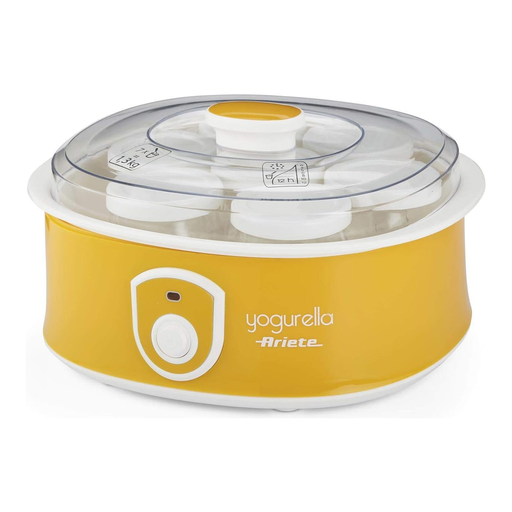
Ariete yoghurt maker 1.3 l (Refurbished A)
An option if you’re considering a refurbished appliance in this capacity range.
The product name lists 1.3 l and 20 W; this version is marked Refurbished A.
View at Joybuy
Frequently asked questions
Can I start making the yoghurt when I get up and eat it at breakfast?
Not straight away with the methods described: My.Yo specifies a fermentation time of 12–14 hours followed by chilling, while the Verbraucherzentrale describes a resting time of around twelve hours followed by storage in the fridge. Start making the yoghurt well in advance.
What do I need to use a non-electric yoghurt maker at a holiday home?
For the My.Yo model described, the manufacturer lists ingredients and culture, around 750 ml of boiling water, a fermentation time of 12–14 hours and somewhere to chill the yoghurt afterwards. Non-electric refers to the maker, not to heating the water.
How should I store homemade yoghurt after fermentation?
The Verbraucherzentrale recommends keeping the jars in the fridge after the resting period until you’re ready to eat the yoghurt. Check beforehand that there’s room for your whole batch.
Do I need a particular programme for special recipes?
Check the instructions for your specific combination of ingredients and culture. For the JG 80, Rommelsbacher lists separate pre-set programmes for natural yoghurt and vegan or lactose-free yoghurt. This doesn’t mean that every plant-based milk will be suitable.


