What should you look for when choosing one?
Single-container model
A good choice if: you prefer one container rather than several individual pots while your kitchen is being renovated.
Consider: the finished yoghurt will need to fit in your fridge, so check the exact version included in the listing.
Model with portion-sized jars
A good choice if: you want to chill and serve yoghurt straight from individual jars.
Consider: more jars and lids take up space and mean more separate parts to clean.
Larger batch with a timer
A good choice if: you want to make several portions at once and have enough room in your fridge.
Consider: make sure you have enough worktop and fridge space for the larger quantity and all its containers.
First, check where you can keep the appliance during the renovation. Then plan how many containers you need and how you’ll chill the finished batch.
| What matters to you |
What to check before buying |
Who is it most relevant to? |
| Worktop space |
Compare the appliance’s footprint and height with the space available; also allow for fridge space for the finished containers. |
If I only have a small suitable area in my temporary kitchen, I’ll check the appliance dimensions and space for the finished containers first. Around 36% of consumers say available space is their most important buying requirement. |
| Individual portions and cleaning |
Check the number and size of the jars, the lids, the cleaning instructions and the space available in your fridge. |
If I want to chill and serve yoghurt in individual portions, I’ll also need to clean more separate jars and lids. Around 29% of consumers say ready-to-serve individual portions matter most to them. |
| Batch size and chilling |
Check the usable container capacity and make sure there’s room in your fridge for all the finished containers. |
If I regularly need a larger quantity, I’ll only make as much as I can chill afterwards. Around 21% of consumers regularly need the largest quantities of yoghurt. |
| Timer |
Check whether the exact model has a timer and automatic shut-off. |
If my routine changes during the renovation, a timer can be useful for planning, but it doesn’t replace cleaning or refrigeration. Around 14% of consumers say a timer and automatic shut-off matter most to them. |
Yoghurt makers at Joybuy
The listings below include single-container models and models with portion-sized jars. For each one, check the exact model version, container sizes and how much room the finished batch will need in your fridge.
 No image available
FOHERE yoghurt maker, two XXL glass containers
For anyone who wants to make a larger batch in containers rather than lots of portion-sized jars.
The listing specifies 2,000 ml and 1,400 ml glass containers, plus programmable timings of up to 240 hours.
View at Joybuy
 No image available
Fosmet yoghurt maker, 1.6 L SUS304, 9 jars
For anyone who wants to store natural yoghurt in individual jars and use temperature and timer controls.
The title lists a 1.6 L SUS304 inner pot, temperature control, a timer and an OLED display; the listing describes nine 100 ml borosilicate glass jars.
View at Joybuy
 No image available
FOHERE yoghurt maker with 8 jars, 1.440 ml
For anyone who wants to make yoghurt in individual jars and use the timer.
The listing specifies eight jars with a total capacity of 1.440 ml, as well as temperature control, a timer of up to 48 hours and automatic shut-off.
View at Joybuy
 No image available
Yoghurt maker, 1.5 l, 20 W
For anyone who wants to make yoghurt in one container rather than several individual jars.
The listing specifies a 1.5-l container, 20 W, a sieve insert and dimensions of 19,5 × 17,5 × 21,4 cm.
View at Joybuy
 No image available
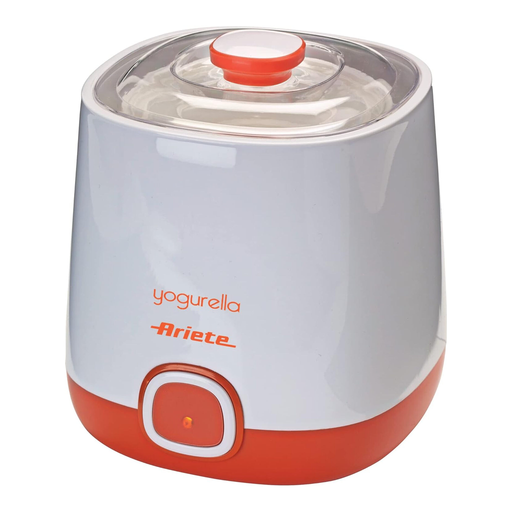
Ariete 621 yoghurt maker
For anyone considering a single-container model who wants to check the exact version before buying.
The listing title specifies 1 l and 20 W; the description mentions a filter. Ariete lists 40 W for the Yogurella 0621/10, so check the model version carefully.
View at Joybuy
Frequently asked questions
Can I leave finished natural yoghurt unrefrigerated during a kitchen renovation?
Make sure you have somewhere to keep it chilled. In an article dated 14 January 2025, the Verbraucherzentrale recommends storing yoghurt on the middle shelf of the fridge at 5 to 7 °C. Sort out refrigeration before making a larger batch.
What else do I need to make yoghurt, and how should I clean the maker?
You’ll need milk, a suitable yoghurt culture or yoghurt to use as a starter, and clean containers. The Verbraucherzentrale describes a method using milk and yoghurt as a starter. According to the instructions, the jars and lids for the Severin JG 3518 can be washed in washing-up water or in a dishwasher; the electrical base must not be immersed. Check the instructions for your specific model.
What should I bear in mind if I want to use raw milk?
If you’re using raw milk, follow the recommendation from the German Federal Institute for Risk Assessment to boil it before consumption. The Institute warns that raw milk may contain pathogens. This precaution relates to the ingredient you use, not to any particular feature of the yoghurt maker.
What are my rights if an appliance is faulty or I buy online in Germany?
If a product is faulty, your statutory rights are against the seller and are separate from any voluntary guarantee. Online purchases generally come with a 14-day right to cancel; when the period starts and any exceptions depend on the contract and the goods. The Verbraucherzentrale explains these rights for consumers in Germany.
Is the CE mark an independent safety approval?
No. According to information from Your Europe, the CE mark is the manufacturer’s declaration that the product meets the relevant EU requirements; there is no central EU body that grants general approval. So don’t treat the mark and product information as an independent comparative test.


