What should you consider when buying?
Electric maker with a large container
A good fit if: you want to portion yoghurt from one container rather than store several individual jars.
The trade-off: You’ll need to serve portions at breakfast or transfer them to other containers beforehand. Accessories such as a filter and extra containers also need storage space.
Electric maker with individual portion jars
A good fit if: you want to keep several individual breakfast portions ready in the fridge.
The trade-off: The jars and lids take up extra storage space and need washing after use.
Combination maker with small and large containers
A good fit if: you want to switch between small portions and a larger batch, depending on your breakfast plans.
The trade-off: More containers and accessories mean more storage and cleaning. Check which parts you can actually fit in your cupboards.
Non-electric maker or screw-top jars
A good fit if: you don’t want another kitchen appliance plugged in while you make yoghurt, or would rather avoid a specialist appliance.
The trade-off: An insulated maker needs hot water. With the screw-top jar method described, the yoghurt needs to be chilled in the fridge after standing.
When cupboard space is limited, it’s not just the maker’s footprint that matters: you also need somewhere to store the jars, lids, filters and extra containers after use.
| Consideration |
What to check before buying |
Who is it most relevant to? |
| Space for the maker and accessories |
Check the footprint and height of the specific model, as well as all the containers supplied with it. Ariete lists dimensions of 17 × 17 × 19 cm for the Yogurella 0621/10; the Rommelsbacher JG 40 is 34.5 cm wide. |
If I only have a narrow cupboard shelf free, the accessories need to fit there too. Around 40% of consumers put available storage space first. |
| Quantity and portioning |
Compare the capacity of the main container or the number and capacity of the jars with how much you use and the space in your fridge. Severin lists seven 150 ml jars for the JG 3510. |
If I want to chill individual breakfast portions straight away, I check how many jars I actually need. Around 23% of consumers prioritise separate portions. |
| Planning the time before breakfast |
Check the timer and automatic shut-off on the exact model you’re considering, and allow extra time for chilling afterwards. For its screw-top jar method, the Verbraucherzentrale recommends leaving the yoghurt to stand for around twelve hours, then storing it in the fridge. |
If I prepare a batch in the evening, I want to be able to plan when the programme ends without forgetting the chilling time. Around 23% of consumers put a predictable fermentation time first. |
| Preparation and running effort |
Check which separate parts are included and how you want to make your yoghurt. The Ariete Yogurella 0621/10 is described as coming with two containers and a filter basket; My.Yo’s insulated 1-litre maker uses hot water. |
If I want to keep extra steps and parts to a minimum, I compare the accessories and how each maker works. Around 14% of consumers prioritise keeping extra effort to a minimum. |
Joybuy product options
The Joybuy products below include yoghurt makers with a stated batch capacity, as well as models with portion jars. Compare the listed dimensions and accessories with the space available in your cupboards and fridge.
 No image available
Yoghurt maker, 1.5 l, 20 W
For a batch of the stated capacity, with a sieve insert for making Greek yoghurt.
The product title lists a capacity of 1.5 l, 20 W, dimensions of 19.5 × 17.5 × 21.4 cm and a lid. In particular, check the height of the space available on your shelf.
Joybuy
 No image available
Fosmet yoghurt maker, 1.6 l, with nine jars
If you want to prepare separate portions, the product title lists nine borosilicate glass jars.
The title also lists a 1.6 l SUS304 inner pot, temperature control, a timer and an OLED display. Nine jars need extra storage space.
Joybuy
 No image available
Yoghurt maker, 1.6 l, with nine borosilicate glass jars
The product description lists nine borosilicate glass jars for making separate portions.
It also lists a 1.6 l inner container, adjustable temperature, a timer and automatic shut-off. Remember to allow extra space for the jars.
Joybuy
 No image available
FOHERE yoghurt maker with eight jars
If you want to prepare several separate portions, the product title lists eight jars with a total capacity of 1,440 ml.
The title lists digital temperature control and a 48-hour timer. Make sure you have space to store the jars.
Joybuy
 No image available
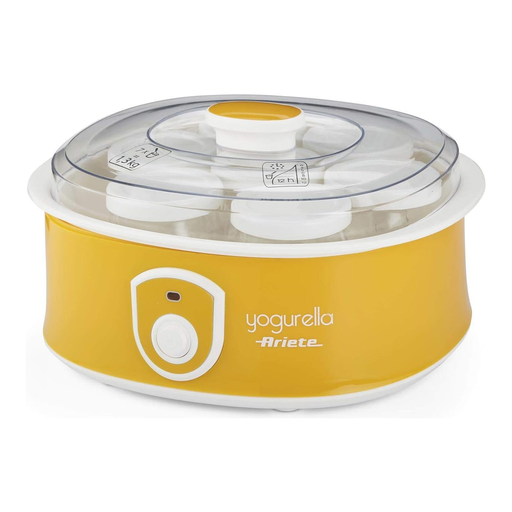
Ariete yoghurt maker, 1.3 l, 20 W, refurbished A
This option may suit you if a maker with a 1.3 l capacity is right for you and you’re happy to consider refurbished goods.
The product title lists a capacity of 1.3 l and 20 W, and identifies the maker as refurbished, condition A.
Joybuy
Frequently asked questions
Does a yoghurt maker need a timer for breakfast yoghurt?
No, a timer isn’t essential. It can make it easier to plan when the programme ends; according to the manufacturer, the Severin JG 3510 doesn’t have a timer. Either way, allow time to store the yoghurt in the fridge afterwards.
Can I make yoghurt without a yoghurt maker?
Yes. The Verbraucherzentrale describes a method using screw-top jars and a blanket. The jars are left to stand for around twelve hours, then stored in the fridge. Follow the ingredient and hygiene steps in the recipe you choose.
Can I use raw milk directly to make yoghurt?
Follow suitable instructions for the type of milk you’re using and observe the hygiene advice. The Bundeszentrum für Ernährung notes that raw milk must be boiled before drinking.
Who is responsible if a yoghurt maker is faulty in Germany?
Your statutory rights are with the seller; a guarantee is a separate, voluntary service. If there’s a fault, you should generally first ask for the product to be repaired or replaced.
What should I look for on the labelling of an electric yoghurt maker?
For an electrical appliance that requires labelling, the Bundesnetzagentur lists the CE marking, identifiable manufacturer details, and the required German-language instructions and safety information as points to check. The CE marking is the manufacturer’s declaration, not an independent quality mark. These electrical-appliance requirements don’t apply in the same way to a non-electric insulated container.


