Evening schedule planners
You set the yoghurt going in the evening and want the running time, finish time and chilling afterwards to fit around your morning.


For an overnight batch, a yoghurt maker with an adjustable running time and automatic shut-off is useful if you want the programme to finish around the time you get up. A simple on/off model can work if you’re happy to keep track of when it needs switching off. Then choose between individual jars and a larger container. The shut-off function won’t chill the yoghurt, so make room in your fridge for it afterwards and keep perishable ingredients chilled until you’re ready to use them, as recommended by the Federal Institute for Risk Assessment.
You set the yoghurt going in the evening and want the running time, finish time and chilling afterwards to fit around your morning.
You get the steps or ingredients ready in advance and need to keep chilled storage separate from preparation, which starts later.
You choose between individually sealed jars and a larger container based on how you want to chill and serve the finished yoghurt.
First check whether the appliance supports the schedule you want. Then choose containers and programmes to suit the batch you plan to make.
| What matters | What to check before buying | Who should consider it? |
|---|---|---|
| Running time and finish time | Check the specific model to see whether you can set the running time and automatic shut-off, or whether it only has an on/off switch. Make separate plans for chilling the yoghurt after the programme ends. | If I start a batch in the evening, I want the appliance to stop after the set running time. Around 36% of consumers prioritise running time and finish time. |
| Preparation and hygiene | Plan when you’ll actually start, and check the recipe, appliance instructions, clean containers and available fridge space. The Federal Institute for Risk Assessment recommends keeping perishable foods as cold as possible until they are used. | If I prepare ingredients in advance, I want to keep them chilled until I’m ready to start. Around 29% of consumers say preparation and hygiene are their main concern. |
| Portion size and fridge space | Compare the number and capacity of the containers you can actually use, as well as the space available in your fridge. Don’t simply add together alternative container sizes to work out the batch capacity. | For a larger batch, I want to divide the finished yoghurt into suitable portions and fit them in the fridge. Around 21% of consumers prioritise portion size and fridge space. |
| Other recipes | Compare the programmes listed for the specific model with the recipes you want to make. | If I want to try recipes beyond plain yoghurt, I check for suitable programmes. Around 14% of consumers prioritise recipe flexibility. |
Automatic shut-off stops the appliance, but it doesn’t put the finished yoghurt in the fridge. The consumer advice centre explains that it should then be stored in the fridge.
Plan the start, expected finish and chilling afterwards together.
Chilling the yoghurt after the programme takes extra time and fridge space.
An on/off switch doesn’t mean the appliance will stop automatically after a set time. Severin explicitly states that the JG 3510 has no timer.
Check the specifications for the full model name and look specifically for a timer and automatic shut-off.
The Rommelsbacher JG 80 is listed with small cups and larger glass containers as different container options. This doesn’t mean that all the containers are intended to be used at the same time for one batch.
Check the capacity of the container you’ll actually use for each batch.
Perishable ingredients should be kept chilled until you’re ready to use them. The Federal Institute for Risk Assessment advises keeping food as cold as possible.
Keep ingredients chilled until you start, and follow the instructions for your specific appliance and recipe.
The JG 80 is worth considering if you want an adjustable running time, a choice of containers and several programmes.
The JM 2 may suit you if you want to make lots of separate portions and use a documented timer function with automatic shut-off.
The JG 3510 is a straightforward portion maker for anyone happy to keep track of when the appliance needs switching off.
The JM 3344 is another simple option for making individual portions in screw-top jars.
The following Joybuy products include yoghurt makers with larger containers, as well as models with timers and individual portion jars. When comparing them, check the listed features and container sizes for each product.
 No image available
The two listed container sizes offer an option for making larger quantities. Check which container is intended for the batch you’re making.
Glass containers: 2000 ml and 1400 ml.
 No image available
If you prefer individual portions and a timer, this model is listed with nine jars and a timer function.
Other listed features: temperature control and an OLED display; 1.6 L SUS304 inner pot.
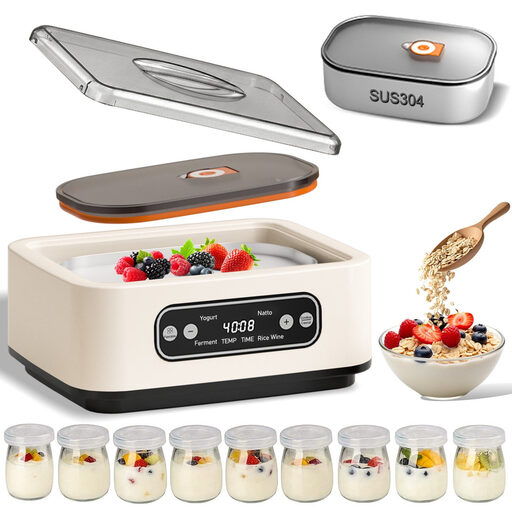 No image available
The jars are a good option if you want to divide the finished yoghurt into individual portions.
Listed features include a 1.6-L SUS304 inner pot, temperature control, a timer and an OLED display.
 No image available
The listed timer and automatic shut-off are useful if you’re planning to make a batch overnight.
Other features listed in the product name: digital temperature control and eight jars.
 No image available
The listed capacity is designed for a batch for several people; a strainer is included for making Greek yoghurt.
Listed features: 1.5 L, 20 W and suitable for 3–5 people.
Don’t rely on the appliance to keep ingredients safe while they wait unrefrigerated. The Federal Institute for Risk Assessment recommends keeping perishable foods sufficiently chilled until they are used. Follow the instructions for your specific appliance and recipe when preparing your batch.
No. The documented shut-off function stops the appliance, but it doesn’t replace chilling. The consumer advice centre explains that the jars should then be stored in the fridge.
The Federal Institute for Risk Assessment advises boiling raw milk before making yoghurt, as the yoghurt won’t be heated again before you eat it. People who are particularly vulnerable should not consume raw milk that hasn’t been boiled.
Your statutory rights for faulty goods apply against the seller. A warranty is an additional voluntary service with its own terms and conditions. The consumer advice centre recommends distinguishing between your statutory rights and a warranty. For the specific offer, also check the seller, warranty terms and availability of replacement containers.
No. Under the rules explained by the German Environment Agency, waste electrical equipment must be collected separately, for example at local collection points or suitable take-back points.