Short on space
If you share your worktop and storage space, first check whether the appliance has a suitable spot while in use and can be put away afterwards.


For natural yoghurt in a shared kitchen, first check how much worktop and fridge space is actually available. Individual jars with lids make it easier to store portions separately, but mean more parts to wash. A single larger container can reduce the number of vessels, but needs to suit the amount you plan to make. A timer and automatic switch-off make it easier to plan, but they’re no substitute for careful preparation or chilling the yoghurt afterwards.
If you share your worktop and storage space, first check whether the appliance has a suitable spot while in use and can be put away afterwards.
If you want to keep your natural yoghurt in your own lidded containers in a shared fridge, the items included and the fridge space available are important things to consider.
If you often make larger quantities, the batch you plan to prepare needs to fit in the shared fridge.
First, measure the available space on your worktop and in the fridge. Then decide whether individual jars or a larger container will work better for the way you store yoghurt and the amount you’re likely to use.
| What matters | What to look for when buying | Who is this most important to? |
|---|---|---|
| Worktop and storage space | Compare the appliance’s dimensions with the free worktop space, and think about where you’ll keep it after use. | If I have to share worktop and storage space, the main thing for me is whether the appliance will actually fit. Around 36% of consumers put the space it takes up first. |
| Separate storage | Check whether lidded portion containers are included and whether there’s enough room for them in the fridge. | If I want to store my yoghurt separately in a shared fridge, I look for suitable containers with lids. Around 29% of consumers prioritise separate storage and hygiene. |
| Timer | Check the timer and switch-off function on the exact model; the appliance switching off won’t chill the finished yoghurt. | If I want to fit yoghurt-making into my kitchen routine, I look for a timer that suits my needs. Around 21% of consumers say that making it easy to plan the timing is their main concern. |
| Batch size | Compare the capacity and number of containers with the available fridge space and the amount you’re likely to need. | If I regularly make larger batches, they need to fit in the shared fridge and be used. Around 14% of consumers focus on making enough to stock up. |
A larger batch needs room to chill after it’s made. The stated capacity alone doesn’t tell you whether the containers will fit in a shared fridge compartment.
Before buying, check where you’ll be able to chill the amount you plan to make.
An unnecessarily large batch could take up extra fridge space.
A timer stops the appliance, but it won’t chill the finished yoghurt.
Plan ahead so you can put the containers in the fridge afterwards.
Details about containers and functions may apply to a specific model variant. For example, Ariete lists the Yogurella 0621/10; those details don’t automatically apply to other variants.
When comparing a specific listing, check the full model number, containers and what’s included.
Ariete describes the Yogurella 0621/10 as a compact option for traditional yoghurt, with a container that can also be used for straining.
The Severin JG 3521 combines portion jars with automatic programmes, including one for natural yoghurt.
The JG 40 is designed for making yoghurt in individual portion jars; other Rommelsbacher models have different features.
According to the manufacturer, the Steba JM 2 is designed for larger batches made in individual jars.
The following yoghurt makers available at Joybuy come with individual jars or larger containers. Choose a format that suits the space available and the amount you can fit in your shared fridge.
 No image available
The two containers could suit a batch split between separate vessels, provided you have enough room in the fridge.
The product title lists glass containers with capacities of 2,000 ml and 1,400 ml.
 No image available
The individual jars could work well if you want to store portions separately; make sure you have enough room in the fridge.
The product title lists a 1.6 l SUS304 inner pot, nine borosilicate glass jars, temperature control and a timer.
 No image available
Eight jars can be handy for separate portions; check in advance that they’ll fit in your shared fridge.
The product title lists eight jars with a total capacity of 1,440 ml, digital temperature control and a 48-hour timer.
 No image available
The container format could suit a larger batch, as long as there’s room for it in the fridge afterwards.
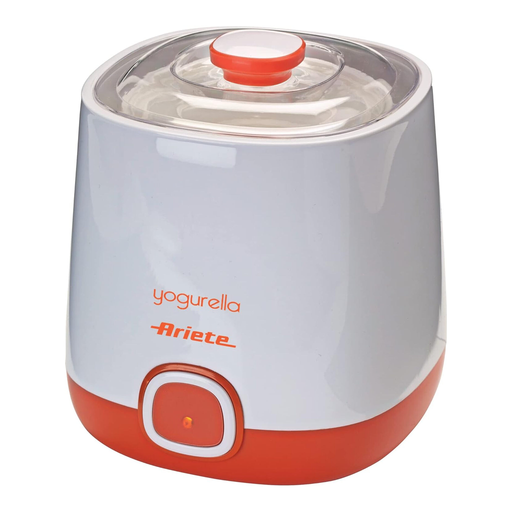
The product title lists a 1.5 l capacity, 20 W, a sieve and a lid. The stated dimensions are 19.5 × 17.5 × 21.4 cm.
 No image available
The container format could suit you if you prefer making a batch in one larger vessel rather than using several portion jars.
The product title lists a 1 l capacity, 20 W and a white finish.
The Verbraucherzentrale describes a method using milk and yoghurt as a starter. If you’re using an electric appliance, follow its instructions for ingredients, temperature and timing. Clean the containers and work surfaces carefully, then chill the finished yoghurt.
The switch-off function stops the appliance; it doesn’t chill the yoghurt. Put the finished yoghurt in the fridge afterwards. For dairy products such as yoghurt, the Verbraucherzentrale recommends the middle shelf of the fridge at 5 to 7 °C.
If an appliance is faulty, statutory consumer rights are separate from a manufacturer’s voluntary guarantee; the Verbraucherzentrale explains that your statutory rights are against the retailer. For the Rommelsbacher JG 40, Rommelsbacher lists a JG 8 replacement jar set; for the Steba JM 2, Steba lists a set of six.
Electrical appliances covered by low-voltage regulations must carry the CE marking; containers and other parts intended to come into contact with milk are covered by EU rules on food contact materials. The European Union explains that the CE marking indicates the manufacturer’s declaration of conformity and is not an individual approval by a public authority. Check the information for the specific appliance and the parts that come into contact with food.