For small portions that can be stored separately, the jars supplied with the maker are what matter most. The maximum capacity doesn’t tell you how small a batch you can make. If the appliance will sit on a shared worktop, also consider its dimensions and how it operates. A non-electric maker doesn’t need a socket during fermentation, but it won’t necessarily make individual portions. Remember to plan for clean containers and space in the fridge, too.
Who is a yoghurt maker for?
Anyone making small batches
If you want to make individual portions and store them separately in a shared fridge, compare the capacity and number of sealable jars. Rommelsbacher lists four 125 ml pots for the JG 80, Severin lists seven 150 ml jars for the JG 3510, and Clatronic lists seven 160 ml jars for the JM 3344. Whether you can make a smaller batch depends on the model.
Anyone sharing a worktop
If you share a worktop or socket with others, check the appliance’s dimensions and consider whether a large container would suit you better than individual jars. Ariete lists dimensions of 17 × 17 × 19 cm and a 1-litre container for the Yogurella 0621/10; My.Yo’s 1-litre maker works without electricity.
Anyone planning their kitchen routine
If you need to fit yoghurt-making around the times you use a shared kitchen, a timer and automatic switch-off may be useful. Rommelsbacher lists these features for the JG 80; according to Severin, the JG 3510 has no timer. Automatic switch-off is no substitute for clean containers or chilling the yoghurt afterwards.
What should you look for?
Electric maker with individual jars
A good fit if: you want to make portions in separate containers and chill them individually afterwards.
The trade-off: Several jars need storage and fridge space, and the number of jars supplied doesn’t tell you the minimum batch size.
Electric maker with a large container
A good fit if: you’d rather have a compact footprint than pre-portioned yoghurt, and you’re happy to transfer it after making it.
The trade-off: A 1-litre container won’t make small individual portions for you. Don’t assume that details for the Ariete Yogurella 0621/10 apply to similarly named listings without checking.
Non-electric maker with a large container
A good fit if: you don’t want to tie up a socket during fermentation and a 1-litre batch suits you.
The trade-off: The yoghurt is made together in one container, and you may still need hot water to prepare it.
| What you’re looking for |
What to check before buying |
Who is it most relevant to? |
| Small individual portions |
Capacity per jar, number of jars and lids; check the specific model’s instructions if you plan to make a smaller batch. |
If I want to store small amounts directly in sealable jars, the right container size is essential. Around 36% of consumers put small portions that can be stored separately first. |
| Shared worktop |
Compare the width, depth and height with the space available; also allow room for the containers and power connection. |
If worktop space is limited, the appliance’s footprint matters to me, especially if other kitchen items need to fit there too. Around 29% of consumers prioritise a compact footprint. |
| A predictable routine |
Check whether the specific model has a timer and automatic switch-off; also plan for cleaning and fridge space afterwards. |
If I need to fit yoghurt-making around the times I use a shared kitchen, having a routine I can plan around is important. Around 21% of consumers prioritise timing and organisation. |
| Fewer appliances and accessories |
Decide whether avoiding a socket or storing portions directly in individual jars matters more; check what’s included. |
If I don’t want to use a socket during fermentation, I’m more willing to use one larger shared container. Around 14% of consumers prioritise keeping appliances and accessories to a minimum. |
Common assumptions to avoid
-
Assuming the maximum capacity is the smallest practical batch
A large 1-litre container and several 125 to 160 ml jars offer different ways to portion yoghurt. Capacity and the number of jars alone don’t tell you the minimum batch size.
Compare the containers supplied and check the instructions for your chosen model to see whether smaller batches are suitable.
Extra containers can take up storage space; making a batch that’s too large for your portions may also mean transferring the yoghurt.
-
Confusing “non-electric” with “no preparation needed”
The My.Yo maker doesn’t use electricity during fermentation. That doesn’t mean every step of the process is preparation-free.
Check the full process if you’re planning around socket availability or preparing yoghurt in a shared kitchen.
Preparing it with hot water takes time and may require extra energy.
-
Assuming similarly named models are identical
Ariete’s data sheet lists a power rating of 40 W for the Yogurella 0621/10; a Joybuy listing describes the AR621 as 20 W. These details don’t prove that they’re the same product version.
Before buying, check the full model number, power rating and what’s included against the manufacturer’s information.
-
Forgetting space in the fridge for filled jars
Individual portions are easy to take out separately, but they need space to chill after preparation. The Verbraucherzentrale recommends keeping filled jars in the fridge until you’re ready to eat the yoghurt.
Plan separately for the appliance on the worktop and the fridge space needed for the containers you’ll actually fill.
Several jars take up extra space in a shared fridge.
Brands and models to consider
Rommelsbacher
The JG 80 Jona combines small portion pots with larger containers and programmes.
- According to the manufacturer, it comes with four 125 ml ceramic pots and two 1.2-litre glass containers. Automatic switch-off and a timer are also listed.
- The extra accessories need storage space. Four preset temperature settings aren’t the same as freely adjustable temperature control.
Severin
The JG 3510 is designed for individual 150 ml jars.
- According to Severin, seven portion jars are included; the appliance has an on/off switch.
- Severin lists no display or timer for the JG 3510. These details apply to this model and not automatically to other appliances from the brand.
Clatronic
The JM 3344 comes with several sealable jars for portions you can store separately.
- According to the manufacturer, seven 160 ml jars are included; additional compatible jars are available as accessories.
- Extra jars aren’t included as standard and need space to store them.
Ariete
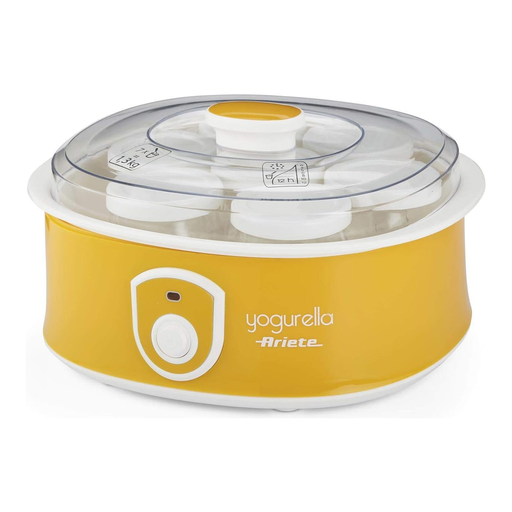
Ariete lists a 1-litre container and compact dimensions for the Yogurella 0621/10.
- Ariete’s data sheet gives dimensions of 17 × 17 × 19 cm and a power rating of 40 W for the Yogurella 0621/10.
- Similarly named listings may show different model or power details. Check the full model number before matching accessories or specifications.
My.Yo
This non-electric maker is an alternative if you don’t want to use a socket during fermentation.
- My.Yo describes a heat-insulating 1-litre maker that works without electricity during fermentation.
- The yoghurt is made together in one container rather than in several small individual jars. Preparation may require hot water.
Yoghurt makers at Joybuy
This selection includes electric yoghurt makers for preparing individual portions, as well as models with larger containers where you can portion the yoghurt afterwards.
 No image available
Fosmet yoghurt maker, 1.6 l, SUS304, 9 borosilicate glass jars
The jars are a good option if you want to store portions separately.
The product name lists a 1.6-litre SUS304 inner pot and nine borosilicate glass jars.
Temperature control, a timer and an OLED display are also listed in the product name.
Joybuy
 No image available
Yoghurt maker, 1.6 l, SUS304 inner container, 9 borosilicate glass jars
The individual jars could suit you if you want to store portions separately.
The product name lists a 1.6-litre SUS304 inner container and nine borosilicate glass jars.
Temperature control, a timer and an OLED display are also listed.
Joybuy
 No image available
FOHERE yoghurt maker with 8 jars and 48-hour timer
The jars could suit you if you want to store portions separately.
The product name lists eight jars with a combined capacity of 1,440 ml, digital temperature control and a 48-hour timer.
Automatic switch-off is also listed.
Joybuy
 No image available
Ariete yoghurt maker, 1.3 l, 20 W, refurbished A
This refurbished version may be worth considering if you’re happy with its condition and check the exact specifications before buying.
The product name lists 1.3 l, 20 W and the grade Refurbished A.
Joybuy
 No image available
FOHERE yoghurt maker with 2 large glass containers
This version is a better fit if you’re happy to make a larger batch and portion the yoghurt yourself afterwards.
The product name lists two glass containers with capacities of 2,000 ml and 1,400 ml.
Joybuy
Frequently asked questions
Do I need to fill all the jars supplied if I only want a few portions?
No. The number and capacity of the jars don’t confirm that every model is suitable for making a smaller batch. Check the instructions for the specific appliance.
What should I keep in mind when making yoghurt in a shared kitchen?
Keep your hands, worktops and containers clean, and avoid contamination from shared utensils. The Bundeszentrum für Ernährung stresses the importance of kitchen hygiene; the Verbraucherzentrale advises keeping sealed jars of finished yoghurt in the fridge until you’re ready to eat them. Also follow the appliance instructions and the recipe you’re using.
How should I store homemade yoghurt?
Put it in the fridge after making it. For dairy products such as yoghurt, the Verbraucherzentrale recommends the middle shelf at 5 to 7 °C. This isn’t a guarantee of how long homemade yoghurt will keep.
Should I check for replacement jars before buying?
Yes. Check whether replacement jars and lids are available for your exact model. Rommelsbacher lists a compatible pot set for the JG 80, while Clatronic offers an additional jar set for the JM 3344. Availability and terms depend on the listing you choose.
What should I look for in an electric yoghurt maker in Germany?
Check that you can clearly identify the appliance and that it comes with German instructions, including the necessary information on use and safety warnings. The Bundesnetzagentur lists these as checks for products; EUR-Lex sets out requirements for electrical equipment within the relevant EU voltage limits. A CE mark isn’t an independent quality award for the yoghurt. These requirements can’t be applied in the same way to a non-electric container.


