Fans of ready-to-store portions
You want to make yoghurt in individual, sealable jars and store it in the fridge, rather than portioning it out afterwards.


For small batches of yoghurt, a maker with individual jars is handy if you want to chill the yoghurt straight away in separate, sealable containers. If worktop space is limited and you don’t mind portioning it afterwards, a model with one larger container may be a better fit. Timers and temperature settings are worth considering if you don’t want to monitor the running time yourself or would like to try different recipes.
You want to make yoghurt in individual, sealable jars and store it in the fridge, rather than portioning it out afterwards.
You’re happy to portion out a larger batch afterwards if the appliance takes up less worktop space.
You want to set the running time or temperature to suit the recipe, rather than relying on a simple on/off switch.
First decide whether you want to ferment the yoghurt directly in individual jars or portion it out afterwards. Then compare the appliance’s footprint, controls and the space available for containers in your fridge.
| What matters to you | What to check | Who is it important to? |
|---|---|---|
| Individual portions | Check the jar capacity, lids and maximum fill level in the instructions. | If I want to chill yoghurt straight away in small, sealable jars, I can skip transferring it later. Around 36% of consumers prioritise individual portions that are ready to serve. |
| Worktop space and storage | Measure the appliance’s footprint, as well as the space for containers and finished portions in your fridge. | If worktop space is limited, I’m more willing to portion the yoghurt afterwards, provided the appliance has a compact footprint. Around 29% of consumers place the greatest importance on the space it takes up. |
| Timer control | Check whether the exact model number has a timer and automatic shut-off. | If I don’t want to switch the appliance off myself at the right time, a preset running time is important. Around 21% of consumers prioritise timer control. |
| Recipe flexibility | Compare the programme temperatures and recommendations for the culture or milk alternative you plan to use. | If I want to try different recipes or cultures, I look for suitable temperature settings. Around 14% of consumers prioritise this flexibility. |
An appliance with a larger container won’t automatically give you ready-made individual portions. You’ll need to transfer the yoghurt into your own containers afterwards.
Before you buy, decide whether you want to ferment the yoghurt directly in portion jars or are happy to transfer it afterwards.
You’ll need suitable storage containers and room in the fridge to portion it out later.
Severin explicitly states that the JG 3510 doesn’t have a timer. By contrast, Rommelsbacher lists an adjustable running time with automatic shut-off for the JG 60.
Check the timer and shut-off function against the full model number instead of assuming they’re available because the appliance has a switch or display.
Storage guidance for unopened shop-bought yoghurt doesn’t guarantee how long homemade yoghurt will keep.
Use clean containers and hands, and chill the finished portions. Don’t eat yoghurt with visible mould.
A spoiled batch can mean wasted ingredients and all the time you spent making it.
The details below relate to specific product ranges and manufacturer information; they aren’t a general assessment of each brand.
The JG 60 is aimed at buyers who want individual ceramic portions and adjustable programmes. The JG 80 adds larger containers to the range.
The JG 3510 is a straightforward maker for individual portions; the JG 3518 is a separate model with information available about replacement jars.
The JM 3344 is designed for individual, sealable portions and simple switch controls.
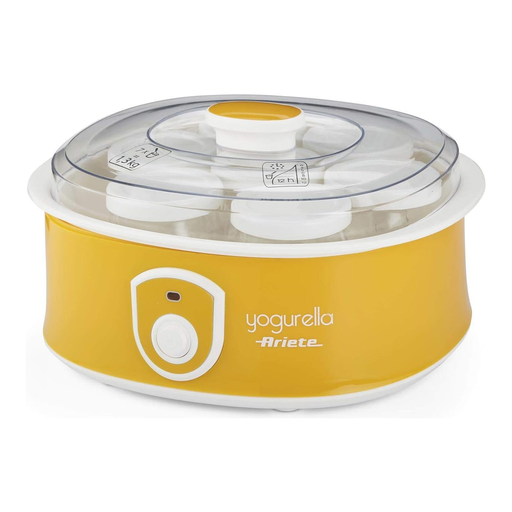
The Yogurella 0621/10 is an alternative with a single container, if a small footprint matters more to you than ready-portioned jars.
The JM 2 has several individual jars and a timer, but it’s better suited to preparing lots of portions than to saving as much worktop space as possible.
This selection includes models with individual portion jars as well as models with one larger container, for anyone weighing up ready-portioned yoghurt against portioning it afterwards in a small kitchen.
 No image available
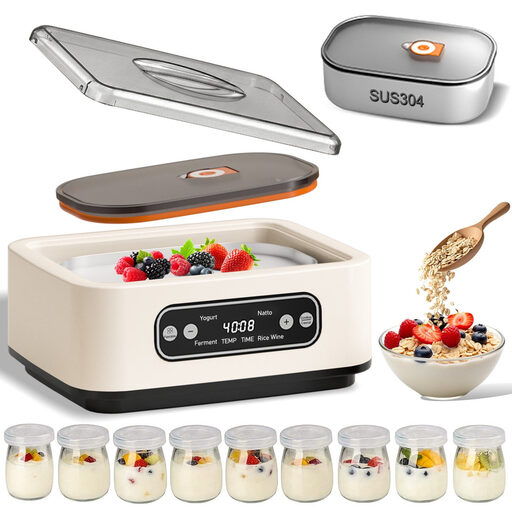
An option if you want to make several small portions in individual jars.
The product name lists a 1.6 l SUS304 inner container, nine borosilicate glass jars, temperature control, a timer and an OLED display.
 No image available
A good fit if you prefer individual jars to one large container of finished yoghurt.
The product name lists a 1.6 l SUS304 inner container, temperature control, a timer and an OLED display, plus nine borosilicate glass jars.
 No image available
The individual jars let you divide one batch into several portions.
The product name lists eight jars with a total capacity of 1,440 ml, digital temperature control, a timer of up to 48 hours and automatic shut-off.
 No image available
An option if you want to make a larger batch and portion it out afterwards.
The product name lists a 20 W, 1.5 l container, a strainer and lid, and dimensions of 19.5 × 17.5 × 21.4 cm.
 No image available
An option for making a larger batch if you’re happy to portion it out yourself afterwards.
The product name lists a capacity of 1.3 l and a power rating of 20 W. Before buying, check the details for the specific refurbished version and what’s included.
Check the instructions for your specific appliance and recipe to find the permitted fill level. The number of jars supplied doesn’t automatically determine how much yoghurt you should make. Use clean containers and hands.
Chill the finished portions in clean, sealable containers. The German Consumer Advice Centre recommends storing dairy products such as yoghurt on the middle fridge shelf at 5 to 7 °C. Guidance on the shelf life of unopened shop-bought products doesn’t guarantee how long homemade yoghurt will keep.
Possible ongoing costs include ingredients, cultures and replacement jars if needed, as well as electricity for electric appliances. Compare costs based on the quantities you actually make and the running time; you can’t assume a general saving compared with shop-bought yoghurt.
No. Your statutory rights cover claims against the seller for faulty goods; a guarantee is an additional voluntary promise with its own terms. The German Consumer Advice Centre recommends checking the applicable terms if a product develops a fault and keeping your proof of purchase.
Check for the CE marking, manufacturer information and instructions in German. The German Federal Network Agency lists these points for market surveillance. The EU Low Voltage Directive applies to equipment within its scope operating at AC voltages of 50 to 1,000 V. A CE mark alone isn’t an independent quality mark and doesn’t confirm that a particular listing complies with the relevant requirements.