Who benefits from each design?

Planners of individual portions

If you want to make yoghurt in several sealable containers and take them out of the fridge one at a time, compare the number and size of the jars. Severin, Rommelsbacher and Steba list different jar sizes and quantities for their respective models.

Batch planners

If you prepare several portions at once, consider whether you want them ready in separate containers straight away or would rather divide a larger batch later. The manufacturer information for Steba, Rommelsbacher and My.Yo describes different types of containers and preparation methods.

Flexible home yoghurt makers

If you want to switch between portion sizes, prefer a timer or would rather use a maker without its own mains connection, check the containers and preparation steps for each model. Rommelsbacher describes alternative containers for the JG 80; My.Yo lists a system that uses hot water.

What to look for when making several small portions

What matters What to check before buying Who is it important to?
Size of each portion Check the capacity of each container supplied and whether it has its own lid. Manufacturers list examples including 125 ml for the Rommelsbacher JG 80, 150 ml for the Severin JG 3518 and JG 40, and 0.2 l for the Steba JM 2. If I want to eat a small portion straight from its container, the individual capacity matters more to me than the total amount. Around 36% of consumers put portion size first.
Number of individual portions ready at once Distinguish the number of portion containers you can use at the same time from the total capacity of a batch. Rommelsbacher lists eight jars for the JG 40, while Steba lists twelve for the JM 2. If I want several separate portions ready after one cycle, the number of jars is what matters to me. Around 29% of consumers put the number of individual portions first.
Timing and operation Check the exact model to see whether a timer and automatic switch-off are specifically listed. Rommelsbacher lists both features for the JG 40, as does Steba for the JM 2; Clatronic lists an on/off switch for the JM 3344. If I want to fit yoghurt-making around my daily routine, having the right timer matters to me. Around 21% of consumers prioritise timing.
Flexibility and replacement containers Check whether a combination model’s containers can be used as alternatives, and whether replacement jars are explicitly listed as compatible with the full model name. Rommelsbacher lists the JG 8 replacement jar set for the JG 40; Steba offers a six-piece set for the JM 2. If I want to switch between container shapes or buy extra compatible jars, being able to use different batch options matters more to me than the number of jars alone. Around 14% of consumers put flexibility first.

Common buying mistakes

  • Assuming total capacity means the same as the number of individual portions

    A one-litre inner container won’t automatically give you several separate portions. Even with a combination model, the smaller and larger containers may be alternative ways of using it.

    Check how many portion containers can be used at the same time and their individual capacity.

    To make individual portions from a large batch, you’ll need suitable containers and time to transfer the yoghurt.

  • Confusing a timer or automatic switch-off with a cooling function

    Automatic switch-off stops the appliance; it doesn’t cool the yoghurt. Homemade yoghurt should be stored in the fridge afterwards.

    Plan the end of the preparation time so you can put the containers in the fridge afterwards.

  • Choosing replacement jars by capacity alone

    Manufacturers list replacement sets for specific models. A similar capacity on its own doesn’t tell you whether a jar will fit your yoghurt maker.

    Before buying, compare the compatibility information with the full model name.

Key brands to help you choose

Severin

According to Severin, the JG 3518 is designed for seven sealable jars, each with a capacity of 150 ml.

  • Severin lists the EG 3513 and EG 3514 replacement jars as compatible.
  • Severin describes the JG 3518 as having an on/off switch. Don’t assume it has automatic switch-off simply because other models do.

Rommelsbacher

According to Rommelsbacher, the JG 40 comes with eight 150 ml jars; the JG 80 combines four small portion pots with alternative large containers.

  • Rommelsbacher lists a timer, automatic switch-off and compatible JG 8 replacement jars for the JG 40.
  • When using the large containers with the JG 80, they replace the individual portions; don’t add the capacities of the different containers together as if they could all be used in one batch.

Steba

According to the manufacturer, the Steba JM 2 comes with twelve sealable glass pots, each holding 0.2 l.

  • Steba lists a timer and automatic switch-off, and offers a six-piece replacement jar set for the JM 2.
  • The 0.2 l pots are larger than the 125–160 ml containers listed for the other appliances covered here. The right choice depends on the portion size you want.

Clatronic

Clatronic describes the JM 3344 as coming with seven screw-top jars, each holding 160 ml.

  • Clatronic lists an on/off switch and offers an additional six-piece set.
  • The manufacturer information for the JM 3344 lists an on/off switch. Don’t assume it has features such as automatic switch-off based on those available on other models.

My.Yo

My.Yo describes a non-electric system that uses hot water and has an inner container for a one-litre batch.

  • According to My.Yo, the system doesn’t need its own mains connection.
  • If you want individual portions ready to serve, you’ll need to divide the batch into suitable containers afterwards.

Yoghurt makers for separate portions and larger batches

The following Joybuy product options include yoghurt makers with several individual containers, as well as models for larger batches that you can divide into portions afterwards.

Fosmet yoghurt maker with nine borosilicate glass jars

Fosmet yoghurt maker with nine borosilicate glass jars

The nine jars listed make it easy to prepare several portions separately.

The product name lists a 1.6 l SUS304 inner pot, temperature control, a timer and an OLED display.

View at Joybuy

FOHERE yoghurt maker with eight jars

FOHERE yoghurt maker with eight jars

Eight jars are a good option if you want to prepare several separate portions in one cycle.

The product name lists digital temperature settings and a timer of up to 48 hours.

View at Joybuy
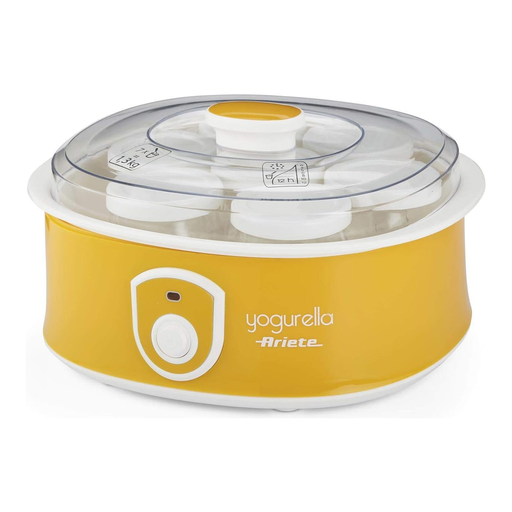
Refurbished Ariete yoghurt maker, 1.3 l, 20 W

Ariete yoghurt maker, Refurbished A

If a stated capacity is important to you, the product name lists 1.3 l. Check whether the containers supplied suit the number of portions you want to make.

The product name lists 1.3 l and 20 W. The appliance is described as “Refurbished A”.

View at Joybuy

FOHERE yoghurt maker with two large glass containers

FOHERE yoghurt maker with two XXL glass containers

The large containers are suited to making a bigger batch, which you can divide into small portions afterwards.

The product name lists two XXL glass containers, with capacities of 2,000 ml and 1,400 ml.

View at Joybuy

1.5 l yoghurt maker with sieve and lid

1.5 l yoghurt maker with sieve and lid

The container is suited to making a larger batch; you’ll need to divide the yoghurt into several small portions afterwards.

The product name lists a capacity of 1.5 l and a power rating of 20 W, as well as a sieve and a lid.

View at Joybuy

Frequently asked questions about small portions of yoghurt

How do I choose between portion jars and a large container?

If you want the portions separated during preparation, check how many sealable jars there are and their individual capacity. A large container is a good choice if you’d rather portion the yoghurt yourself later; Rommelsbacher describes the JG 80 containers as alternative ways to use the appliance.

Can I leave finished yoghurt in the switched-off appliance until my next meal?

Make sure you have time to chill the yoghurt after preparation. The Verbraucherzentrale recommends storing homemade yoghurt in the fridge; automatic switch-off doesn’t provide refrigeration. Shelf-life information for unopened shop-bought products doesn’t apply to homemade yoghurt.

What should I look for when cleaning the appliance and buying extra jars?

Use clean hands and containers, and choose replacement jars using the full model name. The Federal Centre for Nutrition highlights the importance of cleanliness and hygiene when preparing food; manufacturers such as Rommelsbacher and Steba list compatible replacement sets for specific models.

What does CE marking mean for an electric yoghurt maker?

Electrical equipment covered by the relevant harmonised EU legislation must carry the CE marking. The European Union’s Your Europe website explains that CE applies to products subject to such legislation, and that a declaration of conformity is issued by the manufacturer; it isn’t an independent quality mark. The Low Voltage Directive covers, among other things, equipment rated between 50 and 1,000 V AC; this classification doesn’t automatically apply to a non-electric yoghurt maker.