Which machines suit different households

Families who prefer set individual portions

If you want to make several portions directly in separate containers, compare the number of jars and the capacity of each one rather than looking only at the total capacity. Models from Rommelsbacher and Clatronic show how much the number and size of portion jars can vary.

Households with changing needs

If you sometimes need a few small portions and sometimes a larger batch, having containers of different sizes can be useful. For the JG 40, Rommelsbacher recommends filling any unused jars with water rather than running the machine with empty jar slots.

Families who like trying different recipes

If you want to try making more than classic yoghurt, check the programmes and instructions for the specific model. Rommelsbacher and Severin list additional programmes for some models.

What to look for when buying

Buying priority What to check Who it matters most to
Size of each portion Check the capacity of each jar and how many jars are actually included. If I want to serve small portions individually, the capacity of each jar matters to me. Around 31% of consumers give this priority.
Batch size to suit your needs Match the number of portions you need to the containers supplied; for smaller batches, follow the model’s instructions. If my family’s needs change from one meal to the next, I don’t want to be stuck with an unsuitable arrangement of containers. Around 25% of consumers pay particular attention to flexible batch sizes.
Timing and ease of use Check the timer, automatic shut-off and programmes individually for the exact model. If I want to plan when the yoghurt is ready, I need suitable settings; for straightforward operation, a simple switch may be enough. Around 19% of consumers prioritise ease of use.
Programmes for other recipes Check the instructions for the preparation method you want to use and the ingredients required. If I want to try different recipes, I need programmes and instructions that are specifically designed for them. Around 13% of consumers consider this particularly important.
Cleaning and replacement containers Read the cleaning instructions for the jars and lids, and choose replacement containers using the model number. If I use the machine regularly, I want to understand how much work is involved in cleaning multiple parts and finding compatible replacement containers. Around 12% of consumers put ease of care first.

Common misconceptions

  • Comparing only the total capacity

    A large container doesn’t automatically mean that lots of small individual portions are included. The Rommelsbacher JG 80 comes with two 1.2-litre containers and four 125 ml cups.

    Before buying, check the number and size of containers included with the exact model.

    You may need extra compatible portion cups if the number supplied isn’t enough for your meals.

  • Assuming every machine can run a partial load

    For the JG 40, Rommelsbacher recommends using all the jar slots, even when making fewer portions, and filling any unused jars with water. This advice applies to this model and should not be assumed to apply to other machines.

    For smaller batches, check the instructions from the manufacturer of the model you’re considering.

  • Assuming wattage equals energy used per batch

    The rated power alone doesn’t show how much energy a batch actually uses.

    Only compare energy use using measured figures or figures calculated on a clear, like-for-like basis.

Brands and model ranges to consider

Rommelsbacher

The range includes individual jars and models with containers in different sizes. The right option depends on whether you want small individual portions, larger containers, or a combination of both.

  • According to Rommelsbacher, the JG 40 has eight 150 ml jars and a timer; the JG 80 comes with four 125 ml cups and two 1.2-litre containers.
  • For the JG 40, the manufacturer recommends filling any unused jars with water when making fewer portions. The JG 80’s smaller cups make just four individual portions.

Severin

The JG 3510 is a switch-operated model with seven portion jars; the JG 3521 adds automatic programmes while still including seven jars.

  • According to the manufacturers’ data sheets, the jars in both models hold 150 ml each. The JG 3521 has automatic programmes; the JG 3510 is explicitly listed as having no timer.
  • If you need a particular timing function, check the features of the exact model rather than assuming they come with a certain number of jars.

Clatronic

The JM 3344 is designed for seven sealable portion jars, each with a capacity of 160 ml.

  • Clatronic lists an illuminated on/off switch and an optional set of six replacement jars.
  • If you need a timer or automatic shut-off, check specifically whether the JM 3344 has these features.

Camry

The CR 4519 has larger individual containers than the models described here, which have jars with capacities of 125 to 160 ml.

  • The manufacturer lists seven 200 ml jars and a target temperature of 42 °C.
  • The temperature is a figure supplied by the manufacturer, not an independently measured statement about temperature consistency. Each jar also holds more than the smaller portion sizes.

Models for small portions and flexible batches

This selection of Joybuy models includes yoghurt makers with several individual containers as well as options with a larger capacity. Before buying, check the required conformity information for the German market on the specific product page.

Fosmet yoghurt maker with 1.6 l capacity, SUS304 inner pot and nine borosilicate glass jars

Fosmet yoghurt maker, 1.6 l, nine borosilicate glass jars

If you want several small containers, the product title lists nine 100 ml jars.

1.6 l SUS304 inner pot; temperature control, timer and OLED display.

View at Joybuy
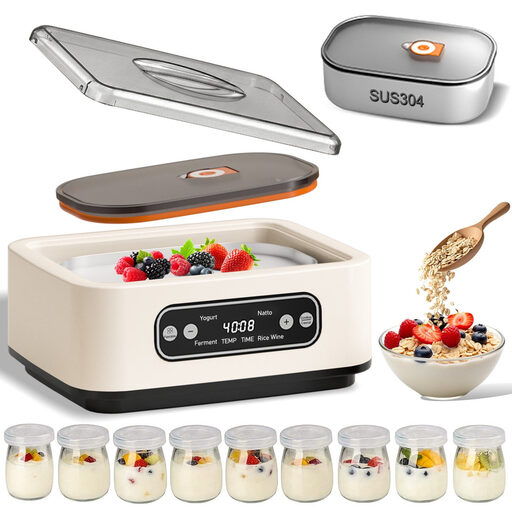
Yoghurt maker with 1.6 l SUS304 inner pot, timer, temperature control and nine borosilicate glass jars

Yoghurt maker, 1.6 l, nine borosilicate glass jars

If you prefer several containers for individual portions, the product title lists nine jars.

SUS304 inner pot; temperature control, timer and OLED display.

View at Joybuy

FOHERE yoghurt maker with eight jars and a total capacity of 1,440 ml

FOHERE yoghurt maker with 8 jars, 1,440 ml

The product title lists eight jars if you want several separate containers.

Total capacity 1,440 ml; digital temperature control and 48-hour timer.

View at Joybuy

Yoghurt maker with 1.5 l capacity, strainer and lid

Yoghurt maker, 1.5 l, with strainer

If you prefer making a larger batch rather than using lots of small individual jars, the product title lists a capacity of 1.5 l.

20 W; includes a strainer and lid. Described as suitable for 3–5 people.

View at Joybuy
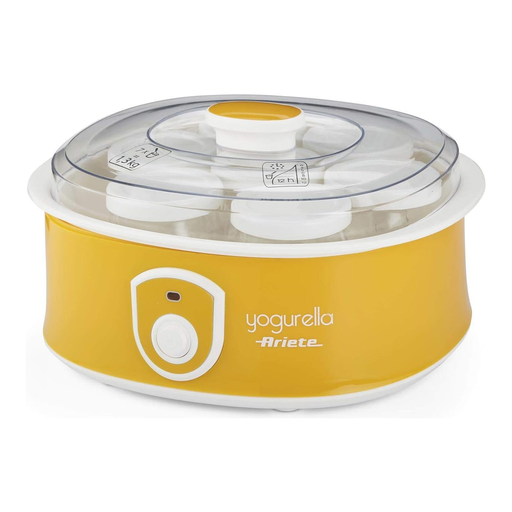
Ariete yoghurt maker with 1.3 l capacity, 20 W, listed as Refurbished A

Ariete yoghurt maker, 1.3 l, 20 W (Refurbished A)

If you want to prepare individual portions directly in containers, the product information describes seven portion jars with lids.

Total capacity 1.3 l; listed as “Refurbished A”.

View at Joybuy

Frequently asked questions

How do I choose the number of jars for a family meal?

Count the separate portions you want and compare this with the containers actually supplied with the model. The machines described here range from four 125 ml cups to seven 150 or 160 ml jars and eight 150 ml jars, for example. Jar capacity and jar count are two different things to consider when buying.

Do the jars need to be chilled after preparation?

Yes, yoghurt should be chilled after preparation. In its article dated 14 January 2025, the Verbraucherzentrale recommends storing dairy products such as yoghurt on the middle fridge shelf at 5 to 7 °C. Guidance on the shelf life of unopened shop-bought products is not a guarantee of how long homemade yoghurt will keep.

What should I bear in mind when it comes to milk and cleaning?

Use clean containers and follow the machine’s instructions. The Federal Centre for Nutrition stresses the importance of kitchen hygiene; according to its guidance, raw milk must be boiled before drinking. If you plan to use raw milk, also check the preparation instructions for your machine.

Does an electric yoghurt maker need a CE mark in Germany?

A new electrical appliance covered by the Low Voltage Directive must carry a CE mark. EUR-Lex gives the relevant voltage range as 50 to 1,000 V AC. Your Europe explains that the manufacturer uses the mark to declare that the product meets the relevant EU rules; it is not an independent quality mark. Check the CE marking on the specific product you’re buying.