Smoothie prepper
If you regularly prepare several smoothies at once, the amount you can make per batch matters. Using one larger container or several portion pots will involve different routines.


Choose a yoghurt maker based on how much you need per batch, then decide whether you’d prefer one larger container or individual portion pots. For smoothie prep, freshly made yoghurt kept in the fridge, with fruit frozen separately, is often the simpler option. Yoghurt can become lumpy and grainy when thawed, and the pots supplied with a yoghurt maker are not automatically freezer-safe.
If you regularly prepare several smoothies at once, the amount you can make per batch matters. Using one larger container or several portion pots will involve different routines.
If you want to have ingredients ready in individual portions, first consider whether you need to freeze the yoghurt at all. The Verbraucherzentrale notes that yoghurt can become lumpy and grainy when thawed; any containers used in the freezer should be specifically suitable for that purpose.
If you’re also considering how the yoghurt is made or whether the temperature can be adjusted, check these features in the instructions for each model.
For smoothie prep, the key things to consider are the amount you can make per batch, the containers for portioning, cleaning and your preferred method of preparation.
| What matters to you | What to check before buying | Who should pay particular attention? |
|---|---|---|
| Batch size | Compare the stated amount per batch, not the combined capacity of all the containers supplied. Rommelsbacher states that the JG 80 makes up to 1.200 g per batch. | If I want to prepare enough yoghurt for several smoothies at once, the actual amount per batch matters. Around 36 % of consumers say batch size is their main buying consideration. |
| Freezing and portioning | Decide whether you’ll keep the yoghurt chilled and freeze the fruit separately. Use containers suitable for liquids in the freezer and leave room for expansion. | If I want to freeze my supplies in portions, I look at how the yoghurt’s texture changes after thawing and whether the containers are suitable. Around 29 % of consumers put freezing and portioning first. |
| Cleaning and storage | Check how easy the containers are to clean and whether suitable replacements are available. Keep the finished yoghurt chilled. | If I make yoghurt regularly, I want to clean the containers thoroughly and store the finished yoghurt properly. Around 21 % of consumers prioritise an easy, hygienic routine. |
| Method of preparation | Check the intended preparation method in the instructions: a system that works without electricity and a machine with adjustable temperature are different options. | If the method matters more to me than how the yoghurt is portioned, I check that it suits the way I want to make it. Around 14 % of consumers focus on the preparation method or adjustability. |
For the Rommelsbacher JG 80, the manufacturer lists two 1.2 l glass containers, but a maximum of 1.200 g of yoghurt per batch.
Compare the stated batch size with the amount you need for your smoothie prep.
If one batch isn’t enough, you’ll need to make additional batches or find suitable containers for portioning the rest.
Jars with lids, or those described as leakproof, aren’t automatically suitable for the freezer. Liquids expand as they freeze, which can damage containers that aren’t suitable or have been filled too full.
Check whether the specific container is freezer-safe. The Verbraucherzentrale says a snowflake symbol can be a useful indication and recommends not filling containers of liquid right to the top before freezing.
A damaged container may become unusable and spill its contents.
A yoghurt maker produces yoghurt through fermentation; freezing is a separate step. Yoghurt can become lumpy and grainy after thawing.
Choose a machine based on batch size and containers, and check freezer suitability separately if you plan to freeze yoghurt.
The JG 80 is worth considering if you want to make a larger batch in one go or portion it later.
The JM 2 is designed for making multiple individual portions, while the JM 3 is a different model with adjustable temperature.
The JG 3518 is designed for smaller individual containers, and the brand also offers a larger jar set.
The JM 3344 is an option for making yoghurt in individual jars with lids.
This heat-insulated system is an option if you’d rather not use an electric yoghurt maker.
This selection at Joybuy includes yoghurt makers for larger batches and models with multiple containers for portioning.
 Image unavailable
An option if you prefer to use larger containers and portion the yoghurt afterwards.
The description lists two glass containers with capacities of 2.000 ml and 1.400 ml, eight programmes, an adjustable timer and a strainer.
 Image unavailable
The combination of an inner pot and several small jars gives you different container sizes to choose from.
The product listing specifies a 1.6 l SUS304 inner pot and nine 100 ml borosilicate glass jars. It also mentions adjustable temperature and a programmable timer.
 Image unavailable
The eight jars are handy if you want to divide a batch between several containers.
The listing gives a total capacity of 1.440 ml, a temperature range of 20–55 °C and a timer of up to 48 hours.
 Image unavailable
An option if you’d rather make a batch in one larger container than in several small jars.
The product title lists a capacity of 1.5 l, 20 W, a strainer and a lid.
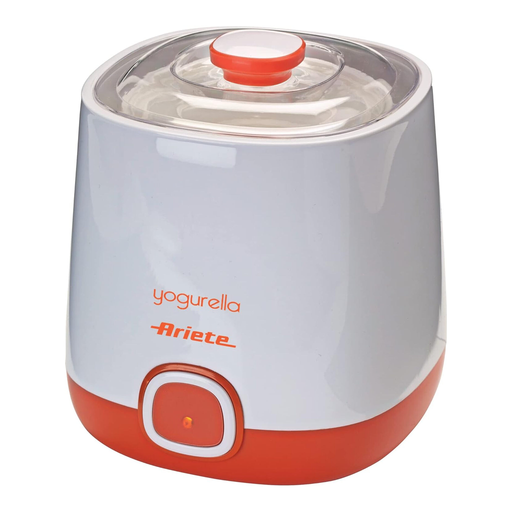 Image unavailable
The stated 1 l capacity gives you a clear batch size for preparing a supply.
The product title lists a capacity of 1 l; the description mentions 20 W and a filter for Greek yoghurt.
If you want to maintain the right texture after thawing, start with chilled yoghurt and fruit frozen separately. The Verbraucherzentrale notes that yoghurt can become lumpy and grainy when thawed. Use containers suitable for liquids in the freezer and don’t fill them right to the top.
Don’t assume they’re freezer-safe just because they have a lid or are described as yoghurt jars. Check whether the specific container is suitable for freezing. The Verbraucherzentrale says a snowflake symbol can be a useful indication and recommends leaving room for liquids to expand.
Use clean hands and containers, and follow the instructions for your chosen method when it comes to milk, culture, timing and temperature. For its own yoghurt recipe, the Verbraucherzentrale says UHT milk can be used straight away; once ready, store the jars in the fridge. This isn’t a universal programme setting for every machine.
Before buying, check that the replacement jars fit the exact model number. Steba lists accessories for the JM 2, and Severin lists compatible jars for the JG 3518; this doesn’t mean they’ll fit other models.
Electrical appliances covered by the EU Low Voltage Directive must meet the applicable requirements, including conformity assessment and CE marking. Containers intended to come into contact with yoghurt must comply with the relevant EU requirements for food contact materials. Check these points for the specific model and its containers; a product listing doesn’t confirm that an individual offer is compliant.