Smoothies to share
If you want to use yoghurt for several people in one blender, compare the quantity per batch and the size of the mixing container – not just the number of containers included.


For a smoothie base to share, a larger container is practical, while individual jars keep portions separate. Compare the stated preparation quantity per batch with your recipe, and allow time for fermentation and chilling afterwards. According to the Verbraucherzentrale, fermentation can take around twelve hours.
If you want to use yoghurt for several people in one blender, compare the quantity per batch and the size of the mixing container – not just the number of containers included.
If you want to prepare the yoghurt in good time, allow for fermentation and chilling afterwards. A timer can make the process easier with a suitable electric model.
If you want to store yoghurt separately or use it for different smoothies, consider whether individual jars or transferring it from a larger container would suit your daily routine better.
First check the quantity per batch, then work out how much time you’ll need before serving. Finally, make sure the choice of ingredients and the way the appliance is used suit your recipe.
| Criteria | What to check before buying | Who should pay particular attention? |
|---|---|---|
| Quantity and container | Compare the manufacturer’s stated quantity per batch, the capacity of the usable containers and the number of jars you’ll need to clean. | If I want to blend yoghurt for several people together, the quantity per batch matters more than the number of containers. Around 36 % of consumers put quantity and container configuration first. |
| Timing | Check whether the specific model has a timer and automatic shut-off, and allow time for fermentation and chilling afterwards. | If you’re preparing yoghurt for a meal at a set time, you’ll need a suitable schedule rather than yoghurt that’s ready to serve straight away. Around 29 % of consumers who prioritise timing say it’s their main concern. |
| Ingredients and variations | Check the instructions for suitable ingredients, starter cultures and programmes for the specific model. | If I want to prepare different bases or variations, the instructions for the appliance and culture are essential. Around 21 % of consumers prioritise ingredient choice or making different batches. |
| Operation and ease of use | For a non-electric model, check how the heat is prepared and the batch size; for an electric model, consider the cleaning process and the space it takes up. | If you want to prepare a batch without a plugged-in appliance, you’ll need to provide the heat yourself and check that the quantity is sufficient. Around 14 % of consumers put non-electric operation first. |
For the Rommelsbacher JG 80, the manufacturer lists two glass containers, each with a capacity of 1.2 l, but gives the preparation quantity as up to 1,200 g of yoghurt per batch.
For your recipe to share, check the stated quantity per batch rather than adding together the capacities of all the containers included.
The Verbraucherzentrale describes one method that involves around twelve hours of fermentation, followed by storage in the fridge.
Start preparing the yoghurt well before your meal, then chill it until you’re ready to use it. The instructions for your specific appliance and the culture you use are also important.
According to the manufacturer, an insulated yoghurt maker such as the My.Yo doesn’t need to be plugged in during fermentation; however, you still need to prepare the heat it requires.
Before choosing a non-electric model, check the preparation steps and whether the stated batch size is enough for your group.
The JG models differ in their container set-up: the JG 80 is designed for larger containers, while the JG 40 is made for individual portions.
The JM 2 is designed for households that want to divide a larger batch between lots of individual jars.
The JG 3518 is an electric yoghurt maker for individual portions, with seven small jars.
The Yogurella models use different container set-ups: the 0617/00 uses jars, while the 0621/10 is described as coming with containers and a strainer for thick yoghurt.
This insulated yoghurt maker is designed for a 1 l batch and, according to the manufacturer, doesn’t need to be plugged in during fermentation.
The following Joybuy products use a larger batch container; some also include individual portion containers.
 No image available
The larger containers are useful if you’re making a yoghurt base to share.
The product name lists two glass containers: 2,000 ml and 1,400 ml.
 No image available
The inner pot offers a larger container option for making a base to share.
The product name lists a 1.6-litre SUS304 inner pot, nine 100 ml borosilicate glass jars, temperature control, a timer and an OLED display.
 No image available
The inner container is designed for a larger batch, while the extra jars give you separate containers.
The product name lists a 1.6-litre SUS304 inner container, temperature control, a timer, an OLED display and nine borosilicate glass jars.
 No image available
The stated container size is useful when planning a yoghurt base to share.
The product name lists a 1.5 l capacity, 20 W power and a strainer for making natural and Greek yoghurt.
 No image available
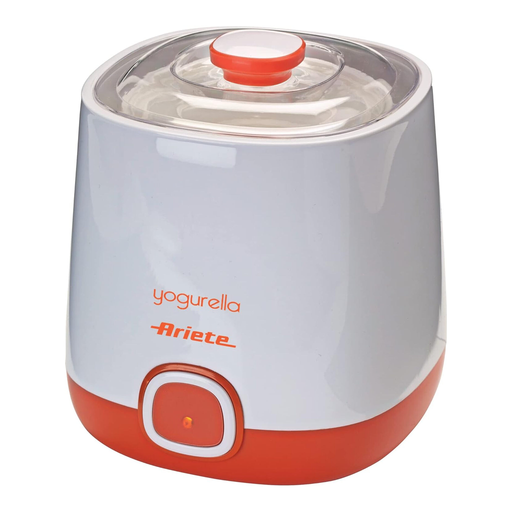
The single container is an option for making a yoghurt base to share, rather than using only small individual jars.
The product name lists a 1 l container. Power ratings may vary between specific versions, so check the version on offer against its rating plate or data sheet.
Plan well ahead: the Verbraucherzentrale describes one method that involves around twelve hours of fermentation, followed by chilling in the fridge. For a specific appliance, follow its instructions and use the recommended culture.
Clean any parts that come into contact with food according to the appliance instructions, and keep the finished yoghurt chilled. The Verbraucherzentrale recommends storing yoghurt on the middle shelf of the fridge at 5 to 7 °C. Shelf-life information for commercially sold products in unopened packaging doesn’t apply to homemade yoghurt.
To make yoghurt, you’ll need milk or a suitable plant-based alternative, as well as an appropriate starter culture. Also check whether the jars you need are included and whether replacement containers are available. What you’ll need depends on your recipe and how you plan to use the yoghurt.
When you buy from a business seller, European Union consumer information states that you’re entitled to a legal guarantee of at least two years from the date you receive the goods. This is separate from any voluntary manufacturer’s guarantee. These rules don’t apply in the same way to purchases from private individuals.
The European Commission describes the CE marking as the manufacturer’s declaration that the product meets the legal requirements that apply to the marking. It isn’t proof of independent testing. Whether a particular directive applies to an appliance depends, among other things, on its technical specifications and the scope of that directive.