What should you look for when buying?
First, decide whether you want to store ready-made portions in individual jars or make one batch to divide up yourself later. Then check how the timer and any extra features fit into your routine.
| What matters to you |
What to look for |
Who is this important for? |
| Timing |
Check for an automatic shut-off, an adjustable running time and instructions for what to do once the programme has finished. |
If I want the yoghurt ready for a specific smoothie time, I need to plan for both fermentation and chilling afterwards. Around 33% of consumers prioritise being able to plan ahead. |
| Batch and portion size |
Compare how much yoghurt can be made at once, the number and capacity of the containers, and how much space they take up. |
I want to make just the right amount for future smoothies and fit the containers in my fridge. Around 27% of consumers care most about getting the portion size right. |
| Cleaning and storage |
Check the cleaning instructions for the jars, lids and seals, as well as the space needed to store covered containers. |
If I regularly store yoghurt and prepared ingredients, I want to keep the containers clean without unnecessary extra steps. Around 20% of consumers prioritise easy, hygienic handling. |
| Recipe flexibility |
Compare only the programmes, temperature and time settings, and accessories specifically listed. |
I want to try different types of yoghurt without paying for features or accessories I’m unlikely to use. Around 20% of consumers put recipe flexibility first. |
Yoghurt makers at Joybuy
Here you’ll find yoghurt makers with individual portion jars, as well as models for making a batch to divide up later as needed.
 No image available
FOHERE yoghurt maker with 2 glass containers
The two containers are a good fit if you want to prepare one batch in containers of different sizes.
According to the product description, it comes with two glass containers of 2,000 ml and 1,400 ml. It also lists eight programmes, an end-of-cycle alert and a strainer for Greek-style yoghurt.
View at Joybuy
 No image available
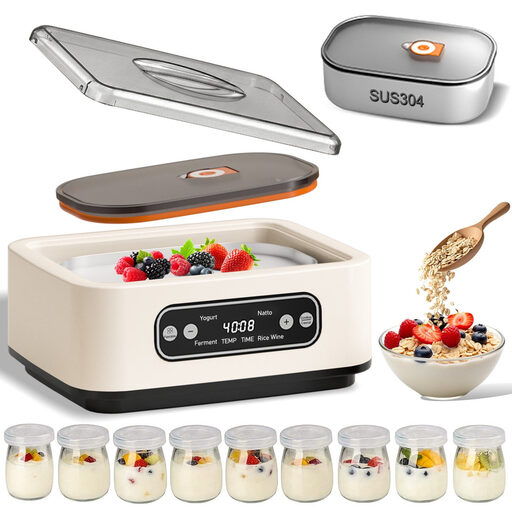
Fosmet yoghurt maker, 1.6 l, 9 jars
Nine small jars are ideal for separate portions that you can set aside individually for future smoothies.
The listed features include a 1.6 l SUS304 inner pot, nine borosilicate glass jars, temperature control and a timer from 1 to 99 hours with automatic shut-off.
View at Joybuy
 No image available
Yoghurt maker, 1.6 l, 9 jars, OLED
The nine jars are a good option if you want to divide the yoghurt into individual portions as you make it.
The product name lists a 1.6 l inner container, nine borosilicate glass jars, temperature control, a timer and an OLED display.
View at Joybuy
 No image available
FOHERE yoghurt maker with 8 jars, 1,440 ml
Eight jars give you separate containers for preparing several smoothie portions in advance.
The product title lists digital temperature control, a 48-hour timer and automatic shut-off.
View at Joybuy
 No image available
Yoghurt maker, 1.5 l, 20 W, with strainer
The single container is ideal for making a batch that you can portion out yourself for smoothies afterwards.
The listed specifications include a 1.5 l capacity, 20 W, a strainer and a lid. According to the product description, the strainer is designed for Greek-style yoghurt.
View at Joybuy
Frequently asked questions
Can I prepare the yoghurt the night before making a smoothie?
Yes, as long as you allow for the fermentation time specified for your appliance and chill the finished yoghurt afterwards. The Verbraucherzentrale recommends storing yoghurt on the middle shelf of the fridge at 5 to 7 °C; an automatic shut-off won’t chill the batch.
How should I store fruit once it has been cut?
Wash raw fruit thoroughly and eat it soon after cutting, or keep it chilled. Keep containers and work surfaces clean; this doesn’t establish a standard shelf life for every prepared fruit and yoghurt mixture.
Do I need a special programme for Greek-style yoghurt?
Not necessarily. Check whether the specific model has a suitable programme or a strainer, and what extra steps the instructions recommend. Rommelsbacher lists a strainer for the JG 80, while Severin lists a programme for Greek-style yoghurt among the options on the JG 3521.
Who should I contact if the appliance is faulty?
If you buy faulty goods from a business seller, EU consumer law gives you a legal guarantee of at least two years from the date you receive them, provided by the seller. This is separate from any voluntary manufacturer’s warranty. You should also check the service and spare-parts information for the specific model.
What certification should I look for on an electric yoghurt maker?
Mains-powered electrical appliances covered by the EU Low Voltage Directive – those with a rated voltage of 50 to 1,000 V AC – must meet the relevant safety requirements, including CE marking. CE marking is not an independent quality mark and doesn’t prove that an appliance is suitable for a particular recipe.


