What to look for when buying
First decide whether you want yoghurt ready in individual breakfast jars or whether you’d rather portion it out from a shared storage container. Also allow enough time to chill it after fermentation.
| What matters |
What to check when buying |
Who is this most important to? |
| Individual portions |
Check the number and capacity of the jars, as well as whether suitable replacement jars are available. |
If I want to prepare several jars for different breakfasts, the number of jars and the space in my fridge matter; around 36% of consumers say pre-portioned individual jars are their main concern. |
| End of fermentation and chilling time |
Check for a timer and automatic shut-off, then allow time for chilling separately. |
If breakfast needs to be ready at a set time, I’ll plan for fermentation and subsequent chilling; around 29% of consumers prioritise being able to plan the timing. |
| Size of a shared batch |
Compare the amount the maker can produce in one go, rather than adding together the capacity of all the containers supplied. |
If I want to serve yoghurt from one container over several breakfasts, the actual batch size is what matters; around 21% of consumers prioritise making a larger batch in one go. |
| Simple or electricity-free preparation |
Check whether the appliance needs electricity, programmes or an automatic shut-off. |
If I don’t want to use a socket where I’ll be setting it up, or I prefer simple operation, the method matters most; around 14% of consumers say this is their main concern. |
Yoghurt makers at Joybuy
These yoghurt makers at Joybuy cover both individual portions prepared in advance and making a shared supply.
 No image available
FOHERE yoghurt maker with two XXL glass containers
The two large containers are ideal for making a shared supply to serve up for breakfast.
Glass containers: 2,000 ml and 1,400 ml.
View at Joybuy
 No image available
Fosmet yoghurt maker with 1.6-litre inner pot and nine jars
The jars are handy if you want to prepare several portions separately.
Inner pot: 1.6 l, SUS304; with temperature control, timer and OLED display.
View at Joybuy
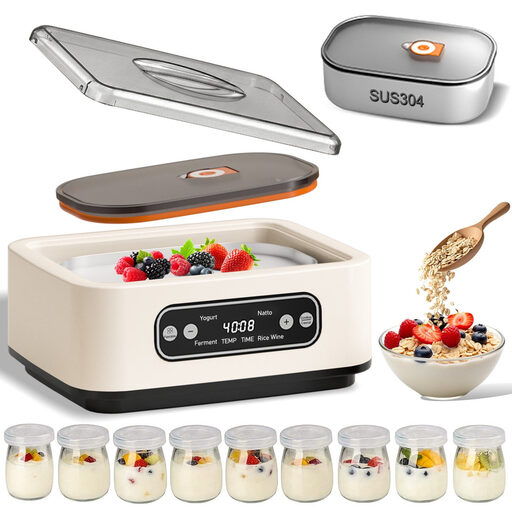 No image available
Yoghurt maker with 1.6-litre inner container and nine borosilicate glass jars
The nine jars are a good option if you want to prepare portions separately.
Inner container: 1.6 l, SUS304; with temperature control, timer and OLED display.
View at Joybuy
 No image available
FOHERE yoghurt maker with eight jars
Eight jars are ideal if you want to prepare several portions separately.
Total jar capacity: 1,440 ml; with digital temperature control, a 48-hour timer and automatic shut-off.
View at Joybuy
 No image available
Yoghurt maker with a 1.5-litre capacity and strainer
The stated capacity for 3–5 people can help you plan portions for several breakfasts.
Capacity: 1.5 l; 20 W; with strainer and lid.
View at Joybuy
Frequently asked questions
When should I start making yoghurt if I want it for breakfast?
As well as fermentation, allow time for the yoghurt to cool and be stored in the fridge. The programme time depends on the recipe and appliance; automatic shut-off won’t chill the yoghurt for you.
How should I store homemade yoghurt?
Put the finished jars in the fridge. The Verbraucherzentrale recommends storing yoghurt on the middle shelf at 5 to 7 °C. You can’t automatically apply the shelf-life guidance for factory-made products in their original sealed packaging to homemade yoghurt.
What should I know if I want to use raw milk?
The German Federal Institute for Risk Assessment warns that unboiled raw milk may contain pathogens and recommends boiling it before consumption. This is a food-safety issue relating to the ingredient, and a yoghurt maker can’t address it.
What should I know about faults and the manufacturer’s guarantee?
Your statutory rights for faulty goods are claims against the seller; a manufacturer’s guarantee is an additional voluntary service with its own terms. If something goes wrong, check your rights and keep your proof of purchase.
What labelling should I look for on an electric yoghurt maker?
Whether a particular appliance needs CE marking depends on whether the relevant EU rules require it for that product. The European Union explains that the marking is required only for products covered by the relevant rules. It’s the manufacturer’s declaration of conformity, not an independent quality assessment; this requirement can’t be applied across the board to a container that doesn’t use electricity.


