For a weekend cookery class, a yoghurt maker with plenty of individual jars is a good choice if you want to chill and serve portions separately; a large container is more suitable if you plan to measure out the yoghurt together. What matters is the amount made per batch, not the combined capacity of all the storage containers supplied. Work backwards from your mixing time to allow for fermentation and then chilling: a timer does not replace the chilling stage.
Who is this planning advice for?
Class leaders preparing lots of portions
If you’re preparing several smoothies, the batch size and number of portions need to match what you’ll need. Steba, Rommelsbacher and the consumer advice centre provide relevant information about containers and preparation.
Class leaders working to a tight schedule
If the yoghurt needs to be ready before the class starts, allow time for fermentation and then chilling. Rommelsbacher’s appliance information and guidance from the consumer advice centre can help you plan.
Class leaders offering different recipes
If you want to vary the ingredients or consistency for different smoothies, make sure the culture, milk base and programmes actually available on the appliance are compatible. Rommelsbacher and Ariete list model-specific features to help you make these choices.
What should you look for when buying?
First work out how much you need per batch and how much fridge space you have. Then match the portioning and timings to the start of your class.
| Buying consideration |
What to check |
Who is it important to? |
| Batch size and portioning |
Compare the amount made per batch separately from the number and capacity of the jars. |
If I’m making yoghurt for several smoothies in one batch, the quantity needs to match the recipe portions; around 33% of consumers put batch size and portion numbers first. |
| Fermentation and chilling |
Check the appliance instructions for preparation and chilling; look for an automatic timer shut-off if it suits your routine. |
If I need chilled yoghurt ready for a set mixing time, I plan for fermentation and chilling separately; around 33% of consumers prioritise this schedule. |
| Recipe variations |
Check the requirements for your specific milk base and starter culture; consider any programmes you need or a draining sieve. |
If I want to use different milk bases or consistencies for smoothies, I check the culture and appliance settings; around 20% of consumers put recipe variations first. |
| Cleaning and space |
Check the number of containers and what’s included against the space available for the appliance and in your fridge. |
If I want to minimise washing up or chill a finished batch without taking up too much room, ease of use matters; around 14% of consumers prioritise it. |
Common planning mistakes
-
Assuming storage containers mean you can make several batches at once
For the Rommelsbacher JG 80, the manufacturer specifies up to 1.2 litres of yoghurt per batch, even though two large containers are included.
Work out what you need based on the amount made per batch, not the combined capacity of all the containers supplied.
Making another batch may require extra preparation time.
-
Confusing automatic shut-off with being ready to serve
The yoghurt still needs to be chilled after fermentation; an automatic shut-off function doesn’t take care of this step.
Work backwards from your mixing time and allow for preparation and chilling separately.
-
Judging individual jars by total capacity alone
A yoghurt maker with several jars divides its capacity between individual containers. This can be convenient for serving, but it also affects fridge space and cleaning.
Consider the number of jars, the capacity of each one and the space available alongside the way you plan to serve the yoghurt.
-
Assuming similarly named appliances are the same without checking the model
The specifications for the Ariete Yogurella 0621/10 list 40 watts and two one-litre containers. Different specifications for a similarly named model don’t prove that the two appliances are identical.
Before buying, check the full model number and compare the details that matter for your class.
Brands to consider
Steba
The JM 2 is worth considering for classes where you need to prepare lots of separate portions of yoghurt.
- Steba specifies twelve sealable 0.2-litre jars and an automatic timer shut-off.
- The jars take up fridge space, and washing twelve separate containers means more cleaning.
Rommelsbacher
The JG 80 combines a larger shared batch with small cups for individual portions.
- Rommelsbacher specifies up to 1.2 litres per batch and four 125-millilitre cups. The running time is adjustable.
- The programme temperatures are preset. Having two large containers supplied doesn’t mean you can make two batches at once.
Severin
The JG 3518 could suit smaller portions that can be stored separately.
- Severin says it comes with seven 150-millilitre jars; the manufacturer lists EG 3513 and EG 3514 as compatible replacement jars.
- If you need more, weigh the amount made per batch against the size of your class.
My.Yo
The non-electric yoghurt maker is an option if you don’t plan to use an electrically powered appliance where you’re preparing the food.
- The supplier specifies a one-litre capacity and operation without electricity.
- You’ll still need to fit the preparation, setting time and subsequent chilling into your class schedule.
Ariete
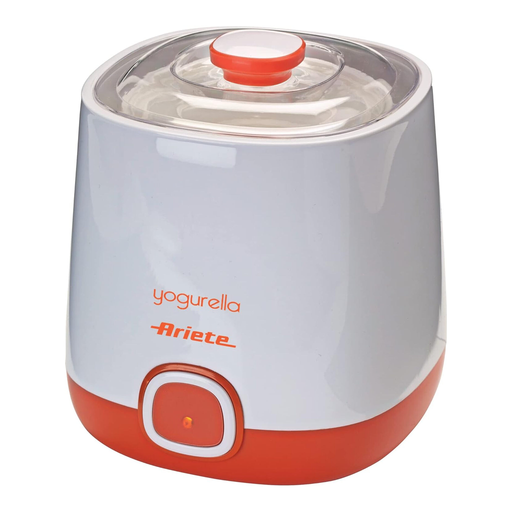
The Yogurella 0621/10 could suit smaller batches where you want to strain some of the yoghurt.
- Ariete’s specifications list a filter basket; they also give two one-litre containers and 40 watts for model 0621/10.
- Different specifications are given for a similarly named 621 variant, including its power and containers. This doesn’t confirm that it is the same model as the 0621/10.
Yoghurt makers on Joybuy
The appliances below offer different options for making a shared batch or individual portions. Check whether the stated use for each model suits your cookery class.
 No image available
FOHERE yoghurt maker with two XXL glass containers
The large containers are suitable if you want to measure out the yoghurt together.
The product name lists two glass containers with capacities of 2,000 ml and 1,400 ml. The product description limits use to private use indoors; check whether that suits your class.
Joybuy
 No image available
Fosmet yoghurt maker, 1.6 l, SUS304, nine jars
The individual jars are an option if you want to prepare smaller portions separately.
The product name lists nine 100 ml jars, a 1.6-litre SUS304 inner pot, temperature control, a timer and an OLED display.
Joybuy
 No image available
FOHERE yoghurt maker with eight jars, 1,440 ml
The multiple jars are designed for yoghurt portioned separately.
The product name lists eight jars with a combined capacity of 1,440 ml, digital temperature control and a 48-hour timer. The product description limits use to private use indoors; check whether that suits your class.
Joybuy
 No image available
Yoghurt maker, 1.5 l, 20 W, with sieve
The stated capacity is useful for making a shared batch; the sieve may suit you if you want to strain the yoghurt.
The product name lists a capacity of 1.5 litres, 20 W and a sieve.
Joybuy
 No image available
Ariete 621 yoghurt maker, 1 litre, 20 W
The stated one-litre capacity could be suitable for a smaller shared batch.
The product name lists a capacity of one litre and 20 W. Compare the model details with those of the Ariete Yogurella 0621/10 before assuming the two models are the same.
Joybuy
Frequently asked questions
Can I start making the yoghurt during the weekend class and use it straight away in smoothies?
Make the yoghurt before your mixing time: fermentation takes time, and the consumer advice centre’s recipe calls for the yoghurt to be chilled afterwards. Follow the instructions for your specific appliance and the ingredients you’re using; an automatic timer shut-off doesn’t replace chilling.
What should I bear in mind when it comes to milk and hygiene?
Use clean containers and follow the instructions for the milk and starter. In its recipe, the consumer advice centre recommends briefly bringing pasteurised whole milk to the boil, while UHT milk can be used directly; this is recipe guidance, not a general appliance requirement. The German Federal Institute for Risk Assessment warns against consuming unboiled raw milk, particularly for vulnerable people.
Do I have to use a special programme for plant-based or lactose-free batches?
Not necessarily: first check the requirements for your specific culture and milk base. According to the manufacturer, the Rommelsbacher JG 80 has a preset programme for vegan or lactose-free versions at 38 °C; this doesn’t guarantee success with every ingredient.
What ongoing costs and consumer rights should I check before buying?
Allow for milk, starter cultures and, if necessary, suitable replacement jars; Severin lists the compatible EG 3513 and EG 3514 series for the JG 3518. For consumer purchases in the EU, you have a statutory two-year legal guarantee against the seller. An additional manufacturer’s warranty doesn’t replace it; the European Commission provides information on Your Europe.
What regulations apply to the yoghurt maker and, where relevant, to my cookery class in Germany?
The European Commission describes CE marking as the manufacturer’s declaration that a product meets the relevant EU requirements, not as an independent quality mark. If your class operates as a food business that produces, processes or distributes food, the German federal portal says it must be registered with the local food safety authority. Section 4 of the German Food Hygiene Regulation sets out the required expertise for handling highly perishable food. Whether these business obligations apply to your class depends on how it is organised.


