What should you look for when buying?
First decide how much yoghurt you need. Then check that the timing, container layout and recipe are right for the appliance and your fridge.
| What to consider |
What to look for |
Who is it important to? |
| Quantity per batch |
Compare your recipe quantity with the amount the manufacturer says can be made per batch; don’t simply add together the capacities of the containers supplied. |
If I’m making several smoothies with a shared yoghurt base, the amount I can actually make at once matters. Around 36% of consumers prioritise making a sufficient batch. |
| Planning around serving time |
Allow separately for the fermentation time in the relevant instructions and the chilling time afterwards; only factor in a timer if one is explicitly listed as a feature. |
If the yoghurt needs to be ready for a set time when guests arrive, I need a schedule with enough time for both steps. Around 29% of consumers prioritise serving time. |
| Jars and fridge space |
Check the number and size of the containers, the cleaning instructions and how much room they’ll need in the fridge. |
If I want to store portions separately or mix in different ingredients later, I’m happy to use several jars. Around 21% of consumers prioritise this. |
| Method and ingredients |
Check the appliance instructions and find a suitable recipe for your chosen milk or plant-based option and starter culture. |
If I want to use a particular base or method, it needs to be compatible with the documented process. Around 14% of consumers prioritise this compatibility. |
Yoghurt makers at Joybuy
These electric yoghurt makers let you prepare a shared yoghurt base or make separate jars. Compare the listed container layout and capacity with your recipe. If you’re working to a set time, remember to allow for chilling afterwards too.
 No image available
FOHERE yoghurt maker with two XXL glass containers
The two large containers are a good option if you’re making a shared yoghurt base for several smoothies.
The product name lists glass containers with capacities of 2,000 ml and 1,400 ml.
View at Joybuy
 No image available
Fosmet yoghurt maker with 1.6-litre inner pot and nine jars
The inner pot and additional jars listed give you different container options for making yoghurt.
The product name lists a 1.6-litre inner pot, nine borosilicate glass jars, SUS304, temperature control, a timer and an OLED display.
View at Joybuy
 No image available
FOHERE yoghurt maker with eight jars
The jar layout may suit you if you want to store yoghurt separately or serve individual portions to guests.
The product name lists eight jars with a combined capacity of 1,440 ml, digital temperature control and a timer of up to 48 hours.
View at Joybuy
 No image available
Yoghurt maker with a 1.5-litre container and sieve
The container is an option for making a shared yoghurt base; the listed sieve may appeal if you also want to make Greek-style yoghurt.
The product name lists a capacity of 1.5 litres, 20 W, a sieve and a lid.
View at Joybuy
 No image available
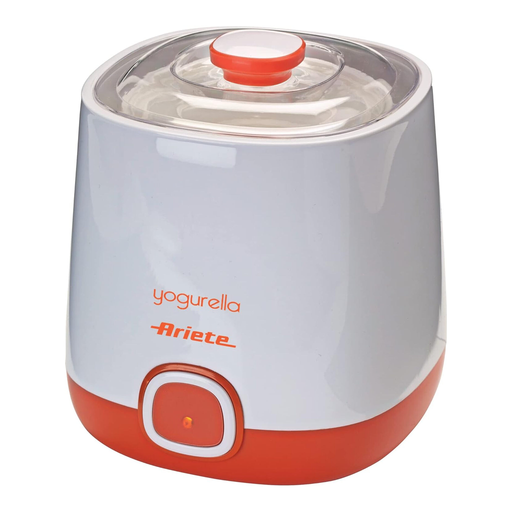
Ariete 621 Yogurella, 1 litre
The listed one-litre container capacity gives you a useful figure to compare with the amount of yoghurt you need for your smoothies.
The product name lists a capacity of 1 litre and 20 W. The manufacturer lists 40 W for the Ariete Yogurella 0621/10, so check the exact model variant before buying.
View at Joybuy
Frequently asked questions
When should I start making yoghurt for my smoothies?
Work backwards from serving time, allowing for fermentation according to the instructions for your specific appliance and then chilling afterwards. EasiYo’s instructions recommend 8–12 hours for its own method to set, followed by a few hours in the fridge. These timings don’t automatically apply to other appliances or recipes.
Can I use raw milk directly in a yoghurt maker?
Don’t use raw milk in place of heated milk without checking first: the German Federal Institute for Risk Assessment recommends heating raw milk before consumption to reduce the risk of infection. You should also follow the instructions for your appliance and the specific recipe.
How should I store the finished yoghurt and clean the appliance?
Put the finished yoghurt in the fridge. The Verbraucherzentrale recommends storing dairy products such as yoghurt on the middle fridge shelf at 5 to 7 °C. According to the instructions, the jars and lids for the Severin JG 3518 can be washed in soapy water or in a dishwasher, but the electrical base must not be immersed in liquid. For other models, follow the relevant instructions.
Who can help if my appliance is faulty, and how should I dispose of it later?
Your statutory rights are with the seller and are separate from any voluntary guarantee. According to the German Environment Agency, old electrical appliances must not go in household waste. They should be collected separately, for example at a recycling centre or an appropriate take-back point.


