Smoothie makers who want individual portions
You want to store a batch in separate jars and take out just the amount you need for each smoothie. Look for suitable jar sizes and lids, and make sure you have enough space in the fridge.


A large container is handy if you want to make several smoothies from one batch. If you’d rather chill individual portions separately, sealed portion jars are a natural choice. If there’s no spare plug socket during fermentation, an insulated yoghurt maker may be an option, provided you have access to hot water. The key things to consider are the usable capacity, the space in your fridge and how easy the containers are to clean.
You want to store a batch in separate jars and take out just the amount you need for each smoothie. Look for suitable jar sizes and lids, and make sure you have enough space in the fridge.
You want to make yoghurt, but need to find room for both the yoghurt maker and the finished batch in a compact kitchen and possibly a small fridge.
You can provide hot water, but don’t want to plug in an electric yoghurt maker during fermentation.
A good fit if: you want to chill individual portions separately for several smoothies.
The trade-off: Several jars take up space together and may break in transit.
A good fit if: you want to take yoghurt from one container for several smoothies.
The trade-off: The filled container needs to fit in your fridge; extra programmes are only useful if you’ll use them.
A good fit if: there’s no spare plug socket during fermentation and you can provide hot water.
The trade-off: You’ll still need hot water and a way to chill the yoghurt afterwards; there’s no programmable fermentation time on the appliance.
| Buying criterion | What to look for | Who it matters most to |
|---|---|---|
| Individual portions | Check the number and capacity of the jars, whether they have suitable lids and whether there’s room to store the finished batch. | If I want to prepare several smoothies and chill the portions separately, I’ll need suitable jars and enough space in the fridge. Around 33 % of consumers prioritise separate portions. |
| Size and footprint | Check the appliance’s external dimensions and the dimensions of the filled container against the space available. | If worktop and fridge space are limited in my holiday home, I want to know in advance whether the appliance and finished batch will fit. Around 25 % of consumers prioritise space requirements and batch size. |
| Fermentation without a plug socket | Check whether you can provide hot water, and follow the instructions for fermentation time and chilling afterwards. | If there’s no plug socket available during fermentation, an insulated yoghurt maker is only an option if I can provide hot water. Around 25 % of consumers prioritise fermenting without plugging in an appliance. |
| Programmes and settings | Check that the ingredients you plan to use are suitable for the instructions and the programmes you can actually select. | If I’m planning to make more than just natural yoghurt, I want to know whether the time and temperature can be set appropriately. Around 17 % of consumers prioritise extra programmes or flexible settings. |
For each specific product, also check the information about the parts that come into contact with food and read the instructions. You’ll also need a way to chill the finished yoghurt.
An insulated yoghurt maker doesn’t heat electrically. You’ll need hot water to make the yoghurt, and it must be chilled afterwards.
Before you buy, check that you can heat water at your holiday home and store the finished yoghurt in the fridge.
A large container and several portion jars take up different amounts of space during preparation and chilling.
Compare the appliance’s external dimensions, the containers supplied and the space available in your fridge together.
If the containers supplied aren’t enough for your storage needs, you may need to buy additional suitable containers.
A previous ranking reflects the comparison at the time and, by itself, says nothing about whether an identical product is available today.
Before making a purchase, check that the model name and version in the current listing match the yoghurt maker you’re looking for.
The JG 40 and JG 80 ranges differ in features including their containers and programmes.
The JG 3510 and JG 3518 models offer different features.
An insulated yoghurt maker with a stated capacity of one litre, for when you don’t want to use an electrical appliance during fermentation.
The JM 3 comes with portion jars and adjustable time and temperature settings.
The Pure Plus is described as having a large glass container and a longer timer.
The Joybuy products below include electric yoghurt makers with portion jars, as well as models with larger containers.
 No image available
The two container sizes may suit you if you want to make a batch of yoghurt for several smoothies.
The title lists two glass containers, one of 2,000 ml and one of 1,400 ml; the product description lists eight modes.
 No image available
The individual jars may suit you if you want to chill several portions separately.
The description lists nine 100 ml borosilicate glass jars, a 1.6 l inner pot, a temperature range of 21–48 °C and a timer from 1 to 99 hours.
 No image available
Eight jars give you the option of splitting a batch for several smoothies and storing the portions separately.
The title lists eight jars with a total capacity of 1,440 ml; the product description lists temperature control from 20 to 55 °C and a timer of up to 48 hours.
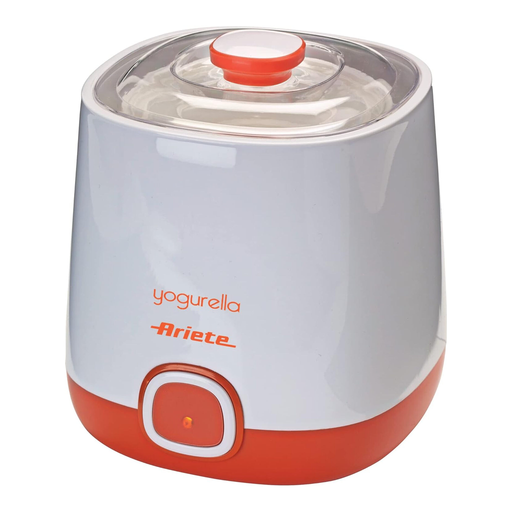 No image available
The stated one-litre capacity may be useful if you want to serve yoghurt from a single batch.
The product title lists a capacity of one litre and 20 W; the description lists two containers and a filter for Greek yoghurt.
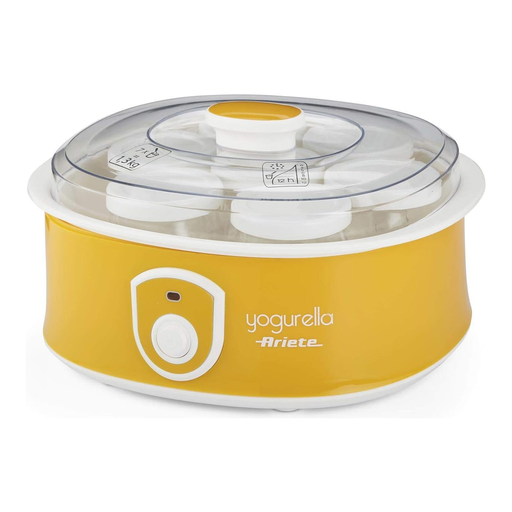 No image available
Seven portion jars may suit you if you want to chill individual portions separately.
The description lists seven portion jars with lids; the title identifies the product as Refurbished A.
Yes. You’ll need a separate blender or another suitable method to make a smoothie. A yoghurt maker prepares the yoghurt base, so check which kitchen appliances are available at your holiday home.
Follow the instructions for your chosen appliance when it comes to milk, starter and fermentation time. For one recipe, Verbraucherzentrale says UHT milk can be used straight away and that the filled jars should then be stored in the fridge. This is an example recipe, not a general fermentation time for every appliance or culture.
Not necessarily. The insulated method described by My.Yo requires hot water. The finished yoghurt also needs to be chilled afterwards.
For parts intended to come into contact with food, check the information provided for the specific product; when such materials are placed on the market, they are covered by Regulation (EC) No 1935/2004. For electrical appliances, the Bundesnetzagentur lists CE marking, manufacturer details and instructions in German among the checks carried out as part of market surveillance.