For an overnight batch with access to a plug socket, choose an electric yoghurt maker with a documented timer and automatic shut-off; the Rommelsbacher JG 80 and Steba JM 2 are examples with these features. If there’s no socket, an insulated system may be suitable if you can heat water; the EasiYo method requires compatible sachets. Once fermentation is complete, the yoghurt needs to be chilled, whatever type of maker you use.
Which type is right for you?
Those planning an overnight batch
If you start a batch in the evening, you’ll want to set the running time without having to get up in the night to switch the maker off. Rommelsbacher and Steba list an automatic shut-off for the models in question; this won’t keep the yoghurt chilled in the morning.
Guests without a spare plug socket
If there’s no power socket where you want to use the maker, an insulated system that doesn’t need electricity may be an option, provided you can heat water. EasiYo describes its Blue Yogurt Maker as using boiling water and compatible yoghurt sachets.
Families needing individual portions
If you want to make several separate portions, consider the jars and how much room you’ll need in the fridge. Rommelsbacher lists eight jars for the JG 40, while the Steba JM 2 comes with twelve.
What should you look for when buying?
| What matters when buying |
What to check |
Who is this important to? |
| Overnight running time |
Check the timer range and whether an automatic shut-off is documented for the specific model. |
If I start a batch in the evening, I want to know how long it will run without having to get up in the night to switch it off. Around 29% of consumers put a predictable running time first. |
| Cooling and hygiene |
Check that the filled containers will fit in your fridge and can be cleaned according to the instructions. The German Federal Institute for Risk Assessment (BfR) recommends heating raw milk before drinking it. |
If I’m processing milk in a holiday home, I’ll factor in cleaning and space for chilling. Around 23% of consumers prioritise storage and hygienic handling. |
| Using the maker without a plug socket |
Check the method and the ingredients you’ll need. EasiYo describes the Blue Yogurt Maker as requiring boiling water and 8–12 hours’ standing time with compatible EasiYo sachets. |
If there’s no socket where I want to use the maker, I want a method that works there without electricity. Around 18% of consumers prioritise being independent of a plug socket. |
| Portion count and storage space |
Check the number and capacity of the containers against the quantity you plan to make and the space available in your fridge. |
For separate portions at breakfast, I want to plan the number of containers and the fridge space together. Around 18% of consumers focus first on portion size and storage space. |
| Other preparation methods |
Compare only the programmes and accessories for the specific model version; they’re no substitute for a suitable recipe. |
If I want to use the maker for other recipes too, I’ll check the documented programmes and accessories. Around 12% of consumers prioritise additional preparation methods. |
Common misconceptions
-
Automatic shut-off doesn’t mean chilled storage
Once it switches off, the maker won’t keep the yoghurt chilled. Be sure to include time to put it in the fridge afterwards in your plans.
Set the running time so you can chill the finished yoghurt afterwards.
-
No electricity doesn’t mean no requirements
The method described by EasiYo requires boiling water and compatible yoghurt sachets; it isn’t automatically suitable for any milk-and-starter mixture.
Check the ingredients and instructions for the specific system, and make sure you can heat water and chill the finished yoghurt afterwards.
-
Don’t assume similar model names mean the same thing
Ariete’s data sheet lists 40 W for the Yogurella 0621/10, while a Joybuy listing is described as the AR621 with 20 W. These details don’t conclusively identify the same version.
Before buying, check the full model number and power rating.
Key brands at a glance
Rommelsbacher
Depending on the model, the JG range is designed for larger containers or individual portions.
- Rommelsbacher lists an adjustable running time and automatic shut-off for the JG 80; the JG 40 is described as coming with eight 150 ml portion jars.
- According to F.A.Z. Kaufkompass, the JG 80’s temperature can’t be adjusted beyond its preset levels.
Steba
The JM 2 is designed for a larger batch made in individual jars.
- Steba lists twelve 0.2-litre jars and a timer with automatic shut-off.
- Twelve containers need a corresponding amount of space for chilling and cleaning; the instruction manual limits use to the home and indoors.
Severin
The digital JG 3521 is described as having several preset yoghurt programmes.
- Severin lists five automatic programmes.
- Features and availability are separate considerations; check the specific model version and listing.
EasiYo
The Blue Yogurt Maker is an insulated model that doesn’t need electricity and is designed for the method described by the manufacturer.
- EasiYo describes using boiling water, a 1 kg container and a standing time of 8–12 hours with EasiYo sachets.
- The instructions don’t confirm that any starter recipe will work with this method.
Ariete
The Yogurella 0621/10 is described as a compact yoghurt maker with containers and a strainer.
- Ariete’s data sheet lists a power rating of 40 W for the 0621/10 and a strainer for draining.
- The Joybuy listing described as AR621 lists 20 W; don’t assume it’s the same version without checking the model number.
Yoghurt makers at Joybuy
The Joybuy products below include yoghurt makers with portion jars or larger containers. For an overnight batch, documented timer functions and the space needed for chilling afterwards are particularly important.
 No image available
FOHERE yoghurt maker with two XXL glass containers
A good choice if you’d like to make one large batch rather than lots of small individual portions.
The product title lists two glass containers with capacities of 2,000 ml and 1,400 ml.
Both containers will need space in the fridge after preparation.
View at Joybuy
 No image available
Fosmet yoghurt maker, 1.6 l, SUS304 inner pot and 9 borosilicate glass jars
An option if you want to portion the yoghurt into individual jars and set the running time with a timer.
The product title lists a 1.6-litre inner pot, nine borosilicate glass jars, temperature control and a timer.
The nine jars will need plenty of fridge space for chilling afterwards.
View at Joybuy
 No image available
FOHERE yoghurt maker with 8 jars, 1,440 ml and 48-hour timer
A good choice if you prefer separate portions and a timer function listed in the product title.
The product title lists eight jars with a total capacity of 1,440 ml, digital temperature control, a 48-hour timer and automatic shut-off.
Make room in the fridge for the individual jars.
View at Joybuy
 No image available
Yoghurt maker, 1.5 l, 20 W, with strainer
An option if you want to make one large batch and use a strainer.
The product title lists a 1.5-litre capacity, 20 W, a lid and a strainer; the dimensions are given as 19.5 × 17.5 × 21.4 cm.
View at Joybuy
 No image available
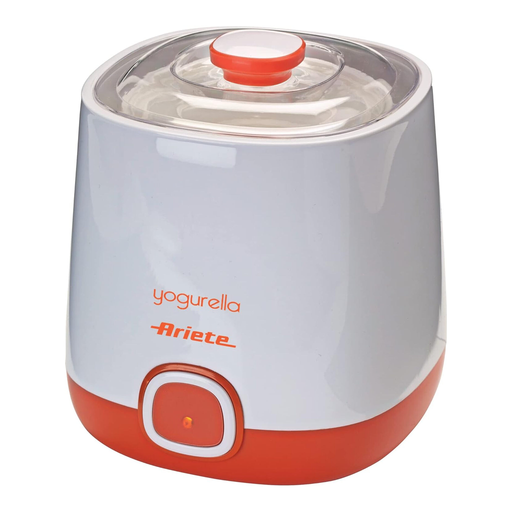
Ariete 621 Yogurella-621, 1 l, 20 W
An option if you’re planning to make one large batch rather than several portions in individual jars.
The product title lists a 1-litre capacity, 20 W and a strainer for draining.
By contrast, Ariete’s data sheet for the Yogurella 0621/10 lists 40 W. Check the model number and power rating before treating this listing as the same version.
View at Joybuy
Frequently asked questions
Can I leave the yoghurt in the maker until breakfast once the programme has finished?
No. Automatic shut-off isn’t a cooling function. Put the finished yoghurt in the fridge after fermentation and plan the running time accordingly.
What should I bear in mind if I use raw milk in a holiday home?
The German Federal Institute for Risk Assessment recommends heating raw milk before drinking it to reduce the risk of infection. Fermentation doesn’t replace this precaution.
How should I clean the jars, and what temperature should I store the yoghurt at?
Clean the jars according to the instructions for your yoghurt maker and keep the finished yoghurt chilled. The Verbraucherzentrale recommends storing yoghurt on the middle shelf of the fridge at 5 to 7 °C; throw away any yoghurt with visible mould.
What do CE marking and the legal guarantee mean when buying in Germany?
Where CE marking is required for a product, it’s the manufacturer’s declaration that the product meets the applicable requirements, not an independent quality mark. The statutory guarantee from the seller is separate from a voluntary warranty; the Verbraucherzentrale states that new goods are generally covered for two years from delivery.
Is a yoghurt maker that doesn’t need electricity automatically suitable for milk and natural yoghurt as a starter?
No, you can’t tell from the design alone. EasiYo describes a method for the Blue Yogurt Maker using boiling water and EasiYo yoghurt sachets; if you’re using other ingredients, check the instructions for the specific system.


