Serving from one bowl to share
If you’d like to serve natural yoghurt for everyone to share, a large container matters more than individual portions. Rommelsbacher lists the JG 80 as coming with two 1.2-litre containers.


First, choose the quantity you’ll need for dinner, then decide how you’d like to serve it: in individual jars for separate portions or in one large container to share. A timer can help you plan when the yoghurt will be ready, but it won’t replace the fermentation time or the need to chill it afterwards. The capacities listed are manufacturers’ specifications, not measured yields.
If you’d like to serve natural yoghurt for everyone to share, a large container matters more than individual portions. Rommelsbacher lists the JG 80 as coming with two 1.2-litre containers.
Individual jars are useful if everyone wants to serve their own portion or you’d like to chill leftovers in sealed containers. Check that the size and number of jars suit your portions.
If you start making the yoghurt before your meal together, a timer can help you plan when the heating phase will end. You’ll still need time and space to chill it afterwards.
| Priority | What to check before buying | Who it matters most to |
|---|---|---|
| Quantity and serving style | Compare the stated quantity per batch, and the number and size of containers, with the portions you’re planning. | If I’m serving several people from one bowl, the right quantity matters more to me than individual jars. Around 40% of consumers prioritise this. |
| Setting time and planning | Check the timer, automatic shut-off and instructions for the specific model; allow separately for chilling afterwards. | If I want to start a batch in good time before a meal, knowing when the heating phase ends is important to me. Around 30% of consumers prioritise being able to plan the setting time. |
| Cleaning and fridge storage | Check the number of containers and lids, the cleaning instructions, whether spare containers are available and how much space you have in the fridge. | If I’m filling several containers and then need to chill them, I pay particular attention to cleaning and storage space. Around 20% of consumers prioritise this. |
| Upfront and ongoing costs | Compare what’s included and any potential cost of compatible spare containers; electricity costs can only be calculated using actual consumption and running time. | If I’m buying an extra appliance, I also want to factor in any potential ongoing costs. Around 10% of consumers prioritise these costs. |
The storage containers included don’t necessarily show how much yoghurt you can make at once. For the Rommelsbacher JG 80, the manufacturer states a yield of up to 1,200 g per batch, even though two 1.2-litre containers are included.
Compare the stated quantity per batch with the capacity of the containers supplied.
Automatic shut-off ends the heating phase, not the chilling process afterwards.
Follow the instructions for the specific model when planning your timings, and allow extra time and fridge space before dinner.
The rated power alone doesn’t tell you how much electricity an appliance uses over a full batch. Depending on what’s included, you may also need to buy compatible extra containers.
Only calculate electricity costs using actual consumption and running time; if you need extra jars, check that they’re compatible with the model.
The JG 60 and JG 80 models differ mainly in that one comes with individual portion jars and the other with larger containers.
The JM 2 is designed for making separate portions in several jars.
The JM 3344 is a jar-style yoghurt maker supplied with seven jars.
The JG 3510 is a straightforward jar-style yoghurt maker without a timer.
The Yogurella 0621/10 is a container-style model supplied with an additional strainer.
Depending on the model, the yoghurt makers below offer larger containers or individual portion jars for natural yoghurt. Compare the stated capacities and features with the quantity you want to make and how you’d like to serve it.
 No image available
An option if you’d rather serve yoghurt in larger containers than in individual portion jars.
The product title lists two XXL glass containers, holding 2,000 ml and 1,400 ml. Before buying, check how much yoghurt the appliance is designed to make per batch.
 No image available
If you’d like to prepare individual portions, the product title lists nine jars as well as the inner pot.
Other features listed in the product title include temperature control, a timer and an OLED display.
 No image available
Separate jars are a good option if you’d like to prepare several portions rather than one bowl to share.
The product title lists eight jars with a total capacity of 1,440 ml, digital temperature control and a 48-hour timer.
 No image available
The stated suitability for three to five people may be useful for a meal together; compare the quantity with the portions you’ll need.
The product title lists a 1.5-litre capacity, 20 W, a strainer and a lid.
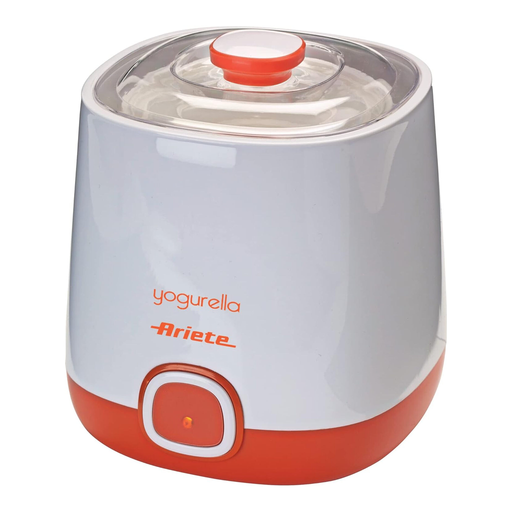 No image available
The one-litre container is an option if you’d prefer one container rather than individual portion jars.
The product title lists a capacity of one litre, 20 W and a white finish.
You can’t tell from the appliance model alone. Follow the instructions for the specific model and ingredients to check how long preparation takes, then allow time for chilling. A timer may stop the heating phase, but it won’t chill the yoghurt.
It depends on the recipe and appliance. The instructions for the Clatronic JM 3344 specify 1 litre of pasteurised UHT milk and a 150 ml pot of natural yoghurt for seven jars; these quantities aren’t a general recommendation for every appliance. Raw milk shouldn’t be treated like milk that has already been heated: the German Federal Centre for Nutrition advises that raw milk must be boiled before drinking.
Use clean containers and keep the finished yoghurt chilled. The right way to store it also depends on the recipe, so follow the preparation and storage instructions.
No. A voluntary manufacturer’s guarantee and your statutory rights are different. The German consumer advice centre explains that, for a fault arising within the first two years, the warranty period may be extended from two to three years if you choose a repair instead of a replacement. Any further repair rights against the manufacturer for a specific appliance should be checked separately.
It’s required if the appliance falls under harmonised EU rules that require CE marking. In that case, the manufacturer uses the marking to declare that the appliance meets the applicable requirements; it isn’t an independent quality seal. When buying a specific appliance, also check its model identity and markings.