Planners who like individual portions
You want to make natural yoghurt directly in sealable jars, then take out individual portions as you need them.


First, decide how much yoghurt you want to make in one batch and whether you want it portioned into individual servings in the appliance. Portion jars save you having to transfer the yoghurt later, but they take up space and need to be washed individually; a large container gives you more flexibility when portioning. Remember to allow time and space to chill the yoghurt after fermentation.
You want to make natural yoghurt directly in sealable jars, then take out individual portions as you need them.
You make one batch and divide the chilled yoghurt into suitable portions later.
You want fermentation to fit into your daily routine, so you take the timer, automatic shut-off and subsequent chilling into account.
Start by comparing the containers and the amount you can actually make in one go. Then check whether the programme end, cleaning and space for chilling fit your routine.
| Consideration | What to look for when buying | Who is this most important to? |
|---|---|---|
| Individual portions ready to enjoy | Compare the number of jars, capacity per jar and lids. Rommelsbacher lists eight 150 ml jars for the JG 40; Steba lists twelve 0.2 l jars for the JM 2. | If I want to take out several portions without transferring the yoghurt later, I look at the number and capacity of the jars and whether they have lids. Around 36% of consumers prioritise individual portions that are ready to enjoy. |
| A flexible supply | Check the capacity of each container that can actually be used at the same time. Rommelsbacher lists two alternative 1.2 l large containers and a batch size of up to 1,200 g for the JG 80; My.Yo states that its non-electric model makes one litre per batch. | If I want to divide one batch into portions myself later, a suitable large container matters more to me than lots of individual jars. Around 29% of consumers prioritise a supply they can portion flexibly. |
| Planning fermentation and chilling | Check the timer and automatic shut-off on the specific model, and make room in the fridge. The Verbraucherzentrale describes storing the yoghurt in the fridge afterwards; the German Federal Institute for Risk Assessment recommends a temperature of 2 °C to no more than 7 °C for perishable foods. | If I want to fit a batch into my daily routine, I also need to think about when I can chill the finished yoghurt. Around 21% of consumers prioritise being able to plan fermentation and chilling. |
| Simplicity and ongoing effort | Compare only the programmes you expect to use, and check how easy the appliance is to clean and whether replacement jars are available. Rommelsbacher lists one programme for the JG 40 and four preset programmes for the JG 80. | If I mainly want to make natural yoghurt, I want to avoid unnecessary features and extra cleaning. Around 14% of consumers prioritise simple features and low ongoing effort. |
Small pots and large containers may be intended for different preparation options. Their capacities do not automatically add up to the amount you can make at the same time.
Compare the capacity per batch separately from the number of individual containers supplied.
A timer switches the appliance off, but it does not chill the finished yoghurt. The Verbraucherzentrale describes storing the finished jars in the fridge.
When planning, allow for both chilling time and the space needed in your fridge.
More features do not automatically make an appliance better suited to making multiple portions of natural yoghurt. Batch size and container format remain the key considerations.
First compare how you want to portion the yoghurt, then choose extra programmes only if you genuinely need them.
The models listed offer options for individual jars and larger containers.
The JM 2 and JM 3 differ in the number of jars, their capacity and their settings.
The JG 3520 is available with several small portion jars.
A non-electric maker for one batch, which you portion yourself later.
The Design ice cream maker Advanced Control 42900 combines a yoghurt programme with an ice-cream-making function.
The following Joybuy products include electric yoghurt makers for batches in larger containers or several jars.
 No image available
An option if you want to make a batch in a larger glass container.
The product title lists two glass containers with capacities of 2.000 ml and 1.400 ml.
 No image available
For making individual portions in separate containers inside the appliance.
The product title lists a 1,6-l SUS304 inner container and nine borosilicate glass jars.
 No image available
An option for making portions in several jars if digital temperature control and a timer suit your routine.
The product title lists eight jars with a total capacity of 1.440 ml and a 48-h timer.
 No image available
For making a batch that you can portion yourself later, provided the container format suits your fridge and your needs.
The product title lists a capacity of 1,5 l, a power rating of 20 W, a strainer and a lid.
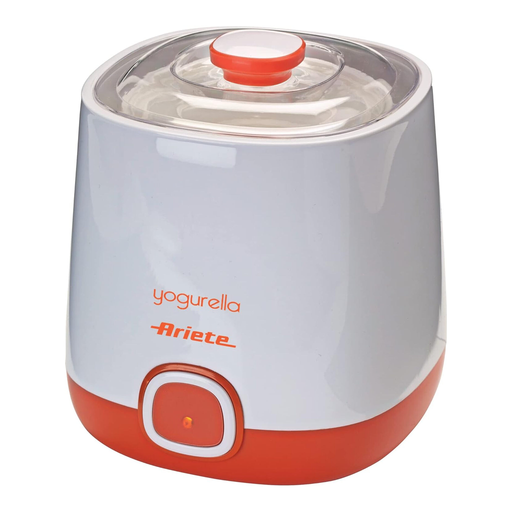 No image available
An option for making a one-litre batch if you want to portion the yoghurt yourself afterwards.
The product title lists a capacity of 1 l and a power rating of 20 W.
You’ll need milk and a suitable yoghurt as a starter, or the right cultures. The Verbraucherzentrale explains how to stir yoghurt into milk; also follow the instructions for your appliance.
Make separate arrangements for chilling: the Verbraucherzentrale describes storing the finished jars in the fridge. The German Federal Institute for Risk Assessment recommends a fridge temperature of 2 °C to no more than 7 °C for perishable foods.
Do not use raw milk without boiling it first. The German Federal Institute for Risk Assessment recommends boiling raw milk before using it to make homemade yoghurt to help prevent infection.
Follow the instructions for the specific model. For the JM 3, Steba advises against immersing the electrical appliance in water; according to its instructions, the jars and lids can be washed in hot water or cleaned in the dishwasher. This does not automatically apply to other appliances.
Regulation (EC) No 1935/2004 governs the placing on the market of materials that come into contact with food, including food-processing equipment. If you add or replace containers, check their intended use and compatibility with your appliance; a general statement about the material does not prove that a particular product complies.