Preparing individual portions for lunch
If you’re preparing yoghurt for several weekdays, you may want to chill individual portions separately and use them when blending each day’s lunch smoothie.


First, choose a yoghurt maker based on how much yoghurt you want to make in each batch and whether you’d like to chill it in individual jars or one large container. Portion jars make it easy to keep servings separate. A large container gives you more flexibility when portioning later, but you’ll need a separate container for taking it with you. Whichever appliance you choose, you’ll also need to plan how to keep your finished smoothie cool while you’re out.
If you’re preparing yoghurt for several weekdays, you may want to chill individual portions separately and use them when blending each day’s lunch smoothie.
If you make a larger batch, you can take out the amount you need later and portion it when blending. Just remember to allow extra space for storage.
If you’d like to experiment with different batches, check the programmes and settings on the specific model and make sure they suit your recipe and the culture you’re using.
Start by comparing the amount you want to make per batch with the container style that suits you. The German Federal Institute for Risk Assessment recommends keeping perishable foods chilled when you’re out and about.
| Criteria | What to look for | Who is it important for? |
|---|---|---|
| Portioning and taking it with you | Compare the number and capacity of the jars. Plan separately for a container and cooling for your finished smoothie. | If I want to chill individual portions of yoghurt for several lunches, I need jars of the right size and must plan separately for a container and cooling for the finished smoothie. Around 33% of consumers prioritise portioning and taking it with them. |
| Amount per batch | Check the stated capacity against the amount your recipe requires; don’t assume the container volume equals the number of ready-to-drink portions. | If I want to prepare enough yoghurt for several weekdays in one go, the amount per batch matters most. Around 27% of consumers prioritise batch size. |
| Programmes for different ingredients | Compare programmes and temperature ranges for the specific model only, and check they suit your recipe and culture. | If I want to try different ingredients, I check the documented settings for the appliance in question. Around 20% of consumers prioritise programmes suited to their ingredients. |
| Operation and cleaning | Check whether the timer or automatic shut-off suits your routine, and which parts the instructions say can be cleaned. | If I regularly prepare yoghurt as part of my working week, I want the appliance’s operation and care to fit my routine. Around 20% of consumers prioritise easy operation and cleaning. |
The manufacturer’s description of the lid applies to the yoghurt jar. It doesn’t tell you how easy a blended smoothie will be to transport or whether it will stay chilled.
Choose a suitable sealed container and a way to keep your smoothie cool while travelling separately from your choice of yoghurt maker. The German Federal Institute for Risk Assessment recommends keeping perishable foods chilled when you’re out and about.
A container’s capacity tells you how much yoghurt it can hold, not the size of your finished smoothie portion. Your recipe and the amount you use in each drink affect how many portions you’ll get from a batch.
Work out how much yoghurt you need for each day of preparation, then compare that with the stated container size or number of jars.
Best-before guidance for packaged products doesn’t guarantee how long homemade yoghurt or smoothies made from it will keep.
Use clean equipment and keep the yoghurt chilled. The Verbraucherzentrale (German consumer advice centre) lists visible mould and clear signs of spoilage as reasons not to eat a product.
The JG 3518 is designed to make individual portions of yoghurt in small jars.
The JG 80 Jona combines larger containers with smaller portion pots and preset programmes.
The JM 2 comes with individual jars for larger batches, while the JM 3 has adjustable temperature, according to the manufacturer.
The Yogurella models offer different container options: individual jars or containers with a filter insert.
This selection includes yoghurt makers with larger containers, portion jars or both. You’ll still need to plan separately for a container and a way to keep your finished smoothie cool.
 No image available
An option for making larger batches of yoghurt to keep.
The product title lists two glass containers with capacities of 2,000 ml and 1,400 ml.
 No image available
The combination of an inner pot and individual jars gives you options for both larger batches and separate portions.
The product title lists a 1.6 l SUS304 inner pot, nine borosilicate glass jars, temperature control, a timer and an OLED display.
 No image available
An option if you’d like to divide a batch between several individual jars.
The product title lists eight jars with a total capacity of 1,440 ml, digital temperature control and a 48-hour timer.
 No image available
The stated capacity gives you a guide to how much you can make in each batch.
The product title lists a capacity of 1.5 l, 20 W, a strainer and a lid.
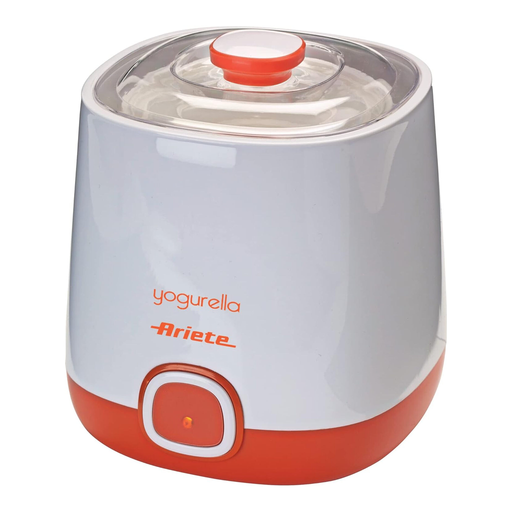 No image available
An option if you’d like to plan your batch around a stated capacity of one litre.
The product title lists a capacity of 1 l and a power rating of 20 W.
Chill the yoghurt after making it. For your blended smoothie, use a suitable sealed container and plan how to keep it cool until you’re ready to drink it. The German Federal Institute for Risk Assessment recommends keeping perishable foods chilled when you’re out and about; this doesn’t give a general shelf-life for a freshly blended smoothie.
Not with the Severin JG 3518. Its instructions say to clean the jars and lids after use and warn against immersing the electrical appliance base in liquid. For other models, follow the relevant instruction manual.
Only if the specific appliance is covered by harmonised EU rules that expressly require CE marking. The EU’s Your Europe guidance explains that CE marking isn’t a blanket requirement for every product, so check the information for the appliance in question.