If you want to make yoghurt in the evening and take it with you in lunchbox-sized portions the next morning, look for individual jars that seal securely and an automatic shut-off that suits your routine. Choose the container size to suit the number of portions you need. Extra programmes are mainly useful if you plan to follow the recipes they’re designed for. Yoghurt needs to be chilled after fermentation – neither a lid nor an automatic shut-off replaces refrigeration.
Which appliance is right for you?
Evening batch-makers
If you start a batch in the evening and don’t want to switch the appliance off in the morning, look for an adjustable running time and an automatic shut-off. Rommelsbacher specifies an automatic shut-off for the JG 40, while Steba lists one for the JM 2. You’ll still need to chill the yoghurt afterwards.
Lunchbox portioners
If you want to take ready-made portions with you without decanting them, compare the jar size and lids. The Verbraucherzentrale advises that yoghurt should be refrigerated after it’s made; you’ll also need to keep it sufficiently chilled during transport.
Meal-preppers for several weekdays
If you’re preparing several lunches at once, the number and capacity of the containers matter just as much as the space you have for chilling them. Rommelsbacher and Steba list different portion formats; more jars also mean more parts to clean.
What to look for when buying
First check whether you can schedule when the programme ends, then compare the size and number of containers with your lunch portions. Choose extra programmes only if they suit the recipes you actually want to make.
| What you need |
What to check before buying |
Who is it important to? |
| Overnight fermentation |
Check the timer, adjustable running time and automatic shut-off on the specific model; allow time for chilling once the programme ends. |
If I start a batch in the evening, I don’t want to have to stop the heating process in the morning. That’s why around 36% of consumers put a programme end time they can plan around first. |
| Taking individual portions with you |
Compare the jars’ capacity, lid type and cleaning instructions; make sure you have a way to keep them chilled during storage and transport. |
If I want to put yoghurt straight from individual jars into my lunchbox, I want to avoid decanting it. Around 29% of consumers prioritise suitable, sealable portion containers for this reason. |
| Enough for several days |
Match the number of portions you need with the number and stated capacity of the supplied containers; allow for space to chill them. |
If I’m preparing several lunches from one batch, what matters to me is how many suitable portions I’ll get. Around 21% of consumers focus primarily on the quantity and number of containers. |
| Different recipes |
Check which programmes are documented and what the recipe instructions say about the milk or alternative you’re using. |
If I want to try more than one recipe, I want to know which programmes are intended for those batches. Around 14% of consumers prioritise programme and recipe flexibility. |
Common buying and usage mistakes
-
Confusing automatic shut-off with refrigeration
An automatic shut-off ends the programme, but it doesn’t chill the yoghurt. For a lunchbox, it’s still important to chill the yoghurt after fermentation and keep it sufficiently cold during transport.
Plan your start time so there’s still time to chill the jars after the programme ends, before you take them with you.
-
Comparing total capacity only
A large container and several ready-to-go individual portions meet different needs. What matters is whether the number and size of the supplied containers suit the lunches you’re planning.
Before buying, compare the supplied accessories listed for the exact model with the portions you plan to make.
-
Assuming one programme works for every recipe
Manufacturer programmes are designed for the batches specified by the manufacturer. They don’t guarantee that every milk alternative or culture will work with them.
Check the recipe and ingredient guidance for the specific appliance before making your planned batch.
Brands to consider
Severin
The JG 3521 combines portion jars with automatic programmes.
- Severin describes the lids as leakproof; according to the manufacturer, the JG 3521 has five automatic programmes.
- The claim about the lids comes from the manufacturer and isn’t based on an independent transport test. Check that the programmes and jar format suit your batch.
Rommelsbacher
The JG 40 is designed for portion jars, while the JG 80 combines smaller pots with larger containers.
- Rommelsbacher lists eight 150 ml jars and a timer with automatic shut-off for the JG 40. The JG 80 is designed to use small portion pots alongside larger containers.
- The models differ in their container formats and intended programmes. Choose according to the portions you need and the recipes you want to make, rather than any claimed superiority in yoghurt quality.
Steba
The JM 2 is designed for larger quantities in individual jars.
- Steba lists twelve 0.2 l jars, a total capacity of 2.4 l and a timer with automatic shut-off. Replacement jars are available separately.
- If you’re only preparing a few lunch portions, weigh up the space required and the cleaning involved against the batch size you actually need.
Clatronic
The JM 3344 is a straightforward yoghurt maker with portion jars.
- Clatronic lists seven 160 ml jars and an illuminated on/off switch.
- You’ll need to stop the batch yourself. Check the model’s instructions if you need a timer function.
Camry
The CR 4519 comes with individual screw-top jars, each with a capacity of 200 ml.
- The manufacturer lists seven jars and a fixed fermentation temperature of 42 °C.
- The temperature is a manufacturer specification, not an independently measured guarantee of temperature stability. Remember to stop the programme manually.
Joybuy products for yoghurt portions
The Joybuy products below range from appliances with individual portion jars to models for larger batches. If you’re making yoghurt overnight, also compare the timer and shut-off details; you’ll still need to allow time for chilling afterwards.
 No image available
FOHERE yoghurt maker with 2 XXL glass containers (2,000 ml and 1,400 ml)
For making a larger batch that you can divide into several portions afterwards.
According to the product name, it includes two XXL glass containers with capacities of 2,000 ml and 1,400 ml.
View at Joybuy
 No image available
Fosmet yoghurt maker, 1.6 l, SUS304, with 9 borosilicate glass jars
If you want to prepare several individual portions, this model also has a timer.
Features listed include a 1.6 l SUS304 inner pot, nine 100 ml borosilicate glass jars, temperature control, a timer and an OLED display.
View at Joybuy
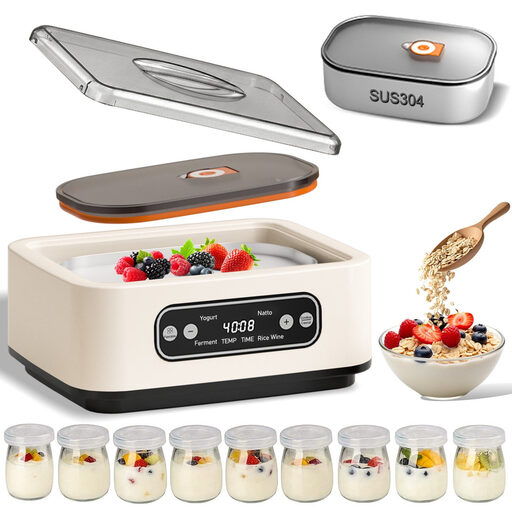 No image available
Yoghurt maker, 1.6 l, SUS304, with 9 borosilicate glass jars
For making a batch in several containers; temperature and timer controls are useful if you want to plan the running time.
The product name lists a 1.6 l SUS304 inner container, temperature and timer controls, an OLED display and nine borosilicate glass jars.
View at Joybuy
 No image available
FOHERE yoghurt maker with 8 jars (1,440 ml) and a 48-hour timer
For making several individual portions when you also want to set the running time.
Features listed include eight jars with a total capacity of 1,440 ml, temperature control, a digital 48-hour timer and automatic shut-off.
View at Joybuy
 No image available
Yoghurt maker, 1.5 l, 20 W, with strainer
If you’d rather make a larger batch than prepare individual lunchbox jars, the stated capacity is an important point of comparison.
The product name lists a 1.5 l capacity, 20 W and a strainer for making Greek yoghurt.
View at Joybuy
Frequently asked questions
Can I leave finished yoghurt unrefrigerated in my bag until lunchtime?
Make sure you chill the yoghurt after fermentation and keep it cold during storage and transport. The German Federal Institute for Risk Assessment (BfR) points out that inadequate chilling during food transport can allow harmful germs to multiply. A sealed jar or automatic shut-off doesn’t replace refrigeration.
Is a timer the same as a cooling function?
No. The automatic shut-off listed by Rommelsbacher for the JG 40 and by Steba for the JM 2 ends the programme, but doesn’t chill the finished yoghurt. Allow time for chilling after making a batch.
How many jars do I need for several lunchboxes?
Choose the number and size of jars to suit the portions you’re planning. Rommelsbacher lists eight 150 ml jars for the JG 40; Steba lists twelve 0.2 l jars for the JM 2. Compare these details with your portion size and the space you have available for chilling.
What should I bear in mind when cleaning the jars?
Follow the instructions for the specific model and clean the containers thoroughly after use. The instructions for the Severin JG 3521 say to clean the jars and lids after every use; this guidance applies to that model.


