Overnight planners
If you start a batch in the evening and don’t want to check on the appliance overnight, a timer and an explicitly stated automatic shut-off are important things to look for.


If you can’t switch the appliance off yourself at night, it’s important to check that it has a clearly documented automatic shut-off. Individual jars are handy for breakfast portions, while larger containers are better for making bigger batches. Also plan for an undisturbed spot to leave the appliance and somewhere to chill the finished yoghurt: an automatic shut-off is no substitute for a fridge.
If you start a batch in the evening and don’t want to check on the appliance overnight, a timer and an explicitly stated automatic shut-off are important things to look for.
Individual jars can make it easier to portion yoghurt later, as long as you have enough space to wash and chill them during your kitchen renovation.
You’ll need an undisturbed spot away from the work, and should weigh up compact dimensions against your preferred batch size and any extra features.
First, check whether the appliance can run without you needing to intervene overnight. Then consider the container style, the space it will take up and any extra features you’d find useful during your renovation.
| What matters | What to look for when buying | Who it matters most to |
|---|---|---|
| Timer controls | Check the timer and explicitly documented automatic shut-off separately: a selectable running time does not automatically mean the appliance will switch itself off. | If I start a batch in the evening and don’t want to check on it overnight, I want the appliance to stop on its own when the programme ends. Around 36% of consumers put timer controls first. |
| Portions and containers | Compare the number and capacity of the jars or containers, as well as the space you’ll need to wash and chill them. | If I want to prepare individual breakfast portions, it matters how many containers I’ll need to wash and chill afterwards. Around 29% of consumers prioritise portioning. |
| Space required | Allow for the appliance’s dimensions, a suitable socket and a clean, undisturbed place for it to run. | With little usable worktop space during a renovation, I need somewhere the appliance can stay undisturbed. Around 21% of consumers put the space it takes up first. |
| Programmes and consistency | Check whether temperatures are preset or adjustable, and whether any strainer you want is actually included. | If I want to make preparations other than natural yoghurt that are specifically supported, or would like to strain the yoghurt, I look for suitable programmes and accessories. Around 14% of consumers prioritise these options. |
Automatic shut-off ends the appliance’s programme, but it doesn’t chill the finished yoghurt. Make sure you have room to store it in the fridge afterwards.
Before starting a batch, check that you’ll be able to chill the containers once fermentation is complete.
The same overall amount of yoghurt might be divided between lots of portion jars or just a few large containers. This affects washing up, portioning and fridge space.
Decide how many portions you need before buying, then compare the number and capacity of the containers with the space you have available.
The stated power and container specifications differ between the Ariete Yogurella 0621/10 and a similarly named 621.
Check the full model number, what’s included and the technical specifications for the specific listing, rather than assuming that products with similar names are the same.
The JG 80 Jona combines large glass containers with programmes for several preparations specified by the manufacturer.
The JM 2 and JM 3 differ in their container configurations and adjustment options.
The JG 3521 is designed for people who want automatic programmes and portion jars.
The manufacturer describes the Yogurella 0621/10 as a compact maker with a filter for strained yoghurt.
The Joybuy products below include models with large containers or a strainer, as well as options with portion jars and timer controls. Similar basic features don’t automatically make different models identical, so check the specifications for the version you’re considering.
 No image available
The large containers are a good fit if you prefer making bigger batches rather than lots of individual portions.
Two glass containers with capacities of 2,000 ml and 1,400 ml; yoghurt strainer included; the product description lists several fermentation modes and an adjustable duration of up to 240 hours.
 No image available
The individual jars are useful if you want to prepare portions directly in their own containers.
1.6-litre SUS304 inner pot; nine 100 ml borosilicate glass jars; temperature control, OLED display and a timer from 1 to 99 hours. The description lists an automatic shut-off.
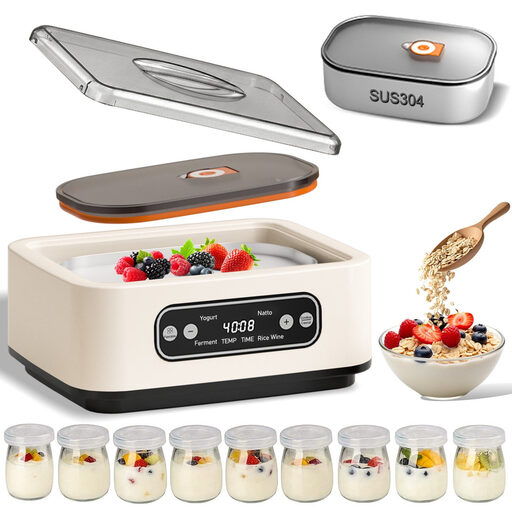 No image available
The nine jars offer a handy way to portion your yoghurt. Check that their number and capacity work with the fridge and washing-up space you have.
1.6-litre SUS304 inner pot; temperature control; adjustable timer from 1 to 99 hours and automatic shut-off are listed in the product description.
 No image available
This model could suit you if you’d like to prepare several portions in individual jars.
Eight jars with a total capacity of 1,440 ml; digital temperature control and a timer of up to 48 hours. The description lists an automatic shut-off.
 No image available
The strainer is a useful feature if you’d like to drain your yoghurt after making it.
1.5 l capacity; 20 W; stated dimensions of 19.5 × 17.5 × 21.4 cm. A strainer and lid are listed in the product title.
No. An automatic shut-off ends the appliance’s programme, but it doesn’t chill the yoghurt. Put the finished containers in the fridge afterwards. If you won’t have access to refrigeration during your renovation, don’t make a batch to save for later meals.
The instructions for the Severin JG 3521 say to clean the jars and lids after every use; the electrical base must not be immersed in liquid. Clean other models according to their own instructions, and handle food with clean hands and containers.
The seller is generally your point of contact if a product is faulty. Your statutory rights are separate from any additional voluntary guarantee. The Verbraucherzentrale states that, in Germany, these rights generally apply for two years from delivery.
Electrical appliances covered by the EU Low Voltage Directive must meet the relevant requirements. Check the specific listing for the appropriate CE marking, as well as any required instructions and safety information in German. The Bundesnetzagentur points out that the CE mark is not an independent quality mark.