Which buying considerations matter most for your shared routine?
First decide whether someone can monitor the end of the programme or whether you want the appliance to switch off automatically. Then choose the containers to suit whether you prefer individual portions or a shared supply.
| What matters |
What to check before buying |
Who is this most important to? |
| Fitting the programme end into your schedule |
Rommelsbacher lists an 18-hour timer with automatic shut-off for the JG 40; Steba lists a timer with automatic shut-off for the JM 2. An automatic shut-off does not mean the appliance has a delayed start, and it does not chill the yoghurt. |
If we plan the batch together but can’t stay by the appliance throughout, we need to decide who will take responsibility for chilling it. Around 40% of consumers put a shared schedule first. |
| Individual portion size |
Rommelsbacher lists eight 150 ml jars for the JG 40; Steba lists twelve 0.2 l jars for the JM 2. Compare the number and capacity with the portions you have in mind. |
If we want to assign jars to individuals and take them out separately, we look for a suitable number and size. Around 30% of consumers give individual portions top priority. |
| A shared supply |
For the JG 80, Rommelsbacher lists two 1.2 l glass containers and four 125 ml ceramic pots. Check which containers you’ll actually use and how they’ll fit in your fridge. |
If we usually help ourselves from a shared supply as needed, a larger container matters more than lots of small jars. Around 20% of consumers prioritise having a shared supply. |
| Simple operation |
Clatronic lists seven 160 ml jars and an illuminated switch for the JM 3344; Severin lists seven 150 ml jars and an on/off switch for the JG 3518. Check the timer functions of the specific model you’re considering. |
If one person can reliably keep an eye on things, straightforward controls may be all we need. Around 10% of consumers prioritise simple, basic operation. |
Joybuy products for plain yoghurt and shared kitchen routines
This selection includes appliances with larger containers for a shared supply, as well as models with individual jars and timer functions. Check whether the containers and shut-off function suit your routine; you’ll still need to plan for chilling the yoghurt afterwards.
 No image available
FOHERE yoghurt maker with two XXL glass containers
For a shared supply, the product title lists two XXL glass containers with capacities of 2,000 ml and 1,400 ml, plus a filter for Greek yoghurt.
View at Joybuy
 No image available
Fosmet yoghurt maker, 1.6 l, SUS304, nine jars
For separate portions and a carefully timed routine, the product title lists nine borosilicate glass jars, temperature control and a timer; the product description specifies automatic shut-off.
The shut-off function won’t chill the jars afterwards.
View at Joybuy
 No image available
FOHERE yoghurt maker with eight jars
For individual portions, the product title lists eight jars with a combined capacity of 1,440 ml and a 48-hour digital timer; the product description specifies automatic shut-off.
The appliance won’t chill the yoghurt after the programme ends.
View at Joybuy
 No image available
Yoghurt maker, 1.5 l, 20 W
For making a shared batch, the product title lists a 1.5 l capacity and a strainer insert. It also describes making plain and Greek yoghurt.
View at Joybuy
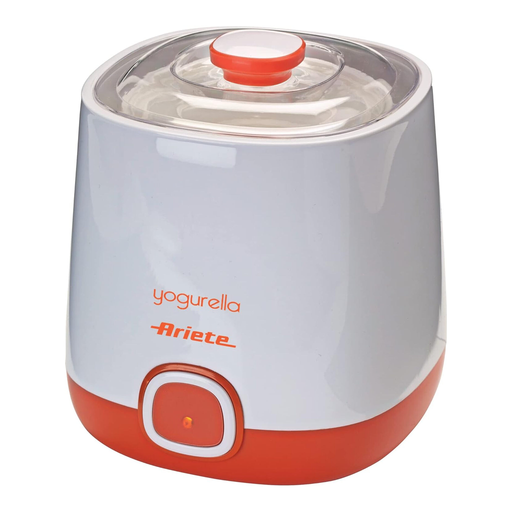 No image available
Ariete Yogurella 621, 1 l, 20 W
For a smaller batch, the product title lists a 1 l capacity. The product description mentions containers with lids, a filter for Greek yoghurt and an adjustable preparation time.
View at Joybuy
Frequently asked questions
Can the timer manage the whole shared yoghurt-making routine?
No. The Rommelsbacher JG 40 and Steba JM 2 are confirmed to have automatic shut-off, but not a delayed start. After preparation, the jars still need to go in the fridge, so you’ll need to arrange for someone to do this.
Which milk is best for your first batch of plain yoghurt?
The Verbraucherzentrale says UHT milk can be used straight away and recommends briefly bringing pasteurised whole milk to the boil first. After mixing it with plain yoghurt, try not to move the jars during fermentation, then chill them afterwards. Also follow the appliance’s instruction manual.
Can you use raw milk without heating it first?
The German Federal Institute for Risk Assessment recommends always boiling raw milk bought directly from a farm before drinking it. The Institute advises children, pregnant women, older people and those who are ill to avoid raw milk and raw-milk products. Heating milk in a yoghurt maker should not be considered a substitute for boiling it.
How should you store finished yoghurt?
Put the jars in the fridge after preparation. The Verbraucherzentrale recommends storing dairy products such as yoghurt on the middle shelf of the fridge at 5 to 7 °C. Throw the yoghurt away if you see any mould.
How should you dispose of a broken electric yoghurt maker?
A broken electrical appliance shouldn’t go in your household waste. According to the German Environment Agency, old electrical appliances must be disposed of separately; local collection points generally accept them free of charge.


