Which serving option is right for you?

Hosting a larger group

If you want to serve the yoghurt for everyone to share at the venue, compare the capacity of the container designed for yoghurt: Rommelsbacher lists two 1.2-l glass containers for the JG 80, while Steba lists a 2-l yoghurt jar for the JM 4 FERMENT.

Bringing individual portions

If you want to bring ready-made portions rather than one large container, check the number of jars, their capacity and whether they have lids. Rommelsbacher lists eight 150 ml jars for the JG 40; Steba lists twelve 0.2 l screw-top jars for the JM 2.

Guests travelling further

If the yoghurt needs to stay chilled during your journey, choose containers that fit the cooling facilities you have available. The Verbraucherzentrale recommends keeping yoghurt chilled; the Federal Institute for Risk Assessment highlights the importance of adequate cooling during transport and storage.

What should you look for when buying?

Priority What to check when buying Who is this important to?
Suitable batch size Compare the usable yoghurt quantity per batch with the container designed for it. If I want to bring a batch to share with a larger group, the quantity needs to suit how I plan to serve it. Around 33% of consumers say batch size is their top priority.
Ready-made individual portions Check the number of jars, their capacity and the lids supplied. If I want to prepare the portions before the get-together and hand them out individually, I need jars and lids that suit my needs. Around 27% of consumers say individual portions are their top priority.
Keeping it chilled on the way Check that the sealed containers will fit in the cooling facilities available and can be kept chilled at your destination. If I have a longer journey, I want to keep the yoghurt chilled until it’s time to eat, so I need containers that will fit in my cooling equipment. Around 27% of consumers say keeping food chilled in transit is their top priority.
Planning fermentation Check whether the specific model has a timer and automatic shut-off, and allow enough time for the yoghurt to chill afterwards. If I want to make the yoghurt ahead of the event, a programme with a predictable end time helps me leave enough time for it to chill. Around 13% of consumers say planning the timing is their top priority.

Common buying misconceptions

  • Adding container capacities together

    Extra containers or a strainer for fresh cheese don’t automatically mean that their combined capacity can all be used for one batch of yoghurt.

    Compare the stated yoghurt quantity per batch and the container intended for it. Steba describes the extra 1.3-l container supplied with the JM 4 FERMENT as having a strainer for making fresh cheese.

  • Confusing a timer or a lid with refrigeration

    Automatic shut-off can make it easier to plan when a programme ends, and lids seal the jars. Neither will chill the finished yoghurt.

    Make separate plans for keeping it chilled after fermentation, during the journey and until it’s ready to eat.

  • Assuming similarly named models are identical

    For the Ariete 621, the power ratings differ between the manufacturer’s specifications and the Joybuy product listing: 40 W versus 20 W. The model name alone doesn’t confirm whether they refer to the same product version.

    Check the full model number and the key specifications before matching an offer to a particular model.

Key brands at a glance

Rommelsbacher

The models listed mainly differ in whether they come with individual portion jars or larger containers.

  • Rommelsbacher lists eight 150 ml jars and a timer with automatic shut-off for the JG 40.
  • According to the manufacturer, the JG 80 comes with two 1.2-l glass containers and four portion pots; its stated yoghurt capacity is up to 1,200 g per batch.
  • The JG 80’s additional features may not be necessary if you only plan to make natural yoghurt.

Steba

The JM 2 is designed for individual jars, while the JM 4 FERMENT comes with a larger yoghurt container and additional programmes.

  • Steba lists twelve 0.2 l screw-top jars for the JM 2, as well as a compatible replacement jar set.
  • The JM 4 FERMENT is supplied with a 2-l yoghurt jar.
  • The additional 1.3-l container is described as having a strainer for making fresh cheese; don’t count its capacity as extra yoghurt for a batch.

Severin

The JG 3521 is designed for making smaller portions and includes additional automatic programmes.

  • Severin lists seven 150 ml jars and five programmes.
  • The manufacturer’s claim that the lids are leakproof is not the same as an independent transport test.

Clatronic

The JM 3344 is a simple option with portion jars for natural yoghurt.

  • Clatronic lists seven 160 ml jars with screw-top lids and an on/off switch.
  • The manufacturer’s website doesn’t list a timer for this model. Additional jars are model-specific.

Ariete

The Yogurella 0621 is described as a yoghurt maker supplied with containers rather than individual jars.

  • Ariete describes it as having two containers and a filter basket for strained yoghurt.
  • For model 621, the manufacturer lists a power rating of 40 W, compared with 20 W on Joybuy. Check the product version and specifications before buying.

Yoghurt makers at Joybuy

This selection includes yoghurt makers with larger containers for serving everyone from one batch, as well as models with jars for pre-prepared individual portions.

FOHERE yoghurt maker with two XXL glass containers

FOHERE yoghurt maker with two XXL glass containers

The container design is suitable for making a batch to serve for everyone to share at the table.

Two glass containers: 2,000 ml and 1,400 ml. Check the yoghurt quantity intended for each batch rather than adding the container capacities together without checking.

Joybuy

Fosmet yoghurt maker with a 1.6-l inner pot and nine borosilicate glass jars

Fosmet yoghurt maker, 1.6 l, SUS304, 9 borosilicate glass jars

The inner pot and individual jars give you different container options for sharing or serving pre-prepared portions.

Features listed include a 1.6-l inner pot, nine borosilicate glass jars, temperature control, a timer and an OLED display.

Joybuy

FOHERE yoghurt maker with eight jars and a 48-hour timer

FOHERE yoghurt maker with 8 jars, 1,440 ml, 48-hour timer

Individual jars are a good option if you want to bring ready-made portions rather than one shared container.

Features listed include eight jars with a combined capacity of 1,440 ml, a digital temperature display and a 48-hour timer.

Joybuy

Yoghurt maker with a 1.5-l container, strainer insert and lid

Yoghurt maker, 1.5 l, 20 W, with strainer insert and lid

The 1.5-l container is an option for making a batch to share out later.

Features listed include a 1.5-l capacity, 20 W power, a strainer insert, a lid and dimensions of 19.5 × 17.5 × 21.4 cm. The product name states that it’s suitable for 3–5 people.

Joybuy
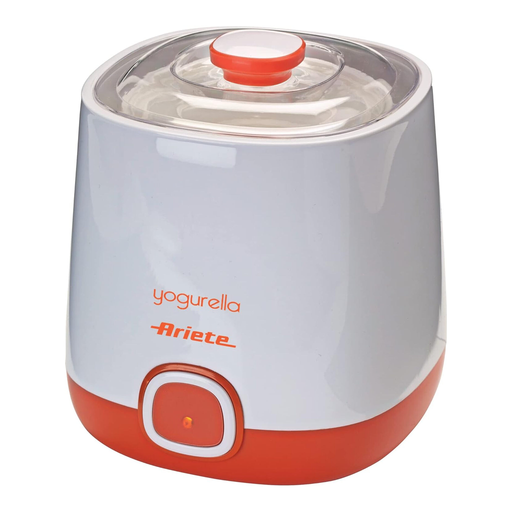
Ariete 621 yoghurt maker with a one-litre capacity

Ariete 621 yoghurt maker, 1 l, 20 W

The one-litre container is an option for making a batch to serve at the venue.

The product name lists a 1-litre capacity and 20 W power. Ariete lists 40 W for model 621, so check the exact product version and its stated power rating.

Joybuy

Frequently asked questions

How should I plan when to make the yoghurt for the get-together?

Follow the instructions for your chosen appliance and allow plenty of time for the yoghurt to chill after fermentation before setting off. A timer with automatic shut-off ends the appliance’s programme, but it doesn’t chill the yoghurt.

How should I store and transport the finished natural yoghurt?

Put the yoghurt in the fridge after making it, and plan how to keep it chilled during transport and until it’s time to eat. For dairy products such as yoghurt, the Verbraucherzentrale recommends using the middle shelf of the fridge at 5 to 7 °C. This is storage advice, not a stated legal temperature limit for transport.

Can I use raw milk to make yoghurt for other people to eat?

Don’t use raw milk without boiling it first to make homemade yoghurt. The Federal Institute for Risk Assessment recommends boiling raw milk, even when it’s being used to make a food such as yoghurt that won’t be heated again before eating.

Which replacement parts should I check before buying?

Check whether you’ll need replacement jars made for your specific model. Steba lists a replacement jar set for the JM 2; Clatronic lists optional extra jars for the JM 3344.

Do food hygiene regulations for food businesses automatically apply to a private bring-and-share evening?

Not automatically: under Regulation (EC) No 852/2004, the regulation doesn’t apply to the domestic preparation, handling or storage of food for private domestic consumption (EUR-Lex, consolidated text of 20 April 2009). This doesn’t provide a blanket answer for a differently organised event, such as commercial or public food distribution. Keeping the yoghurt chilled remains important in any case.