For those who prefer small batches
You want to make natural yoghurt for yourself without regularly filling a large container. The key is to check that the maker can handle genuinely small batches and comes with suitable jars.


If you usually make natural yoghurt in small quantities, individual jars with lids are a sensible place to start – but check the instructions for the specific model to see whether you can use just a few filled jars. A large container is a better fit if you want to make a batch to keep in reserve. A non-electric maker could suit you if you’d rather avoid electric heating and are happy to make a larger batch. Whichever type you choose, use clean containers and chill the yoghurt afterwards.
You want to make natural yoghurt for yourself without regularly filling a large container. The key is to check that the maker can handle genuinely small batches and comes with suitable jars.
If you eat natural yoghurt regularly and want to prepare several portions to keep chilled, the number of containers and the space in your fridge are likely to matter more than the smallest possible batch size.
A non-electric, insulated yoghurt maker may suit you if you’re happy to use a larger container and follow a different preparation routine.
| What matters | What to check before buying | Who it matters most to |
|---|---|---|
| Small batches | Check the jar capacity and the specific model’s guidance on making smaller batches. Also consider how much milk and starter you’ll need. | If I’m making yoghurt just for myself, I don’t want to make more than I need. Around 36% of consumers put a genuinely usable small batch size first. |
| Making a supply and fridge space | Consider the number and capacity of the containers, as well as the space needed in your fridge for the maker and filled jars. | If I want to prepare several portions, suitable containers and enough fridge space are important. Around 29% of consumers prioritise having individual portions ready to store. |
| Ease of use | Think about whether a timer with automatic shut-off or a natural yoghurt programme suits your routine, and check the instruction manual. | If I want a straightforward way to make yoghurt, I look for features that fit my routine. Around 21% of consumers prioritise controls that are simple and suit their needs. |
| Using it without a plug socket | Check the container capacity and preparation instructions against the number of portions you want to make. | If I want to avoid electric heating, I also need to be happy making a larger batch. Around 14% of consumers prioritise a non-electric design. |
A maker supplied with several jars doesn’t mean you have to fill them all at once. Other models may not be designed for making a small batch.
Compare the amount you want to make with the capacity of the containers and the instructions for the specific model, rather than looking at the total capacity alone.
A non-electric maker, such as the one-litre model described by My.Yo, doesn’t take the place of preparing the yoghurt or chilling it afterwards.
Choose this type if its preparation routine works for you – not simply because it doesn’t need to be plugged in.
The rated power alone doesn’t tell you how much electricity a maker uses over a complete batch.
Don’t use the wattage alone to estimate specific electricity costs or savings compared with shop-bought yoghurt.
The JM 3344 is an electric maker with individual jars, and may be worth considering if you want to make smaller quantities.
The JG 3518 is designed for making several smaller portions in individual jars with lids.
The JG 80 comes with containers in different sizes and a natural yoghurt programme. It may suit you if you plan to make larger batches as well as filling small jars.
The JM 2 is more suited to people who want to prepare several portions and use a timer.
This non-electric maker may suit you if you want to make yoghurt without electric heating.
The CR 4519 is an electric maker with larger portion jars.
This selection includes electric yoghurt makers with individual jars, as well as models with a larger container.
 No image available
The nine jars let you portion the yoghurt into individual containers.
Listed features include a SUS304 inner container, temperature control, a timer and an OLED display.
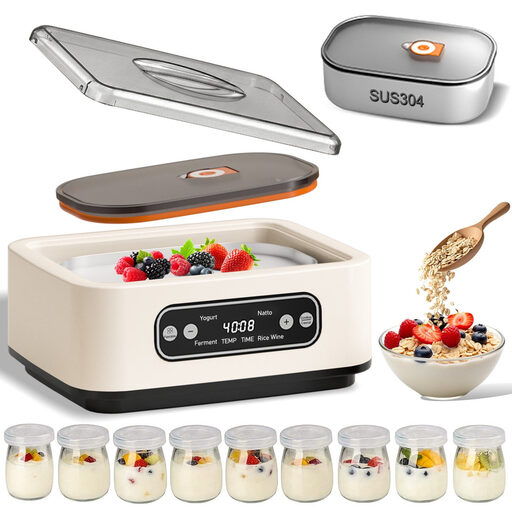 No image available
The nine 100 ml jars are designed for portioning yoghurt into individual servings.
Listed features include a SUS304 inner container, temperature control, a timer and an OLED display.
 No image available
The eight jars let you divide the batch between individual containers.
Listed features include digital temperature control and a timer of up to 48 hours.
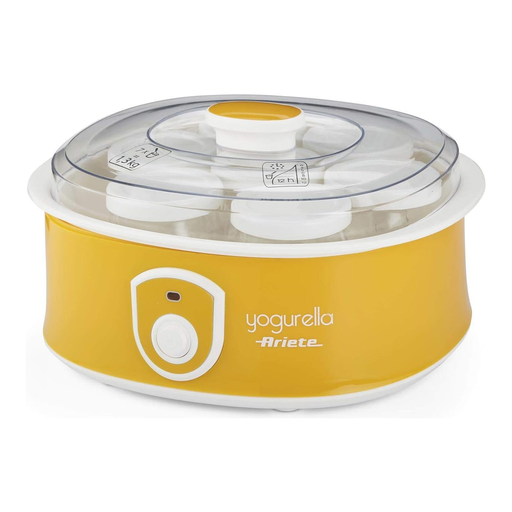 No image available
The description lists seven jars, which are suitable for dividing the yoghurt into individual portions.
The stated preparation time is three hours of fermentation. The product on offer is refurbished.
 No image available
The title describes the 1.5 l maker as suitable for 3–5 people, so it may not be the most practical choice for making one small portion.
Listed features include a container, a strainer and constant heating. According to the title, the strainer is designed for making Greek yoghurt.
It depends on the instructions for the specific model. The manufacturer’s instructions for the Clatronic JM 3344 explicitly describe making a smaller quantity; the number of jars supplied with other makers doesn’t confirm that you can do the same.
Use clean containers and kitchen utensils, and follow the cleaning instructions for your maker. The Verbraucherzentrale recommends keeping homemade yoghurt in the fridge afterwards and says dairy products should be stored on the middle shelf.
You’ll need milk and a suitable yoghurt culture or starter for every batch. Ongoing costs depend on the ingredients you use and how often you make yoghurt. When you buy from a business seller in the EU, you’re generally entitled to a minimum two-year legal guarantee from the date you receive the goods. Your Europe explains how this legal guarantee differs from a voluntary manufacturer’s warranty.
Electrical appliances covered by the relevant EU low-voltage rules must carry a CE mark. This is the manufacturer’s declaration of conformity, not an independent quality mark. Materials that come into contact with food must comply with the relevant EU rules. The CE requirement for electrical appliances doesn’t automatically apply in the same way to a non-electric maker.