Breakfast with limited worktop space
If worktop space is limited, compare the appliance’s dimensions with the cupboard space you have for containers, lids and accessories.


For breakfast in a small kitchen, your choice should mainly depend on whether you prefer individual jars or one larger container, and how much room you have on the worktop, in the fridge and in your cupboards. Extra programmes only matter if you actually plan to make the foods they’re designed for. For electrical appliances within the 50 to 1,000 V AC range, the relevant requirements, including CE marking, apply. According to Your Europe, this marking is not an independent safety inspection.
If worktop space is limited, compare the appliance’s dimensions with the cupboard space you have for containers, lids and accessories.
If you want to prepare several portions directly in sealable jars, remember to allow room in the fridge for the filled jars as well as checking how many the yoghurt maker holds.
If you’re planning to make more than plain yoghurt, check whether the specific model has programmes for those recipes and whether the extra space it takes up is worthwhile.
First, measure the available worktop and fridge space. Then compare the number and shape of the jars or containers with your breakfast plans, and only consider extra programmes for recipes you genuinely want to make.
| Consideration | What to check before buying | Who it matters most to |
|---|---|---|
| Worktop and cupboard space | Measure the appliance’s width and depth, and allow room for containers, lids and accessories. | If worktop space is limited, I also want to be able to store accessories and containers easily. Around 36% of consumers prioritise worktop space and storage. |
| Portion size and fridge space | Check the number and volume of the jars against the portions you need to make and the space available in your fridge. | If I want to prepare several breakfasts, the portions need to fit in the fridge and be easy to take out. Around 29% of consumers prioritise individual portions and fridge space. |
| Planning ahead | Check the timer and automatic shut-off, and allow time for both setting and chilling. | To have chilled yoghurt ready in the morning, I need to start the batch in good time and allow for chilling. Around 21% of consumers put planning the timing first. |
| Additional programmes | For each recipe you plan to make, check which programmes, containers and steps the specific model supports. | If I want to try recipes beyond plain yoghurt, the features designed for them matter more than having the simplest possible process. Around 14% of consumers put recipe variety first. |
Several portion jars also need space in the fridge, where they’ll have to be stored once the yoghurt has set.
As well as measuring the space for the appliance, allow room for the full set of containers and weigh up individual jars against one larger container.
Extra jars and accessories take up cupboard space in the kitchen and room in the fridge.
Once the yoghurt has set, it still needs to cool and be kept chilled.
Plan when you start the batch so there’s enough time for it to chill before breakfast.
A programme for a particular type of recipe doesn’t mean that every recipe or plant-based milk will work in the machine.
Check the instructions for the specific model against the recipe you want to make, rather than choosing based on the programme name alone.
The JG 40 and JG 80 differ in their containers and preparation options.
The JM 2 is designed for making yoghurt in individual jars. The manufacturer lists twelve 0.2 l jars, with a total capacity of 2.4 l.
According to Severin, the JG 3521 is aimed at buyers who want automatic programmes for making different types of yoghurt.
The following Joybuy products include models with individual jars and larger containers for homemade breakfast yoghurt.
 No image available
The larger containers suit making a batch that you can portion out for breakfast as needed.
Includes two glass containers, with capacities of 2,000 ml and 1,400 ml, plus a yoghurt strainer insert.
Before buying, check the CE marking on the version being offered; it is not an independent safety inspection.
 No image available
Nine small jars are a good option if you want to prepare individual breakfast portions.
The title lists a 1.6 l SUS304 inner pot, nine borosilicate glass jars, an OLED display, and adjustable temperature and time.
Before buying, check the CE marking on the version being offered; it is not an independent safety inspection.
 No image available
Eight jars could suit you if you want to prepare several individual portions at once.
The product title lists digital temperature control and a 48-hour timer.
Before buying, check the CE marking on the version being offered; it is not an independent safety inspection.
 No image available
The strainer insert is useful if you’d also like to make Greek yoghurt.
The product title lists a 1.5 l capacity, 20 W power and dimensions of 19.5 × 17.5 × 21.4 cm.
Before buying, check the CE marking on the version being offered; it is not an independent safety inspection.
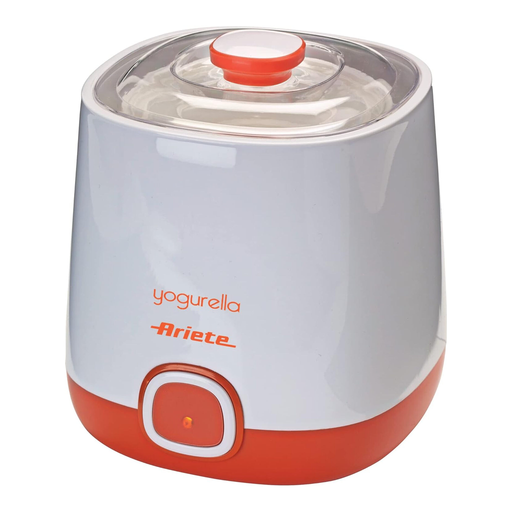 No image available
The included filter may be useful if you’d like to make Greek yoghurt as well as plain yoghurt.
The product description lists a 1 l capacity, 20 W power and dimensions of 16 × 16 × 18 cm.
Before buying, check the CE marking on the version being offered; it is not an independent safety inspection.
Allow time for cooling and refrigeration as well as the several-hour setting period. UGB Health Advice recommends around 6–12 hours at 40–45 °C for a traditional batch made with milk and yoghurt culture; the exact time depends on the recipe.
Use clean hands, containers and utensils, then put the finished yoghurt in the fridge. The Federal Centre for Nutrition notes that warmth and moisture can also encourage unwanted micro-organisms; this does not mean there is a set shelf life for every homemade batch.
No. The Federal Centre for Nutrition advises that raw milk must be boiled before consumption. Also follow the instructions for your appliance and recipe.
Electrical equipment within the scope of 50 to 1,000 V AC must meet the relevant product requirements, including CE marking. According to Your Europe, the manufacturer is responsible for compliance; CE marking is not independent EU approval. When checking a specific product listing, make sure the marking and electrical specification match.
No. Your statutory rights apply when goods are faulty, and are exercised against the seller. A guarantee is an optional extra promise, subject to its own terms. The Verbraucherzentrale recommends checking who the seller is and what guarantee terms apply, if any.