People who prepare small portions
If you want to make and chill yoghurt directly in individual sealable containers, jar size and the number of jars are important things to consider. Severin and Rommelsbacher offer models with portion jars.


If you want to store small portions directly in jars, compare the jar size and number of jars, as well as the space needed for the appliance and its accessories. A single container may be a better choice if storage space is limited and you prefer to portion the yoghurt when serving. A timer is most useful when it fits your routine. Whichever type you choose, chill your finished yoghurt; the Federal Office of Consumer Protection and Food Safety recommends keeping dairy products refrigerated at all times.
If you want to make and chill yoghurt directly in individual sealable containers, jar size and the number of jars are important things to consider. Severin and Rommelsbacher offer models with portion jars.
If cupboard space is tight, remember to allow room for the lids and containers as well as the appliance itself. The manufacturer lists the dimensions of the Severin JG 3518; for other models, measure the space available in your cupboard.
If you make yoghurt at set times, check whether a timer and automatic switch-off suit your routine. Rommelsbacher lists these features for the JG 40 and JG 60.
First, decide whether you prefer ready-portioned servings or one container that you can portion later. Then compare the space required, chilling needs and any useful timer functions.
| What matters | What to look for | Who will find this useful? |
|---|---|---|
| Small individual portions | Check the capacity of each jar, the number of jars and whether the lids suit your preferred portion size. | If I want to store yoghurt in individual containers, I check that the jar size and number of jars meet my needs. Around 34% of consumers prioritise small, ready-portioned jars. |
| Cupboard and worktop space | Check the appliance’s external dimensions and make room to store all the jars, lids and accessories together. | If my cupboard space is limited, I want to know whether the whole set will fit, not just the appliance. Around 33% of consumers prioritise available storage space. |
| Chilling and cleaning | Allow for space in the fridge, check the cleaning instructions and consider the number of containers and lids. The Federal Office of Consumer Protection and Food Safety recommends keeping milk and dairy products refrigerated at all times. | If I have limited fridge space or want to keep cleaning simple, I take the finished batch and all its containers into account. Around 20% of consumers pay particular attention to chilling and cleaning requirements. |
| A predictable routine | Check the timer duration and automatic switch-off for the specific model, then plan for chilling. Rommelsbacher lists a timer of up to 18 hours with automatic switch-off for the JG 40. | If I want to prepare a batch at set times, I check that the timer suits my daily routine. Around 13% of consumers prioritise planning their timing. |
Jars and lids need extra cupboard space, and the finished batch also needs room in the fridge. According to the manufacturer, the Steba JM 2 comes with twelve jars.
Before choosing a model, measure the space needed for the full set and the finished portions.
Lots of individual jars and lids can take up extra space in your cupboards and fridge.
The stated container size does not automatically tell you what smaller batch size is suitable for a particular model. For the Rommelsbacher JG 40, the manufacturer recommends filling unused spaces with jars of water.
Check the instructions for your specific model to find out how to make a small batch.
The power rating alone does not tell you the actual running time or the energy used for a batch.
Compare energy use only using consumption data for similar preparation cycles.
The JG 3518 is a yoghurt maker with small portion jars.
The JG 40 combines portion jars with a timer, while the JG 60 comes with several container sizes.
The JM 2 is designed for people who want to prepare a batch in several jars.
The PE1784 is a yoghurt maker with a removable single container.
The manufacturer describes a non-electric yoghurt maker with a single container and thermal insulation.
The models below cover both types: portion jars for servings you can take out individually, and single containers where you portion the yoghurt later.
 Image unavailable
The nine jars are a good fit if you want to take out portions individually.
The product title lists a 1.6 l SUS304 inner pot, as well as temperature control, a timer and an OLED display.
 Image unavailable
Eight individual jars are a good choice if you want to store several portions separately.
The product title lists a total capacity of 1,440 ml, digital temperature control and a timer of up to 48 hours.
 Image unavailable
A single container is a good fit if you want to decide on portion sizes when serving.
The product title lists a 1.5 l capacity, 20 W, a strainer and lid, and appliance dimensions of 19.5 × 17.5 × 21.4 cm.
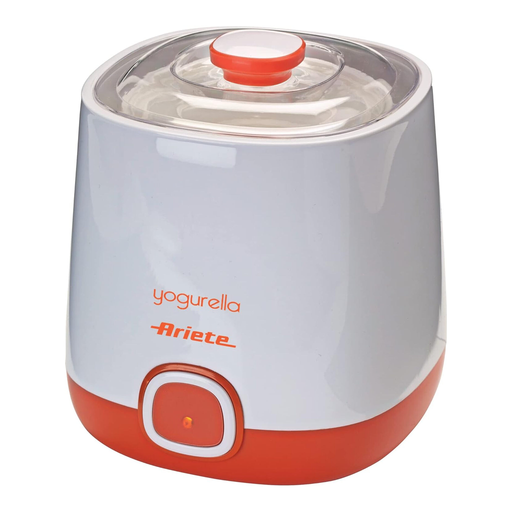 Image unavailable
A model with a single container is a good choice if you prefer to portion the yoghurt when serving.
The product title lists a 1-litre capacity and 20 W.
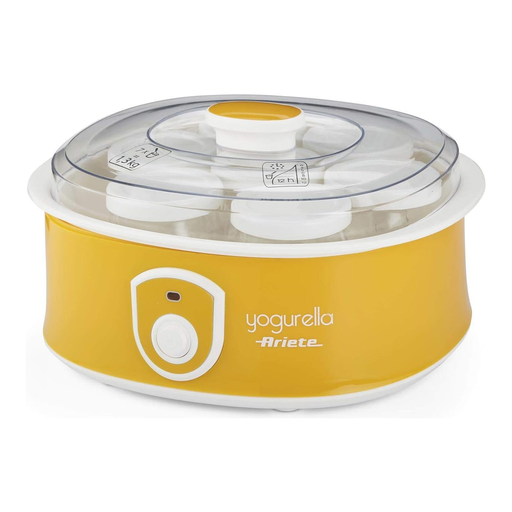 Image unavailable
The listed seven jars with lids are suitable if you want to store portions separately.
The product title lists 1.3 l and 20 W; the product is marked as refurbished (A).
Compare the capacity of each jar with your preferred portion size, not just the total capacity. For the JG 40, the manufacturer recommends filling every space with a jar and adding water to any unused jars.
Make room in the fridge for the yoghurt once it is ready. The Federal Office of Consumer Protection and Food Safety recommends keeping milk and dairy products refrigerated at all times; this does not establish a specific shelf life for homemade yoghurt.
The Federal Office of Consumer Protection and Food Safety advises boiling “milk from the farm” thoroughly before drinking it. It generally advises young children, older people, people with weakened immune systems and pregnant women not to consume raw milk products; a yoghurt maker does not replace these precautions.
Check the marking for the specific model if the appliance is covered by EU rules that require CE marking. According to the European Union, CE marking is a declaration made by the manufacturer, not a quality mark issued by a central EU body. This requirement cannot be applied universally to a non-electric container.
For a faulty product, your statutory consumer rights apply against the seller; a guarantee is separate and voluntary. Check replacement jars against the exact model name: Severin lists the EG 3513 and EG 3514 as suitable replacement jars for the JG 3518.