For people who eat at different times
If you want to take out small portions separately, individual jars are an obvious choice. Rommelsbacher and Steba list different jar sizes and quantities for their models.


For meals eaten at different times, individually sealed jars are a good choice if you want each portion ready to go separately. A large storage container is better if you’d rather serve yourself at mealtimes. The key considerations are the capacity of each container and how many you need. Timers and programmes are extra features: they don’t replace portioning or chilling the yoghurt afterwards, as the consumer advice centre also points out.
If you want to take out small portions separately, individual jars are an obvious choice. Rommelsbacher and Steba list different jar sizes and quantities for their models.
If you prepare yoghurt in advance, you’ll need to consider how many sealed jars will fit in your fridge. The Federal Centre for Nutrition recommends storing dairy products such as yoghurt on the middle shelves of the fridge.
If you want to try making more than just natural yoghurt, compare the programmes available on each model. Rommelsbacher and Severin list different programme options for specific appliances.
A good choice if: You want to split a batch across several meals and take out just one jar at a time.
Bear in mind: More individual jars take up fridge space and mean extra lids to wash.
A good choice if: You’d rather make one larger batch and portion it out when you eat. The Rommelsbacher JG 80 comes with two 1.2-litre glass containers as well as small jars.
Bear in mind: For separate meals, you’ll need to portion the yoghurt out yourself and then chill it.
| Buying consideration | What to look for | Who should consider it? |
|---|---|---|
| Portion size | Rommelsbacher lists 125 ml per jar for the JG 80, while Steba lists 200 ml per jar for the JM 2. Compare the capacity with your usual portion size. | If I want to use a whole jar for each meal, its size needs to suit my portion. Around 36% of consumers put choosing the right size for each individual jar first. |
| Batch size and fridge space | Check the number of jars and the space they’ll take up in your fridge. The Federal Centre for Nutrition recommends keeping yoghurt on the middle shelves. | If you want to prepare several meals in advance, you’ll need room for the finished, individually sealed jars. For around 29% of consumers, chilled storage of their batch is a priority. |
| Timer and automatic shut-off | Steba lists a timer with automatic shut-off for the JM 2; Rommelsbacher lists a timer with shut-off for the JG 40. Remember to allow time to move the yoghurt into the fridge, too. | If I want the preparation to fit into my daily routine, I look for a suitable timer. Around 21% of consumers prioritise being able to plan the process. |
| Programmes and recipes | Compare the programmes on the exact model with the recipes you plan to make: Rommelsbacher lists programmes for the JG 80, while Severin lists five automatic programmes for the JG 3521. | If you want to try making different recipes, check the programmes against your plans before buying. Around 14% of consumers put recipe variety first. |
The Rommelsbacher JG 80 includes two 1.2-litre containers and four 125 ml jars, designed for different uses. So the total capacity doesn’t tell you how many small portions are already separated into individual jars.
Compare what’s included with the capacity of each container separately.
You may need extra jars that are suitable for portioning. More individual jars also mean more washing up.
An automatic shut-off ends the set programme, but it doesn’t store the finished yoghurt in the fridge.
Remember to make moving the jars to the fridge a separate step.
Severin lists 14 jars of 150 ml each for the JG 3520, but five automatic programmes for the JG 3521.
Before buying, check the full model number and what’s included for the same version.
The range includes appliances with different types of container and features.
The JM 2 is for buyers who want several separate jars and a timer.
The details about portion jars and automatic programmes relate to different models.
According to the manufacturer, the CR 4519 has individual jars and maintains a stated constant temperature.
The appliances below include yoghurt makers with individual portion jars, as well as models with larger containers for making a single batch.
 No image available
The nine individual jars are designed for separate portions.
The product description lists nine 100 ml jars, a SUS304 inner pot, temperature control, a timer and an OLED display.
 No image available
The individual jars let you divide a batch into separate containers.
The product description lists eight jars with a total capacity of 1,440 ml, digital temperature control and a 48-hour timer.
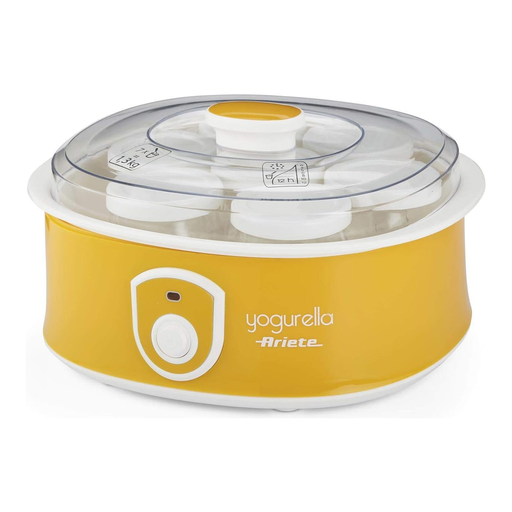 No image available
Seven individual portion jars are ideal for keeping portions separate and ready to serve.
The product description lists 1.3 l, 20 W and energy class A+; the item is described as refurbished A.
 No image available
The two large containers are better suited to making a single batch; you’ll need to portion out individual meals separately.
The product description lists containers with capacities of 2,000 ml and 1,400 ml.
 No image available
A single large container is a good option if you’re making a bigger batch and portioning it out yourself.
The product description lists a capacity of 1.5 l and 20 W, along with a sieve and lid.
Once the yoghurt is ready, put it in the fridge. The consumer advice centre explains that yoghurt should be chilled after preparation, and the Federal Centre for Nutrition recommends storing it on the middle shelves of the fridge. An automatic shut-off isn’t a cooling function.
No. The consumer advice centre provides instructions for making yoghurt in screw-top jars without an electric appliance. Follow your chosen instructions for preparing the milk, leaving it to stand and chilling it afterwards, rather than mixing timings from different recipes.
In Germany, your statutory rights for faulty goods are against the seller; a guarantee is separate and offered voluntarily. The consumer advice centre explains that, if there’s a fault, the first step may be to ask for it to be put right through a repair or replacement (as at 28 September 2026).
Waste electrical equipment must be handed in at an authorised collection point or to an organisation authorised to collect it. The Federal Ministry for the Environment lists municipal collection points, manufacturers and retailers among the options.
No. The European Union explains that the CE marking is the manufacturer’s declaration that the product meets the relevant requirements. It doesn’t assess the yoghurt itself, and it isn’t a certificate issued centrally by the EU.