Smoothie portioners
You want to prepare yoghurt in separately sealed jars for individual smoothies and store them in a shared fridge.


For smoothies in a shared kitchen, individual jars make sense if you want to seal portions separately and label them in the fridge; a large container is a better fit if you regularly make bigger batches. The key questions are whether the finished quantity will fit in the shared fridge and how many jars and lids you’re happy to wash. Programmes and timers are most useful if you plan to make different batches or want the machine to switch off automatically.
You want to prepare yoghurt in separately sealed jars for individual smoothies and store them in a shared fridge.
You regularly use larger quantities of yoghurt and are weighing up a large container against smaller portions.
You share worktop and storage space, so you’re weighing up the appliance’s dimensions, the number of containers and the washing-up involved.
A good fit if: You want to seal smoothie portions separately and store them in the fridge.
The trade-off: More jars mean more individual parts to wash and put away.
A good fit if: You want to make several smoothies from one batch.
The trade-off: The filled container needs space in the fridge, and you’ll need to handle it hygienically every time you serve some.
A good fit if: You only need yoghurt for smoothies occasionally and have limited worktop space or access to a socket.
The trade-off: The batch takes time and needs a suitable, undisturbed place to set, as well as space in the fridge afterwards.
The breakdown below groups shoppers by their main priority when choosing a yoghurt maker for smoothies in a shared kitchen.
| Priority | What to check when buying | Who it matters most to |
|---|---|---|
| Individually sealable portions | Check the number, capacity and seals of the jars. Rommelsbacher lists eight 150 ml jars for the JG 40; the Severin JG 3520 comes with 14 150 ml jars. | When I prepare individual smoothies, I want to seal the jars separately and keep track of them in the shared fridge. Around 36% of shoppers prioritise keeping portions separate. |
| Space and cleaning | Check the appliance’s dimensions, the number of individual parts and the cleaning instructions for the base, jars and lids separately. Severin gives the JG 3520’s dimensions as 12.8 × 24 × 24 cm (H × W × D). | When we share worktop, storage and sink space, I want to know how much room the appliance and containers will take up. Around 28% of shoppers pay particular attention to space requirements and cleaning. |
| Batch size | Check the supplied container and its capacity against the space in your fridge. The Steba JM 4 FERMENT is available with a 2-l yoghurt jar; the Rommelsbacher JG 80 comes with two 1.2-l glass containers and four 125 ml ceramic pots. | If I want to make several smoothies from one batch, having enough yoghurt for a few days matters more to me than having lots of individual jars. Around 22% of shoppers prioritise batch size. |
| Programmes and controls | Check whether you can adjust only the running time or the temperature as well, and whether the recipe you want to make is suitable for the appliance. The JG 80 has fixed programme temperatures; the Steba JM 4 FERMENT offers a DIY programme for setting the temperature and time. | If I want to try different batches, I want to know which settings I can actually change. Around 14% of shoppers particularly value flexible batches and controls. |
With individual-portion machines, several separate containers need space in the shared fridge after preparation. Lids and parts waiting to be washed also take up room.
Measure your worktop and fridge space, and take the number of supplied jars into account.
For the JG 40, Rommelsbacher recommends filling any unused jars with water and placing them in the machine to improve temperature distribution.
If you often make smaller quantities, check the instructions for the specific model before you buy.
Clean preparation and refrigeration affect how long yoghurt keeps; you can’t assume a single shelf life for every homemade batch.
Keep the finished yoghurt chilled, use clean utensils to serve it and discard it if you see mould or other clear signs of spoilage.
Poor storage can cause yoghurt to spoil and lead to food waste.
The JG 40 and JG 80 ranges offer different container formats for individual portions and larger batches.
The JG 3520 is designed to make a larger number of individual portions.
The JM 2 uses individual jars, while the JM 4 FERMENT has a large container and additional programmes.
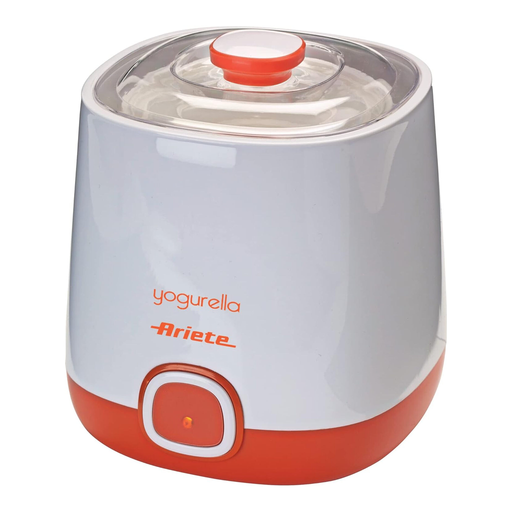
The Yogurella 0617/00 is an individual-jar option that comes with seven jars.
The selection includes yoghurt makers with individual jars and appliances for larger batches, for preparing smoothie yoghurt in a shared kitchen. Check the specific listing for a CE mark, identifiable manufacturer details and German-language instructions; the German Federal Network Agency lists these as points to check. The German Federal Institute for Risk Assessment also explains that materials intended to come into contact with food must be suitable for their intended use.
 No image available
Suitable for larger batches if one of the glass containers fits in your fridge.
The product name lists two XXL glass containers, with capacities of 2,000 ml and 1,400 ml, plus a sieve.
 No image available
Could suit separate smoothie portions if you have room to chill and wash several jars.
The product name lists a 1.6-l SUS304 inner pot, nine borosilicate glass jars, temperature control, a timer and an OLED display.
 No image available
The eight jars are worth considering if you’d rather store individual portions than use one large container.
The product name lists eight jars with a total capacity of 1,440 ml, digital temperature control and a timer of up to 48 hours.
 No image available
An option for making a larger batch, provided the finished container fits in your fridge.
The product name lists a 1.5-l capacity, 20 W, a sieve and a lid. Stated dimensions: 19.5 × 17.5 × 21.4 cm.
 No image available
The one-litre size could suit a batch for several smoothies, if there’s room for the container in your fridge.
The product name lists a 1-l capacity and 20 W.
No. According to the consumer advice centre, you can also make yoghurt in screw-top jars without a specialist appliance. You’ll need time and a suitable place for the mixture to set; afterwards, the jars should go in the fridge. If you’re using an appliance, follow the instructions for that particular model.
Wash your hands, worktops and used utensils thoroughly. According to the instructions, the jars and lids for the Severin JG 3520 can be washed in washing-up water or in the dishwasher; the electrical base must not be immersed in liquid. Keep finished yoghurt covered in the fridge and use clean cutlery to serve it.
Rommelsbacher says this is theoretically possible, but recommends filling any unused jars with water and placing them in the machine to improve temperature distribution.
The German Federal Network Agency lists correct CE marking, identifiable manufacturer details and German-language instructions as points to check. Check these details on the specific listing. For containers and other parts that come into contact with food, the German Federal Institute for Risk Assessment explains that they must be suitable for their intended use.