Households with staggered mealtimes
If you want to make a batch of plain yoghurt and take out individual portions later, separate jars with lids are a practical option.


For staggered mealtimes, sealable individual jars are practical because you can chill separate portions after making them and take them out later. A timer can make it easier to plan when the machine finishes, but it doesn’t replace chilling afterwards or offer a delayed start. A large container is a better fit if you want to make a batch or use yoghurt as an ingredient, and don’t mind portioning it later. Before buying, also check the CE marking on the specific appliance being offered.
If you want to make a batch of plain yoghurt and take out individual portions later, separate jars with lids are a practical option.
If you want to plan the fermentation process for the evening, check whether the machine simply switches off at the end or also has a delayed-start function. Once it’s ready, the yoghurt still needs to be chilled.
If you want to take different amounts of yoghurt for meals or recipes, compare small pots with large containers. With a large container, you’ll need to portion it later.
A good fit if: you’re making several separate portions and want to plan when fermentation finishes.
The trade-off: several individual jars take up space and need washing; the automatic switch-off doesn’t chill the yoghurt.
A good fit if: you want to make a batch or use yoghurt as an ingredient, and are happy to decide on portion sizes later.
The trade-off: with a large container alone, you’ll need to serve or transfer the portions later.
A good fit if: separate portions matter more than automatic switch-off, and you can keep track of when fermentation is finished yourself.
The trade-off: simple on/off controls are no substitute for a timer.
A good fit if: you want to see whether homemade plain yoghurt works for your routine.
The trade-off: making it requires your own preparation and planning; once ready, the jars need to go in the fridge.
| Priority | What to check before buying | Who is it important to? |
|---|---|---|
| Individual portions that suit your needs | Compare the number of jars, capacity per jar, lids and fridge space with your usual portion sizes. | If I need separate jars for different mealtimes, I want to be able to chill individual portions with the lids on. This is the top priority for around 36% of consumers. |
| Being able to plan when fermentation finishes | Check the difference between a timer with automatic switch-off and a separate delayed-start function; remember to plan for chilling afterwards. | If I prepare the mixture in the evening, I want to know when the machine will finish. Timing is the most important buying priority for around 29% of consumers. |
| A batch that can be chilled | Check whether the sealed jars or large container will fit in your fridge. Don’t assume shelf-life information for shop-bought products also applies to homemade yoghurt. | If I want to use yoghurt later as a batch or an ingredient, I look at how the finished batch can be stored. A batch that can be chilled is a priority for around 21% of consumers. |
| Ease of use | Compare how many containers need filling and washing, as well as the documented controls and features. | If I make yoghurt regularly, I want to keep the work involved in handling the containers and operating the machine manageable. Ease of use is the top priority for around 14% of consumers. |
Automatic switch-off ends the machine’s cycle. It doesn’t chill the finished yoghurt automatically.
Remember to put the finished, sealed portions in the fridge afterwards.
You’ll need extra room in the fridge and an additional step once fermentation is complete.
A machine with large containers won’t automatically give you lots of small, separately sealed portions. Even machines that come with both types of container may include only a limited number of small pots.
Compare the number of small pots included with the number of meals you’re planning.
The rated power alone doesn’t tell you how much energy the machine uses over a complete fermentation cycle.
To compare costs, you need verified energy use per cycle, the cycle duration and your electricity tariff. Don’t calculate costs directly from the wattage.
The JG 40 and JG 80 models differ in their containers and features.
The JM 2 is listed with several individual jars and automatic switch-off; the JM 3 is a documented variant with adjustable temperature.
The JG 3518 is designed for separate portions in individual jars with lids.
The AD 4476 is listed with individual screw-top jars and simple on/off controls.
The Yogurella 0621/10 is designed for making yoghurt in larger containers.
The appliances below cover options with individual jars and larger containers. Check the CE marking on each specific electric appliance being offered. The EU explains that this marking represents the manufacturer’s declaration of conformity.
 No image available
The version with jars may suit you if you want several separate portions, provided you check that the listed features meet your needs before buying.
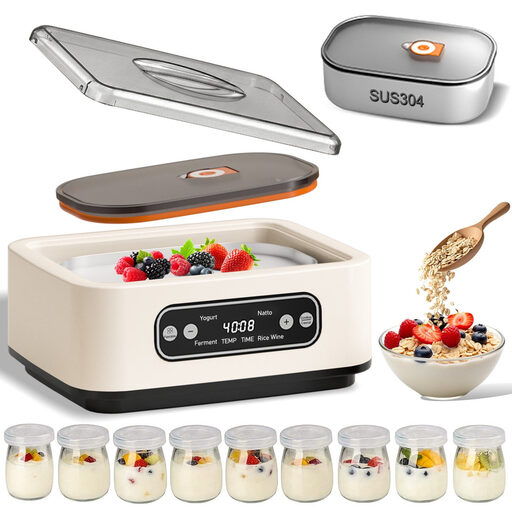
The product name lists nine borosilicate glass jars, temperature control, a timer and an OLED display.
 No image available
If you want separate portions and the ability to plan timings, compare this model’s features with the number of jars you need and how you plan to use it.
The product name lists temperature control and nine borosilicate glass jars.
 No image available
The listed larger capacity may suit you if you want to make a batch and portion it yourself later.
The product name lists a 1.5 l capacity, 20 W, a sieve and a lid. Check that the container and the way the machine works suit your needs.
 No image available
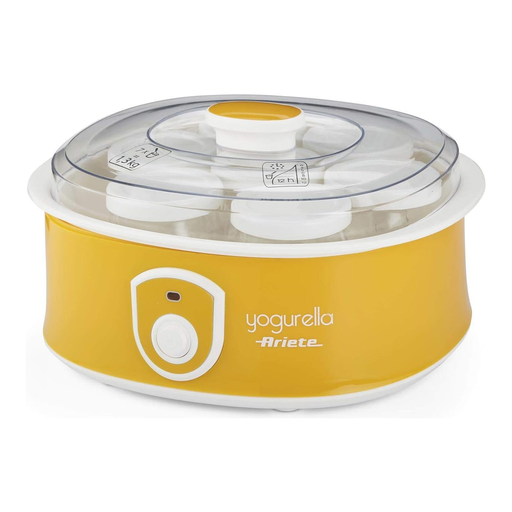
This version is labelled as refurbished. If you’re planning individual portions for different mealtimes, check which containers are included in the specific offer before buying.
The product name lists a capacity of 1.3 l and a power rating of 20 W. The ‘Refurbished A’ label applies to this version.
 No image available
If you want to make a larger batch of yoghurt, a model with large containers may suit you. You’ll need to portion it later for individual mealtimes.
The product name lists two XXL glass containers, with capacities of 2,000 ml and 1,400 ml.
No. Automatic switch-off ends the machine’s cycle; it doesn’t cool the yoghurt or start the machine automatically at a later time. The German consumer advice centre says that finished jars should then be stored in the fridge.
Keep the finished, sealed portions in the fridge until they’re ready to eat. The German consumer advice centre recommends storing yoghurt on the middle shelf of the fridge at 5 to 7 °C. Shelf-life information for unopened shop-bought products isn’t a guarantee of how long homemade yoghurt will keep.
For electrical appliances covered by the Low Voltage Directive, including those with a rated voltage of 50 to 1,000 V AC, CE marking is an EU requirement. Your Europe explains that the manufacturer uses it to declare conformity with the relevant EU product rules; it isn’t an independent quality mark. Check the marking on the specific appliance being offered.
In Germany, electrical waste is collected separately and is generally accepted free of charge at local collection points. It must not go in your general household waste.