Lunchbox portion planners
If you want to prepare several days’ worth at once, look for individually sealable portions and remember to plan how you’ll keep them chilled until you eat them.


If you want to prepare yoghurt for several working days at once, start by comparing the number and size of the jars supplied, along with their lids. A large container is a better fit if you’d prefer to portion yoghurt from a batch as needed; extra programmes are most useful if you want to try different recipes. Once made, yoghurt still needs to be kept properly chilled in storage and while you’re taking it with you.
If you want to prepare several days’ worth at once, look for individually sealable portions and remember to plan how you’ll keep them chilled until you eat them.
If you’re comparing larger batches with the number of portions you need, remember to factor in the space available in your fridge.
If you want to try options beyond natural yoghurt, check that the programmes or settings available on the model match the recipes you have in mind.
When preparing breakfast and lunchbox portions, the key things to consider are the format that suits you, chilling requirements and the features your recipes call for.
A good fit if: You want to make several portions directly in individual jars and take them with you.
Consider: More jars take up extra space when you’re washing and chilling them; a lid won’t keep the contents cold.
A good fit if: You want to take different-sized portions from one batch.
Consider: You may need additional suitable containers for lunchbox portions.
A good fit if: You want to see whether making yoghurt regularly fits into your routine before buying a machine.
Consider: You’ll need to manage the temperature and timing yourself, following your recipe. The finished yoghurt will still need to be chilled.
| What you need | What to check before buying | Who is this important for? |
|---|---|---|
| Taking it with you and storage | The number and capacity of the jars, what the product says about the lids, and how you can keep the finished yoghurt chilled until you eat it. | If I want to prepare yoghurt directly in individual jars and take it with me, sealable portions and chilling go hand in hand. Around 36 % of consumers would make portability their top buying priority. |
| Batch-making for several days | Check which containers are actually included and their sizes, not just the total capacity. You’ll also need to allow for fridge space. | If you want one batch to last several working days, compare the batch size with the number of jars you can portion directly into. Around 29 % of consumers would put planning their batch first. |
| Recipes and settings | Check the programme temperatures or adjustable temperature range of the exact model against the recipe you want to make. | If I want to try different types of recipes, the available settings should suit them. Around 21 % of consumers would put recipe options at the top of their buying priorities. |
| Ease of use and cleaning | Check how the machine is operated and its cleaning instructions. If needed, also check whether compatible replacement jars are available. | If you make yoghurt regularly and want to keep the everyday effort to a minimum, look for simple controls and an easy-to-plan cleaning routine. Around 14 % of consumers would prioritise a simple routine. |
A lid can keep the contents in the jar, but it won’t keep them cold. The German Federal Institute for Risk Assessment notes that insufficient temperatures during transport and storage can allow harmful germs to survive and multiply.
Whatever the lid, plan how you’ll keep the finished yoghurt properly chilled until you eat it.
A storage container isn’t the same as a set of small jars you can take with you. For the Rommelsbacher JG 80, the manufacturer lists two large glass containers and four small pots.
Count the containers supplied in the size you’ll actually want to use for your working days.
If you want individual portions to take from a large storage container, you may need additional suitable containers.
Machine features alone don’t prove that every recipe or milk alternative will work. The starting ingredients, cultures and recipe all play a part too.
Check the instructions for the specific machine and the variation you want to make. If you’re only making natural yoghurt, extra programmes may not be a deciding factor.
The JG 3518 and JG 3521 models differ mainly in the number and type of containers supplied and their automatic programmes.
The JM 3 is designed for individual jars, with adjustable time and temperature.
The JG 40 has small portion jars and a timer, while the JG 80 combines small pots with larger storage containers.
The Yogurella 0621 is a container-and-strainer option for Greek-style yoghurt.
This selection includes yoghurt makers with individual portion jars and models for making larger batches. Decide whether you want to make yoghurt directly in individual containers or transfer it from a larger batch later.
 No image available
The nine small jars are a good option if you want to prepare several individual portions.
Features listed include nine 100 ml borosilicate glass jars, a 1.6 l inner pot, an adjustable temperature of 21–48 °C, a timer from 1–99 hours and an OLED display.
 No image available
Eight individual jars can be useful if you want to prepare several portions in one batch.
Specifications list eight jars with a total capacity of 1,440 ml, adjustable temperatures from 20–55 °C and a timer of up to 48 hours.
 No image available
The listed capacity is suited to making a larger batch, which you can then portion into suitable containers.
The product details list a 1.5 l capacity and a strainer for draining Greek-style yoghurt.
 No image available
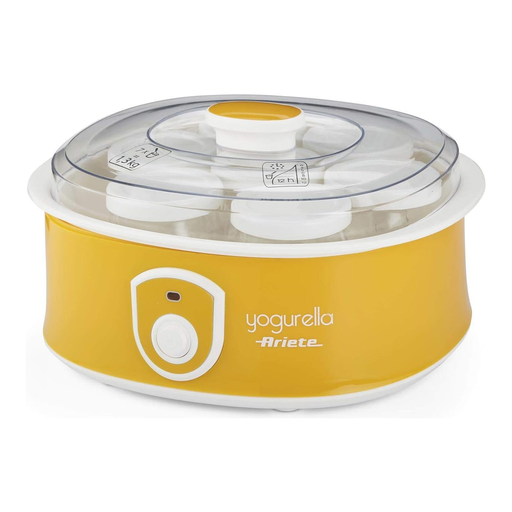
The description lists seven portion jars with lids, so you can plan to prepare yoghurt in individual containers.
Listed as refurbished. Specifications include a 1.3 l batch capacity and 20 W.
 No image available
The large containers are suited to making batches for storage; you’ll need to transfer the yoghurt into individual portions for lunchboxes.
Features listed include two glass containers with capacities of 2,000 ml and 1,400 ml, eight programmes and a strainer for Greek-style yoghurt.
A lid won’t keep it cold. Finished yoghurt should be stored in the fridge, and it’s important to keep it properly chilled while you’re transporting it too. Plan for the journey time and the chilling options available.
It depends on the number and size of the containers supplied, as well as your portion size. Severin lists seven 150 ml jars for the JG 3518, while Steba lists eight 180 ml jars for the JM 3. The Rommelsbacher JG 80 comes with four small 125 ml pots and two large containers; the larger containers are a different way to store a batch.
Use suitable ingredients and cultures, work with clean hands and containers, and follow the recipe and cleaning instructions for your specific machine. If you’re using raw milk, it’s important to heat it before processing; the German Federal Centre for Nutrition advises that raw milk must be boiled before drinking.
Not necessarily. Programmes and temperature settings vary between models, and they don’t guarantee that any recipe will work. Compare the specific settings with the instructions for the type of yoghurt you want to make, and take the ingredients and cultures into account too.
Individual jars let you make and store separate portions; with a large container, you’ll need to transfer lunchbox portions later. The key factors are which containers are supplied, your portion sizes and the space available for chilling them.