
Lieferung heute & morgen

Qualitätsgarantie

Willkommens-Angebote freischalten: KOSTENLOSE Lieferung | Bis zu 80 % RABATT | Kostenlose 30-Tage-JoyPlus-Testphase
App herunterladen
An electric food slicer promises perfectly uniform slices of bread, cold cuts, or cheese—right in your own kitchen. But the market is crowded, and not every appliance delivers on its promises. Many buyers are frustrated by flimsy construction, weak motors, or cumbersome cleaning. As your Joybuy Product Recommendation Officer, I'll help you navigate the common pitfalls and find a model that truly meets your needs.
Before you make a decision, you should be aware of the most common flaws that often only become apparent during daily use after the purchase.
To avoid these problems, you should focus on three core technical features. These define the durability, safety, and functionality of a good meat slicer.
A metal food slicer is more than just a matter of aesthetics. A full-metal construction, or at least a solid metal housing, provides the necessary stability. The appliance remains secure even under load, vibrations are minimised, and the slicing action stays precise. Models with a solid base plate and non-slip feet offer additional safety. Look for high-quality workmanship without sharp edges or large gaps.
A powerful motor is essential for an electric slicer. Instead of just looking at the wattage, the motor type is what's relevant. DC motors are considered particularly high-torque, durable, and often quieter in operation than conventional AC motors. They maintain a constant speed even under load, which ensures a clean cut without tearing.
The blade determines what you can slice and how well. There are two main types:
Another must-have is a continuously adjustable slice thickness. A good machine allows for precise adjustment from paper-thin (approx. 1 mm) to thicker slices (approx. 15–20 mm) to find the perfect thickness for any food.
Based on these quality criteria, we have identified models that offer a suitable solution for different user profiles.
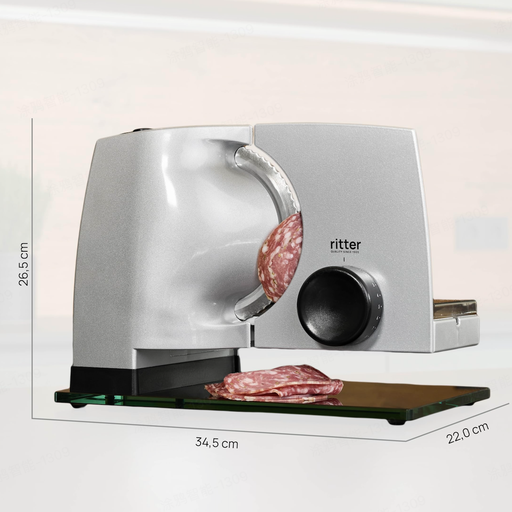
Why This Fits Their Persona: This model combines German engineering quality with an elegant, space-saving design. The cantilever construction with a shatterproof glass base plate is not only an eye-catcher but also makes it easy to slice directly onto a plate.
The metal construction ensures stability, while the detachable carriage significantly simplifies cleaning, thus avoiding the hidden cleaning effort trap.
A combination of high-quality materials (metal, glass) and a well-thought-out, easy-to-clean design. Made in Germany.
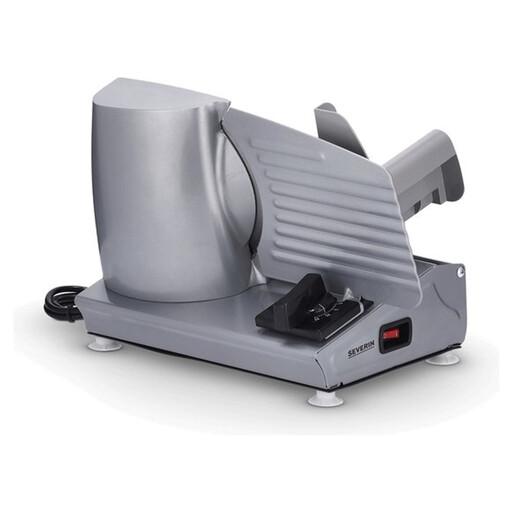
Why This Fits Their Persona: For families who slice bread, cold cuts, and cheese daily, versatility is key. This Severin food slicer comes with two blades, covering all use cases. Its robust build is designed for durability.
The stable metal housing and 180-watt motor provide the necessary power and stability to avoid giving way, even with hard bread crusts. The traps of a weak motor and flimsy construction are effectively avoided here.
Two included stainless steel blades (serrated and a smooth ham blade) for maximum flexibility. The carriage can be tilted for easy cleaning.
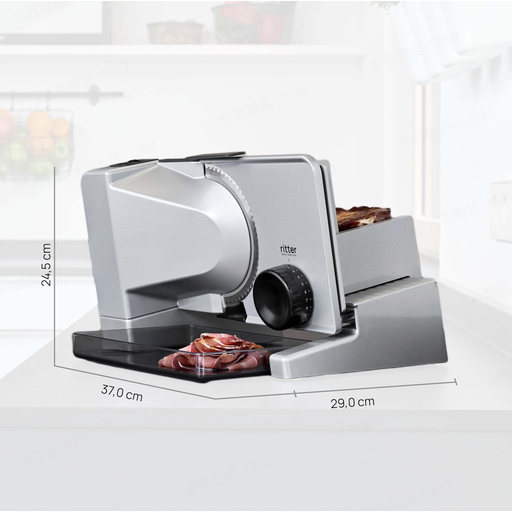
Why This Fits Their Persona: Anyone who values maximum precision and control needs a machine with professional-grade features. This model offers a full-metal construction, a powerful DC motor, and electronic speed control for perfect results with any type of food.
The solid full-metal construction and high-torque DC motor completely eliminate the problems of instability and underperformance. This appliance is designed for heavy use and precision work.
Electronic speed control to adapt to the food being sliced and a quiet, powerful DC motor. Includes both a serrated and a smooth ham blade.
We have compiled a complete, real-time list of products that fully satisfy these strict selection criteria and UK safety regulations.
Proper cleaning is essential for the hygiene and longevity of the appliance. Always unplug the machine before any cleaning. Ideally, the carriage, food holder, and blade cover plate should be easy to remove. You can usually clean these parts with warm water and mild dish soap. Wipe the housing and the area behind the blade with a damp cloth. The blade itself should be cleaned carefully from the centre outwards.
A serrated blade is standard equipment and ideal for anything with a hard crust and a soft interior, especially bread. The toothed blade cuts cleanly through the crust without crushing the inside. A smooth blade (ham blade) is the choice for precise, paper-thin slices. It glides cleanly through soft foods like ham, roasts, or cheese, creating a smooth cut surface without grooves.
A plastic model might suffice for occasional use. However, for anyone who values durability, precision, and safety, a metal food slicer is a worthwhile investment. The greater stability leads to more uniform slicing results, the robust mechanism wears out more slowly, and the heavier weight prevents the appliance from slipping during operation. For regular use, a model with a metal construction is therefore highly recommended.