
Lieferung heute & morgen

Qualitätsgarantie

Willkommens-Angebote freischalten: KOSTENLOSE Lieferung | Bis zu 80 % RABATT | Kostenlose 30-Tage-JoyPlus-Testphase
App herunterladen
A Zwilling kitchen knife can be suited to very different tasks depending on its design, blade length and care requirements. However, focusing only on the brand name, striking colours or the highest possible hardness rating does not automatically mean you will buy the right model. For home cooks, families and professional kitchens, the key consideration is whether the knife matches the intended use.
A small Zwilling paring knife is practical for apples, potatoes and garnishing. However, it cannot replace a chef’s knife when you need to prepare larger quantities of vegetables. Conversely, a 20 cm chef’s knife is often unnecessarily unwieldy for delicate work on small fruits.
Practical rule: Choose the blade based on the cutting task you perform most often, not the longest blade available.
Stainless steel reduces the risk of corrosion, but it does not make a knife immune to moisture, salt or incorrect cleaning. Residue and leaving the knife in washing-up water for extended periods can affect the surface and cutting edge.
Many models are described as dishwasher-safe. However, washing by hand with warm water and mild detergent is often the gentler option for preserving cutting performance. The blade should be dried completely after washing.
An ergonomic knife handle can improve control. However, handle circumference, the transition between blade and handle, weight and your individual hand size are also important. A non-slip plastic handle can be useful for wet hands, while a traditional three-rivet handle offers a different feel.
A smooth edge is suitable for controlled cuts and can be sharpened with suitable tools. A serrated blade grips hard skins and softer interiors more effectively, for example when cutting bread, tomatoes, sausage or certain types of cheese. You can find more models in the Zwilling serrated knife category.
Several Zwilling ranges use a special steel formulation. FRIODUR ice-hardened blade refers to a process described by Zwilling for treating the blade. Product specifications mention properties including edge retention, flexibility and corrosion resistance. These details should be understood as technical features, not a guarantee of a specific service life.
Look out for specific product details such as:
A secure handle should allow controlled work even with normal kitchen moisture. A bolster or shaped transition can provide finger protection. When choosing a Zwilling knife set, it is worth comparing the handles and blades of the individual knives: a set can be cost-effective if you genuinely use several types of knife regularly. For occasional use, a single suitable knife is often sufficient.

Why this product suits this profile: The 10 cm blade is designed for everyday tasks involving fruit and vegetables. The textured plastic handle supports easy handling without the need to buy an extensive knife set.
The compact blade is clearly designed for peeling, trimming and garnishing. This means you do not end up buying an oversized all-purpose knife for small tasks.
FRIODUR ice-hardened blade, pointed shape and non-slip plastic handle. Hand washing is recommended for care.
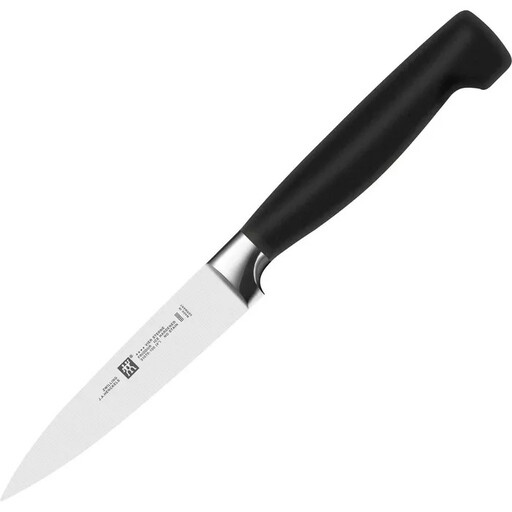
Why this product suits this profile: This Zwilling paring and garnishing knife combines a 10 cm blade with a SIGMAFORGE construction that, according to the product description, is forged from a single piece.
The construction, material and blade-length specifications can be checked in detail. This makes choosing easier than relying solely on promotional claims about hardness or sharpness.
FRIODUR ice-hardened stainless steel, an ergonomic seamless plastic handle and suitability for fruit, vegetables and smaller pieces of meat.
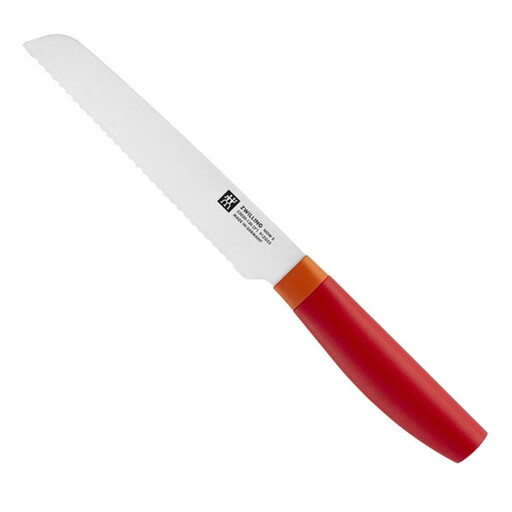
Why this product suits this profile: The serrated blade is designed for foods with a firm outer skin and softer interior, including tomatoes, bread, cheese and sausage.
The blade type is chosen to match the intended use, rather than using a smooth edge for every food. Do not use it on bones, frozen food or for levering.
13 cm FRIODUR blade, textured plastic handle and specialist suitability for hard skins or crusts with softer food underneath.
We have put together a complete, regularly updated list of products that fully meet these strict selection criteria and the safety regulations applicable in the EU.
For consistent cutting performance, the knife should be used on a suitable wooden or plastic chopping board. Glass, stone and other hard surfaces can damage the edge. After use, three simple steps will help:
Depending on the manufacturer’s instructions, a honing steel or sharpening stone can be used for smooth blades. Serrated blades, on the other hand, require a suitable solution; an ordinary honing steel is not automatically suitable for them. A knife should not be used for levering, bending or cutting through bones.
For peeling, trimming and garnishing, models measuring 8 to 10 cm, such as a Zwilling fruit knife, paring knife or garnishing knife, are practical. For larger quantities and bigger ingredients, a chef’s knife with a longer blade is a better choice.
This depends on the individual model. Some product specifications state that the knife is dishwasher-safe, while others explicitly recommend hand washing. Even when dishwasher use is permitted, hand washing followed by drying generally reduces contact with heat, detergents and other hard objects.
A Zwilling knife set is worthwhile if you regularly want to cover several tasks, such as chopping vegetables, portioning meat and slicing bread. Buying individual knives is often more cost-effective and space-saving if you initially only need a suitable chef’s knife, paring knife or steak knife. For cheese, a specialised Zwilling cheese knife with a serrated blade and cut-outs may be more suitable than a general-purpose kitchen knife.