
Lieferung heute & morgen

Qualitätsgarantie

Willkommens-Angebote freischalten: KOSTENLOSE Lieferung | Bis zu 80 % RABATT | Kostenlose 30-Tage-JoyPlus-Testphase
App herunterladen
A Zwilling kitchen knife can be used in the home for many years – provided the knife type, blade length and care routine match your actual needs. However, there are clear differences between chef’s knives, Santoku knives, paring knives and knife sets. If you focus only on advertised “exceptional sharpness” or striking design, you may end up buying a knife that does not suit your cutting technique or dishwasher routine.
According to the product information, some Zwilling knives are dishwasher-safe, while others must explicitly not be placed in the dishwasher. Heat, detergents and contact with other cutlery can put stress on the edge and handle. Even when a kitchen knife is labelled dishwasher-safe, hand washing is often recommended to help protect the edge for longer.
You should therefore check the specific product description before buying rather than assuming that one model represents an entire range.
FRIODUR refers to an ice-hardening process used on the steel of several Zwilling knives. In the product information, it is associated with properties including corrosion resistance and edge retention. However, the process alone does not indicate whether a knife is suitable for bread, herbs, fish or hard foods.
Even a sharp kitchen knife can be prone to damage if used incorrectly. With most chef’s and Santoku knives, bones, frozen food, glass or stone worktops and hard shells are not part of the intended use.
A comprehensive kitchen knife set may initially seem versatile. However, if several specialist knives are rarely used, the main result is often more effort when it comes to care and storage. For many households, an 18- to 20-cm chef’s knife or Santoku knife, together with a compact paring or garnishing knife, is sufficient.
A two-piece set can therefore be more practical for new cooks than a large collection containing knives that remain unused.
The blade length should suit your hand size, chopping board and typical ingredients. A longer blade is not necessarily better.
The Zwilling knives described here are often made from special stainless steel. The Four Star knife set is specified as having a hardness of 55 to 58 HRC. This value describes the material’s resistance, but is not the only measure of suitability for everyday use.
You should also look for:
When choosing German kitchen knives, you should check the origin of the individual model. Not every knife from a German brand is necessarily manufactured in Germany. In the product information available here, several models are labelled “Made in Germany”, while other products list China or Japan as their country of origin.
Use a wooden or plastic chopping board. Glass, stone and ceramic can damage the edge more quickly. After hand washing, dry the knife immediately. Depending on the blade geometry, a honing steel or suitable whetstone can be used for maintenance. A honing steel realigns the edge, whereas sharpening removes material.
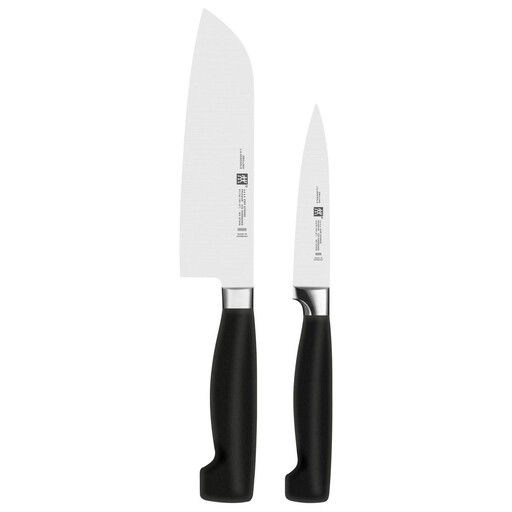
Why this product suits the profile: The set focuses on two frequently needed knives for everyday kitchen tasks: a chef’s knife and a paring knife.
The manageable selection avoids buying several specialist knives that are rarely used. According to the product information, the set is not intended for use in the dishwasher.
20 cm chef’s knife and 10 cm paring knife; FRIODUR ice-hardened steel with 55 to 58 HRC according to the product data.
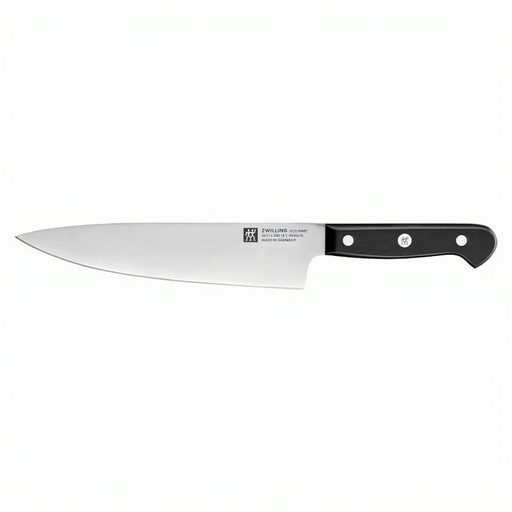
Why this product suits the profile: This classic chef’s knife is designed for versatile cutting tasks and features an ergonomic plastic handle with a three-rivet design.
The product information specifies a precise blade length, a cutting angle of approximately 30 degrees and FRIODUR ice-hardened special steel, rather than making an unsubstantiated performance claim.
20 cm blade; dishwasher-safe according to the product description, although hand washing is recommended to protect the blade.
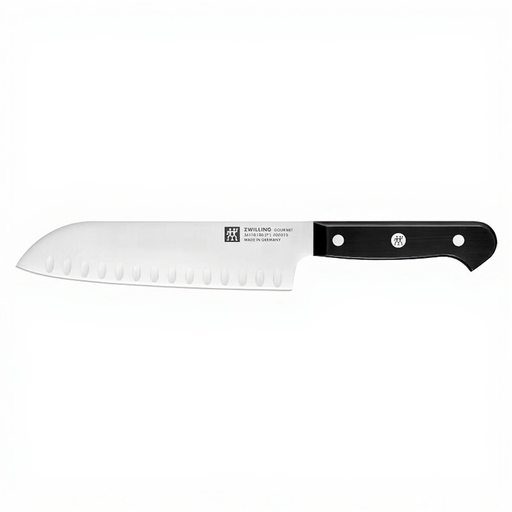
Why this product suits the profile: The broad Santoku blade is designed for vegetables, fish and boneless meat, offering a different cutting geometry from a classic chef’s knife.
The usage limits are clearly stated: no frozen food, bones or hard objects. This helps prevent the flat edge from being used for unsuitable tasks.
18 cm FRIODUR blade; dishwasher-safe according to the product data and made in Germany.
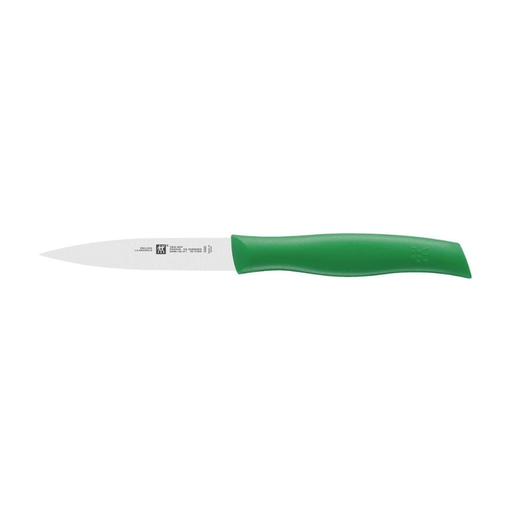
Why this product suits the profile: The compact, curved blade is ideal for small tasks such as peeling, trimming and garnishing fruit and vegetables.
The 10 cm blade is not used as a substitute for a chef’s knife. This keeps the knife choice focused on the precise tasks for which its design is intended.
Curved 10 cm blade; plastic handle; dishwasher-safe according to the product information.
We have put together a complete, regularly updated list of products that fully meet these strict selection criteria and the safety regulations applicable in the EU.
A dishwasher-safe kitchen knife offers extra convenience, but it does not replace suitable storage and careful handling. Knives with wooden handles, or those explicitly specified for hand washing, should not be placed in the dishwasher.
A chef’s knife with a 20 cm blade is suitable for many cutting tasks, including vegetables, herbs and boneless meat. If you prefer a broader blade and a more horizontal cutting motion, you may wish to consider an 18 cm Santoku knife. Your cutting technique, hand size and available workspace are the key considerations.
That depends on the individual model. According to the product information available here, the ZWILLING Gourmet Chef’s Knife and Gourmet Santoku Knife are dishwasher-safe. The Four Star knife set and the Professional S Santoku knife, on the other hand, are specified for hand washing or as unsuitable for dishwasher use. The specific product page should be the deciding source before you buy.
There is no reliable way to specify a fixed service life. It depends on the cutting surface, type of food, frequency of use, cleaning and sharpening. A suitable chopping board, hand washing and regular care can help maintain cutting performance for longer.