
Lieferung heute & morgen

Qualitätsgarantie

Willkommens-Angebote freischalten: KOSTENLOSE Lieferung | Bis zu 80 % RABATT | Kostenlose 30-Tage-JoyPlus-Testphase
App herunterladen
Reliable mobile refrigeration is essential for countless activities, whether you're camping, on a long-haul truck journey, or on a family holiday in an RV. A compressor cooler promises consistent temperatures right down to deep-freeze levels, regardless of the outside temperature. However, the market is crowded, and many products fail to live up to their advertising claims.
This guide will help you identify the crucial features and navigate common pitfalls. We'll show you what truly matters when making your selection, ensuring your investment pays off for years to come.
Before you decide on a model, you should be aware of the most common issues that often only become apparent after the purchase, leading to disappointment.
The Technology Mix-Up: Confusing Thermoelectric with Compressor Many budget-friendly “electric coolers” use thermoelectric technology (Peltier elements). These often only cool to 15–20 °C below the ambient temperature. On a hot summer day with 30 °C inside a car, these coolers will only reach 10–15 °C at best—too warm for many types of food. A true compressor cooler functions like a household refrigerator, reliably reaching temperatures as low as -20 °C, even in high external heat.
Unrealistic Claims on Power Consumption and Noise Levels Manufacturers often advertise low decibel (dB) ratings or minimal power consumption. These figures are typically measured in the energy-saving ECO mode under optimal conditions. In MAX mode, which is necessary for rapid cool-downs or in hot weather, both power consumption and operating noise can increase significantly. A supposedly quiet cooler can thus turn into a disruptive noise source in an RV or truck cabin.
Missing or Inadequate Battery Protection A 12V electric cooler connects directly to the vehicle's battery. Without an effective, multi-stage battery protection system, the cooler risks deep-discharging the battery overnight. The result is a vehicle that won't start the next morning. A good system will shut the cooler off in time and can be adjusted in several stages (e.g., High, Medium, Low) to match the battery's charge level.
To avoid buyer's remorse, focus on the following objective criteria. These define the performance and real-world usability of your future cooler.
A key advantage of compressor technology is its ability not only to cool but also to function as a portable freezer. Look for an adjustable temperature range, ideally from +20 °C to -20 °C. This provides maximum flexibility, whether you're chilling drinks or transporting frozen goods. Models with a dual-zone cooler option even allow for simultaneous cooling and freezing in separate compartments.
Flexibility is the key word here. A good model should support multiple power sources. A 12V/230V cooler is ideal, as it can be operated both in a vehicle (via the 12V or 24V truck connection) and from a standard wall outlet. Check the power consumption in watts (W) for both ECO and MAX modes. Low consumption in ECO mode is crucial for extended off-grid use, such as during camping or when used as an RV refrigerator.
The required volume depends heavily on your intended use. For day trips, 15–25 litres are sufficient, while for family holidays or long-haul drivers, 40 litres or more is practical. Pay attention to practical details like sturdy carrying handles, wheels, an interior light, or a USB port for charging devices. A cooler with app control offers added convenience, allowing you to monitor and adjust the temperature from your smartphone without having to open the lid.
Instead of presenting a confusing list, we have selected models that meet specific needs and avoid the pitfalls mentioned earlier.
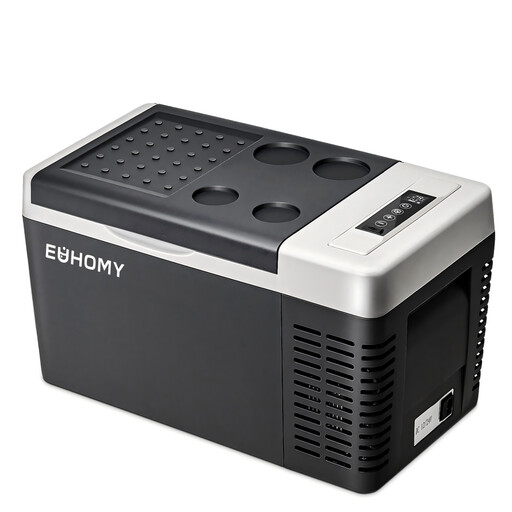
Why This Fits Their Persona: Ideal for spontaneous outings or short camping trips. The compact 18-litre size is sufficient for drinks and snacks for 1-2 people without taking up much space in the boot.
Uses true compressor technology for cooling down to -20°C and features a 3-stage battery protection system to safeguard the vehicle's battery.
APP Control: Temperature management via Bluetooth. Quiet Operation: According to the manufacturer, it operates at just 42 dB, ensuring a quiet environment.
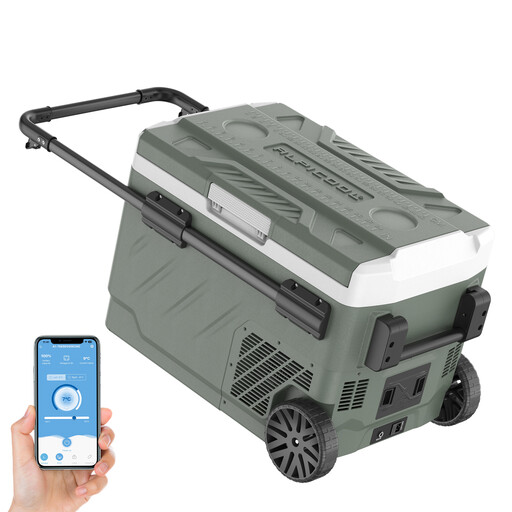
Why This Fits Their Persona: For those on the road for extended periods, volume and flexibility are essential. With 40 litres and two independently controlled zones, this model is a fully-fledged car refrigerator for a week's worth of groceries or provisions on tour.
Offers true dual-zone cooling with independent controls. The 3-stage battery protection is designed for continuous operation in trucks (24V) and RVs (12V).
High Mobility: Equipped with robust wheels and a retractable handle for easy transport. Flexible Connections: Can be powered by 12V/24V DC and 100-240V AC.

Why This Fits Their Persona: For users who prioritise high efficiency, quiet operation, and off-grid freedom. Perfect for van life, boat trips, or demanding camping scenarios where performance and low noise are paramount.
Directly addresses the noise issue: the manufacturer states a noise level of under 39 dB, which is quieter than a library. Its performance specs are precise and designed for efficiency.
Optional Battery Power: With a separately available battery, the cooler can run autonomously for up to 39 hours. Versatile Charging Options: Supports charging via AC, car, solar, and USB-C.
We have compiled a complete, up-to-date list of products that fully meet these strict selection criteria and all relevant safety standards.
This depends on the car battery's capacity, the set temperature, the ambient temperature, and the selected battery protection mode. A high-quality cooler with a three-stage battery monitor (e.g., H/M/L) will automatically shut off before the battery voltage becomes critical. In ECO mode, a good unit can often run for over 24 hours without jeopardizing a healthy car battery.
Modern compressor coolers are significantly quieter than older models. The noise level is specified in decibels (dB). Ratings around 40-45 dB are common, which is comparable to a quiet conversation or the hum of a refrigerator. Models advertised as an especially quiet cooler can achieve levels below 40 dB, making them very suitable for use in sleeping cabins or RVs.
Yes, it is recommended to let the cooler stand upright for several hours (often 6-12 hours, depending on the manufacturer's instructions) after transport before turning it on. This allows the refrigerant in the compressor system to settle, which ensures optimal cooling performance and a long lifespan for the device.