
Lieferung heute & morgen

Qualitätsgarantie

Willkommens-Angebote freischalten: KOSTENLOSE Lieferung | Bis zu 80 % RABATT | Kostenlose 30-Tage-JoyPlus-Testphase
App herunterladen
Reliable cooling is essential when travelling, camping, or for professional truck drivers. However, the market for portable coolers is confusing and full of marketing promises. Many buyers invest in a unit that fails to meet their expectations, quickly loses performance, or even drains their vehicle's battery.
This guide reveals the three most common pitfalls when buying a compressor cooler and what you need to look for to make an informed decision. We focus on the technical facts that are crucial for long-lasting and efficient cooling performance.
Before you decide on a model, you should be aware of the typical problems that lead to disappointment.
To avoid the pitfalls mentioned above, you should focus on three core areas. These determine the performance, reliability, and real-world usability of your portable cooling and freezing solution.
The key advantage of a compressor cooler is its ability to actively cool and even freeze. Look for a wide, adjustable temperature range, typically from +20°C to -20°C. This allows for flexible use as a normal car refrigerator for drinks and fresh food, or as a portable freezer for frozen goods on long trips. Models with Dual-Zone technology offer two separately controllable compartments, allowing you to cool and freeze simultaneously—a significant advantage for extended self-sufficiency when camping.
Flexibility is the key here. A good unit should support multiple power sources. The standard is a 12V/230V cooler that can be operated via the car's cigarette lighter (12V DC) as well as a standard wall socket (230V AC). For truck drivers, compatibility with 24V on-board electrical systems (24V truck cooler) is essential.
Also, pay attention to the power consumption, specified in watts (W), and the presence of an ECO mode. This reduces the compressor's output once the target temperature is reached, significantly lowering energy consumption, which is especially critical when running on battery power.
Modern units offer convenience features that make mobile life easier. A cooler with app control via Bluetooth allows you to monitor and adjust the temperature without having to open the unit.
Other important features include:
Instead of making a blanket recommendation, we have matched models based on typical use cases.

Why This Fits Their Persona: Ideal for short trips, use in a car, or as a supplement in a campervan. The compact size is space-saving yet offers enough room for the essentials. Modern features like app control are a practical bonus in this class.
This model uses true compressor technology instead of inefficient thermoelectric cooling. The integrated 3-stage battery protection reliably prevents the vehicle battery from being drained.
App Control via Bluetooth: Temperature management via smartphone. Low Power Consumption: Efficient operation with only 45W in MAX mode and an ECO function.
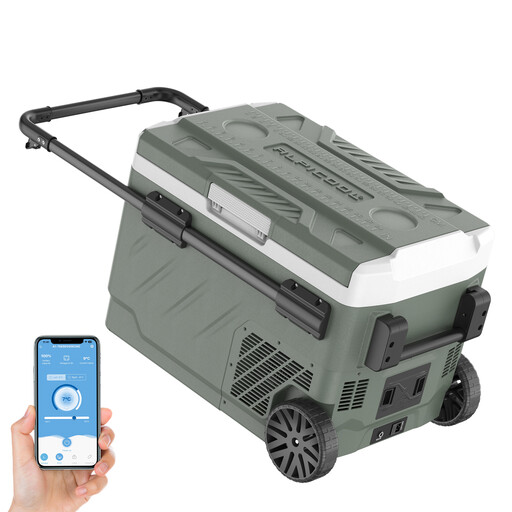
Why This Fits Their Persona: Perfect for longer trips where different types of food need to be stored. The dual-zone function allows for chilling drinks and freezing meat at the same time. Wheels and a telescopic handle make transport a breeze.
Offers true, separately controllable cooling zones, thus bypassing the limitations of single-temperature-zone coolers. The large, highly usable volume is practical for families.
Dual-Zone Technology: Simultaneous cooling and freezing in two separate compartments. High Mobility: Equipped with sturdy wheels and a retractable handle for easy transport.

Why This Fits Their Persona: Anyone on the road for weeks needs maximum storage space and reliability. With a 55-litre capacity and 24V compatibility, this model is designed for professional use in trucks or on boats, where a self-sufficient supply must be guaranteed over long periods.
Addresses the problem of insufficient volume for long-term users. The explicitly advertised ECO mode with very low consumption is designed for continuous operation and conserves the on-board battery.
Large Capacity: 55 litres provide space for a week's worth of groceries. Flexible Power Supply: Supports 12V/24V DC and 100-240V AC, enabling use in trucks, cars, and with a wall socket.
We have compiled a complete, up-to-date list of products that fully meet these strict selection criteria and German safety regulations.
The runtime depends on several factors: the car battery's capacity (in Ah), the cooler's efficiency (use ECO mode), the set and ambient temperatures, and the battery monitor setting. An average 40-litre cooler consumes about 0.5-1 kWh per 24 hours. With a healthy 60 Ah car battery and the battery protection enabled, a cooler can often run for 24 to 48 hours without starting the engine.
Modern compressor coolers are optimised for use in motorhomes and truck cabins. The operating noise level is typically around 40-45 decibels (dB), which is comparable to a quiet refrigerator. Furthermore, the compressor does not run continuously; it only switches on as needed to maintain the temperature.
Yes, this is recommended. Similar to a household refrigerator, a compressor cooler should stand upright for 6 to 12 hours after transport, especially if it was transported on its side. This allows the refrigerant in the compressor system to settle, ensuring optimal cooling performance and a long lifespan for the unit. Please refer to the manufacturer's specific instructions for details.