If you only need a few bread rolls for a light meal, buying them fresh individually or taking out just the number you need from a pack of frozen rolls can help you avoid leftovers. Long-life rolls for baking can also be an option if the pack size suits your needs and you have a suitable appliance. Whichever you choose, consider the quantity, storage, preparation and, where relevant, the ingredient and allergen information.
Which rolls might suit you
Small households that only need a few rolls at a time
If you usually need just one or two rolls, buying them individually lets you choose exactly how many you want. Frozen rolls are another option, provided you can take out just the number you need and have enough freezer space.
If you want to bake rolls at home
Long-life and frozen rolls for baking take time and require a suitable appliance. The temperature, baking time and storage instructions depend on the product and the guidance on its packaging.
If you have specific ingredient or allergen requirements
For packaged rolls, the ingredients list and allergen information can help you choose. For loose rolls, check with the retailer or ask for its allergen information.
What to look for when buying
Fresh rolls bought individually
A good fit if: You only need a few rolls for today and don’t plan to bake them at home.
The trade-off: You’ll need to shop again or freeze any leftover rolls for another meal.
Long-life rolls for baking
A good fit if: You can use the pack within your usual timeframe and have a suitable appliance for baking them.
The trade-off: You’ll need to allow time for baking before eating, and a larger pack may not be practical for just one meal.
Frozen rolls for baking
A good fit if: You want to keep rolls in for future meals and can take out just the number you need.
The trade-off: You’ll need freezer space and a suitable appliance for baking them.
| What to consider |
What to check when buying |
Who it matters to |
| Right quantity |
How many rolls are in the pack, and whether you can buy them individually or take out just the number you need. |
If I only need a few rolls, I don’t want to have to use up the rest before my next meal. Around 36% of consumers prioritise buying the quantity they need. |
| Preparation |
Storage requirements, baking time and appliance instructions on the specific pack. |
If I want the rolls to be warm when I serve them, baking them needs to fit into my routine. Around 36% of consumers say this is their main priority. |
| Ingredients and type |
Ingredients, allergens and the specific type of grain; for loose rolls, check the retailer’s allergen information. |
If certain ingredients aren’t suitable for me or I’m looking for a particular type of grain, I check the information for each product. Around 28% of consumers prioritise this. |
Avoiding common buying mistakes
-
Choosing a large pack when you only need a few
If you only eat a few rolls at each meal, you’ll need to plan how to use or store the rest of the pack.
Compare the pack size with what you actually need, and check whether you can freeze any leftovers.
-
Using the baking instructions for a different product
The temperatures and baking times listed by REWE already vary between the examples Harry Doppelbrötchen Rohlinge and ja! Sonntagsbrötchen.
Follow the instructions on your own pack and use the type of heating specified there.
-
Judging allergens by the product name alone
A roll’s name won’t tell you all its ingredients or any precautionary allergen warnings. Even products that look similar can have different information.
For packaged rolls, read the current labelling. For loose rolls, ask the retailer to show or explain its allergen information.
Brands and retailers to consider
REWE
A place to compare rolls from the in-store bakery with long-life and frozen rolls for baking.
- REWE has separate online categories for rolls for baking and frozen rolls for baking. The retailer says its in-store bakeries are replenished several times a day.
- For small households, the number of rolls in each pack still matters; the retailer’s information about its in-store bakery doesn’t say anything about a specific roll.
Lidl – Unser Brot
Worth considering if you’re looking for individual rolls from the in-store bakery for your next meal.
- Lidl describes its in-store bakery range as freshly baked several times a day.
- The specific selection may vary from one store to another.
ALDI Nord – GOLDÄHREN
An option for shoppers considering a pack of Meisterbäcker rolls in wheat or spelt.
- ALDI Nord’s product page lists six rolls per pack and the wheat and spelt varieties.
- ALDI Nord notes that special-buy items may only be available in limited quantities.
Der Meisterbäcker
A local bakery option in the Bergwinkel region for freshly bought bread and rolls.
- The bakery describes long fermentation and natural sourdough as features of its own range.
- This information applies to this bakery and not to other products with “Meisterbäcker” in the name.
Frozen rolls at Joybuy
This selection focuses on frozen rolls for meals when you only want to bake a few at a time and keep the rest for later. Before buying, check that the pack size, freezer space and preparation method suit your household.
 No image available
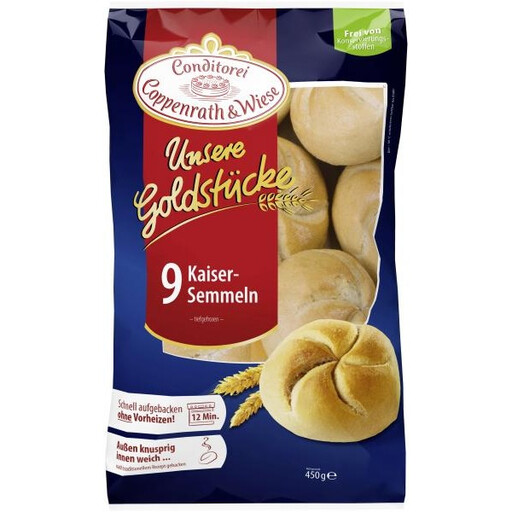
Coppenrath & Wiese Our Gold Pieces Kaiser Rolls, 9 rolls, 450 g
This pack could suit a small meal if you have freezer space and an oven. It contains 9 rolls, with a stated total weight of 450 g. Check the preparation instructions, ingredients and allergen information on the current packaging.
View at Joybuy
Frequently asked questions
Long-life or frozen rolls for baking: which are best for a small meal?
Frozen rolls could suit you if you only need a few at a time, can take them out individually and have enough freezer space. Long-life rolls for baking are an alternative if you can use the pack soon; with either option, check the number of rolls and the storage instructions.
Do frozen rolls need to defrost before baking?
Not necessarily: EDEKA recommends baking frozen rolls without defrosting them first in its guide. For your product, follow the instructions on the pack.
What can I do with leftover rolls?
You can freeze any rolls you don’t need and take them out later as required. Otherwise, the Verbraucherzentrale recommends storing bread and rolls at room temperature in a dry place away from light. If any have visible mould, throw them away in their entirety.
Where can I find allergen information for loose rolls?
Ask the retailer for allergen information about the specific loose roll. For packaged rolls, check the ingredients list and allergen labelling on the packaging. The Verbraucherzentrale explains how labelling works for both packaged and loose foods.


