What should you look for when buying?
First, check whether the ingredients on the specific pack contain any allergens you need to avoid. Then confirm whether the product needs to be gluten-free, and finally read any precautionary allergen information that’s relevant to you.
| What matters |
What to check when buying |
Who it matters most to |
| Allergens in the recipe |
Check the ingredients list on the current pack for wheat, milk ingredients and, where relevant, egg. |
If I need to avoid wheat, milk or egg, I want to make sure my allergen isn’t an ingredient in the biscuit. Around 40% of consumers prioritise avoiding allergens listed as ingredients. |
| Gluten-free options |
Look for an explicit gluten-free label; don’t assume spelt means gluten-free. |
If I need gluten-free biscuits, the word ‘spelt’ doesn’t help, and I also need to check the other ingredients. For around 30% of consumers, gluten-free options are the priority. |
| Traces and multiple allergens |
Distinguish precautionary allergen information from ingredients in the recipe, and compare the information on the current pack with the allergens that matter to you. |
If I have a nut or multiple allergy, I don’t want to mistake possible accidental traces for ingredients that have been deliberately added. Around 30% of consumers prioritise checking for traces and multiple allergens. |
A precautionary allergen statement refers to possible accidental traces, not an ingredient in the recipe. According to the German Federal Institute for Risk Assessment, these statements are voluntary. Their presence or absence doesn’t, on its own, guarantee that a product is safe for you.
Comparing brands and product ranges
These examples show how recipes and labelling can vary between individual products. A brand name alone doesn’t tell you whether another pack from the same brand meets your needs.
Leibniz
The classic butter biscuit listed by REWE is a useful example of how to check a conventional recipe.
- REWE lists the ingredients in this product, including wheat flour and butter.
- The ingredients list also includes milk ingredients and whole egg powder, so this product isn’t suitable if you’re allergic to either.
EDEKA GUT&GÜNSTIG
The butter biscuit described by EDEKA provides another example of the labelling used on a supermarket own-brand product.
- EDEKA lists wheat flour, butter and whole milk powder in the recipe.
- EDEKA mentions possible traces of tree nuts and notes that the information may differ from what’s shown on the packaging.
REWE Bio / ja!
The spelt and classic butter biscuits listed by REWE show why similar product names need to be checked individually.
- For the organic product, REWE explicitly describes spelt as a type of wheat; for the ja! product, REWE lists wheat flour.
- Both listed products contain milk ingredients. Their information about possible traces differs.
Poensgen
The butter biscuit listed by REWE is explicitly labelled gluten-free.
- The gluten-free label is a useful way to identify a product if you need to avoid gluten.
- The listed product contains milk ingredients and sweet lupin flour. The gluten-free label doesn’t answer questions about these allergens.
Sondey
Lidl Germany describes Sondey as its own brand of sweet biscuits and small baked treats.
- You can compare a specific Sondey butter biscuit with other biscuits using the information on its pack.
- For an allergy-related decision, it’s the ingredients and precautionary allergen information on that specific pack that matter, not the brand name.
Butter biscuits at Joybuy
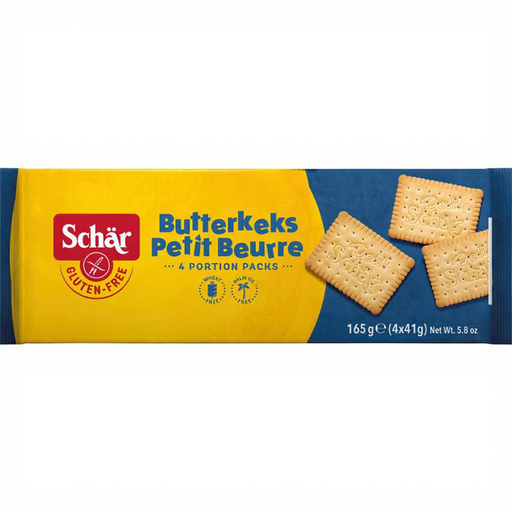
This product is a butter biscuit labelled gluten-free. As well as checking the gluten information, pay particular attention to milk, egg and any other details that matter to you on the current pack.
 No image available
Schär Gluten-Free Petit Beurre butter biscuits, 165 g
This may be an option if you’re looking for butter biscuits labelled gluten-free, provided the other ingredients meet your needs. According to the product description, it contains milk and egg. Before buying, check the full ingredients list and any precautionary allergen information on the current pack.
View at Joybuy
Frequently asked questions
Are classic butter biscuits suitable if you have a milk or wheat allergy?
Not based on their product name alone. The examples from Leibniz, EDEKA GUT&GÜNSTIG and ja! described by REWE and EDEKA contain wheat flour and milk ingredients. The Leibniz Butterkeks also lists whole egg powder. Always check the ingredients list on the specific pack.
Is a spelt butter biscuit gluten-free?
No. Spelt isn’t a gluten-free alternative. REWE explicitly describes the spelt in its listed organic spelt butter biscuit as a type of wheat. If you need a gluten-free product, look for a suitable label on the specific product.
Is a gluten-free butter biscuit automatically milk-free?
No. The gluten-free Poensgen Butterkeks listed by REWE contains butterfat, sweet whey powder and skimmed milk powder, as well as sweet lupin flour. So even when a product is labelled gluten-free, check the full ingredients list.
What does ‘May contain traces of tree nuts’ mean?
This refers to possible accidental traces, not an ingredient that’s been deliberately added. According to the German Federal Institute for Risk Assessment, precautionary allergen statements are voluntary. A statement being present or absent doesn’t, on its own, mean a product is safe for you. If you have a severe allergy, follow the approach agreed with your doctor for your individual situation.


