
Lieferung heute & morgen

Qualitätsgarantie

Willkommens-Angebote freischalten: KOSTENLOSE Lieferung | Bis zu 80 % RABATT | Kostenlose 30-Tage-JoyPlus-Testphase
App herunterladen
Custom car ambient lighting enhances your vehicle's interior and creates a personal atmosphere. However, the market for retrofit kits is confusing. Many products overpromise and underdeliver, leading to disappointment rather than a high-quality result. Before making a purchase, it's crucial to understand the common pitfalls that often only become apparent after installation.
This guide highlights the three most common problems with budget-friendly LED kits and explains which technical features you should look for to find a durable and functional solution for your vehicle.
Many car owners invest in LED interior lighting for their car, only to find that the result doesn't meet their expectations. These three issues are particularly common:
To avoid these problems, you should carefully check three technical aspects before buying. These are the key factors that determine the quality, durability, and functionality of your new ambient lighting.
The type of light guide is crucial for uniform illumination. Modern systems use acrylic light strips instead of traditional fibre optics.
Therefore, look for product descriptions that explicitly mention acrylic as the material for the car LED strips.
Modern RGB interior lighting for your car should do more than just display static colours. The key lies in the control technology.
The "X-in-1" designation (e.g., 18-in-1) describes the scope of the kit. A modular system makes retrofitting car ambient lighting significantly easier. Instead of one long cable that has to be routed through the entire car, these kits consist of a main controller and several sub-controllers.
This design avoids long cable runs through the vehicle and ensures a tidy, professional installation. A comprehensive kit typically includes light strips for the dashboard, doors, door handles, storage compartments, and the footwell.
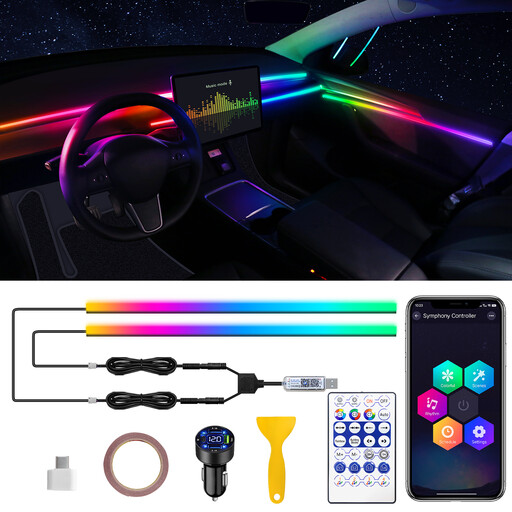
Why This Fits Their Persona: Ideal for users who primarily want to upgrade the dashboard without undertaking a complex installation throughout the entire vehicle. The simple power supply via USB/Type-C makes it a straightforward plug-and-play solution.
Avoids the complicated wiring trap with a simple setup that focuses on the central area and requires no sub-controllers.
Uses modern acrylic light guides for uniform light and offers full Dreamcolor (RGB-IC) functionality with app, remote, and touch controls.

Why This Fits Their Persona: Perfect for car enthusiasts aiming for complete and harmonious lighting throughout the entire interior. The 18-in-1 kit covers the dashboard, four doors, door handles, storage compartments, and the footwell.
The modular system with main and sub-controllers prevents messy cable runs. The acrylic technology ensures even illumination without hotspots.
A comprehensive kit for a complete interior design. Offers full RGB-IC functionality with app control and music sync for a dynamic lighting experience.

Why This Fits Their Persona: For the discerning tuning fan who wants no compromises. This 22-in-1 kit offers the maximum scope, including rare elements like lighting for the door speakers (door horn light).
Bypasses the limited control trap with an advanced app that, according to the manufacturer, even allows for dual-zone control for different colours in various areas.
The most extensive lighting scope on the market for a detail-oriented and seamless integration. The modular system with 5 controllers ensures a stable and clean installation.
We have compiled a complete, up-to-date list of products that fully meet these strict selection criteria and safety regulations.
Yes, most modern kits are designed for DIY (Do-It-Yourself) installation. The light strips are usually wedged into existing gaps on the dashboard or in the door panels. An included pry tool helps to gently open these gaps. Modular systems with sub-controllers further simplify the installation, as no cables need to be run across the vehicle. However, it is recommended to test the lights before the final installation.
Power is typically supplied via the vehicle's 12V electrical system. Simple kits often use the cigarette lighter socket or a USB port. More comprehensive kits are connected directly to the fuse box, which allows for a hidden wiring setup. The sub-controllers in the doors are typically wired to the power supply for the power windows or door locks.
The difference lies in how the LEDs are controlled. With standard RGB, the entire LED strip lights up in a single colour chosen at that moment. With Dreamcolor (RGB-IC), an individual chip (IC = Integrated Circuit) is built into each LED or small LED segment. This allows each segment to be controlled individually. As a result, dynamic effects like colour gradients, chasing light animations, or rainbow patterns can be displayed across the entire strip. For a modern and dynamic look, RGB-IC is the more advanced technology.