
Lieferung heute & morgen

Qualitätsgarantie

Willkommens-Angebote freischalten: KOSTENLOSE Lieferung | Bis zu 80 % RABATT | Kostenlose 30-Tage-JoyPlus-Testphase
App herunterladen
A sudden loss of tire pressure can disrupt your plans and create uncertainty, whether you're on your way to work, out on a bike tour, or on holiday. A cordless air pump promises a quick and straightforward solution. However, the market is flooded with devices whose marketing claims often promise more than the technology can deliver. As a Joybuy Product Recommendation Officer, I'm here to help you cut through the noise and find a device that truly meets your needs.
Before you make a purchase, you should be aware of the common pitfalls that often lead to disappointment:
To make an informed decision, you should focus on the technical parameters that are crucial for functionality. A good portable air compressor is distinguished by a well-rounded balance of power, endurance, and ease of use.
The maximum pressure, often advertised as a 150 PSI compressor, is primarily relevant for road bike tires. For cars, motorcycles, and most bicycle tires, values between 2 and 3.5 bar (approx. 30-50 PSI) are sufficient. Far more important for practical use is the air flow rate, measured in litres per minute (L/min). It determines how quickly the tire inflates. A good cordless compressor for automotive use should have an air flow rate of at least 20 L/min to take a standard car tire from 2.0 to 2.5 bar in just a few minutes.
The battery capacity, typically between 4000 and 8000 mAh, provides an indication of its endurance. Look for manufacturer specifications that refer to concrete use cases, e.g., "Inflates X car tires from Y to Z bar on a single charge." A modern car compressor battery should feature a USB-C port. This allows for flexible charging via power banks, in the car, or with a standard wall adapter, making proprietary charging cables obsolete.
A reliable air pump with a pressure gauge is essential. Digital displays with an auto-shutoff feature are the standard here: you set the target pressure, and the compressor automatically turns off once it's reached. This prevents over-inflation and ensures precise results. Other useful features include:
Instead of making a blanket recommendation, we have identified models tailored to specific use cases.
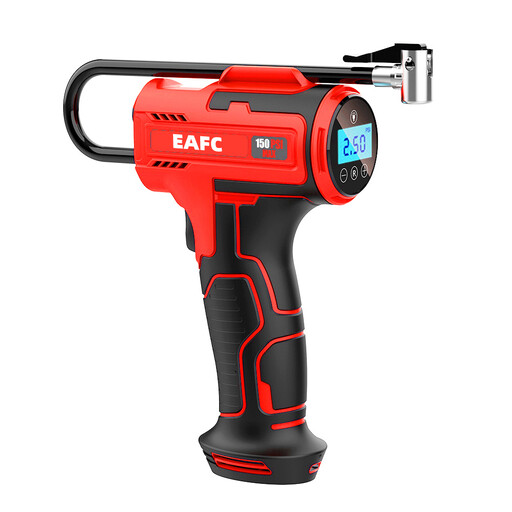
Why This Fits Their Persona: Ideal for users seeking a reliable, cordless base solution for occasional pressure top-ups on car and bike tires, without investing in professional-grade features. Its simple operation and compact format make it a handy helper for the trunk.
This model sidesteps the battery trap with a solid 4000 mAh battery, sufficient for everyday tasks like topping up several tires. The digital display with an auto-shutoff feature also prevents inaccurate inflation.
Advantage: Delivers core features (cordless, digital display, LED light) at an accessible price point. Pros: Universal use for cars, motorcycles, bikes, and balls.

Why This Fits Their Persona: Perfect for commuters and families who need a powerful and durable device for the regular maintenance of multiple vehicles. The combination of a high air flow rate and a large battery minimises waiting times and makes it a reliable companion.
This model debunks the PSI myth by combining a high maximum pressure (160 PSI) with a strong air flow rate (35 L/min). The large 7500 mAh battery ensures realistic, long-lasting performance that goes beyond a single top-up.
Advantage: High inflation speed and large battery capacity. Pros: Also serves as a power bank for charging devices; large, easy-to-read LED display.
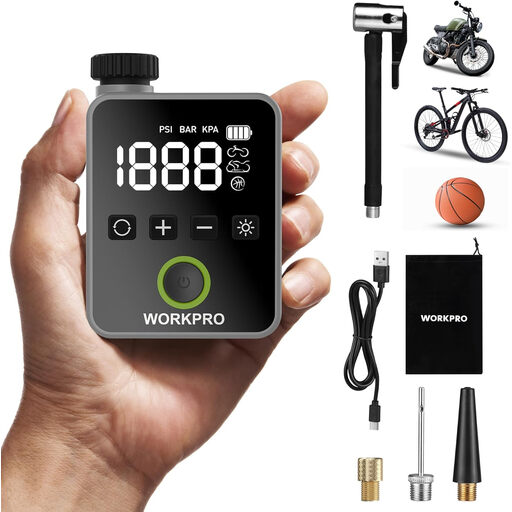
Why This Fits Their Persona: For cyclists, campers, and tech-savvy users where every gram counts. Weighing just 270g and with a pocket-sized design, this compressor is extremely portable without compromising on functionality. It's a multifunctional tool for on the go.
This model avoids the poor build quality trap by opting for a robust design and precise functions despite its small size. The auto-shutoff feature and clear HD display ensure accurate results often missing in budget products.
Advantage: Extremely lightweight and compact. Pros: Multifunctional as an air pump, power bank, and emergency torch (incl. SOS mode); four modes for different applications.
We have compiled a complete, up-to-date list of products that fully meet these strict selection criteria and safety standards.
Yes, most powerful models can. However, it's a demanding task that heavily taxes the battery and can take 8 to 15 minutes, depending on the tire size and the device. For such emergencies, a model with a high air flow rate (L/min) and a large battery capacity (at least 6000 mAh) is recommended. Some devices can also be powered by the car's 12V socket during operation.
Accuracy is a key quality indicator. Models from established brands typically offer high precision, often with a deviation of less than 0.1 bar. The integrated auto-shutoff feature ensures the preset pressure is reached exactly. Nevertheless, it's good practice to occasionally double-check the pressure with a separate, calibrated tire pressure gauge.
The battery's lifespan depends on the frequency of use and storage conditions. On average, a lithium-ion battery can withstand several hundred charge cycles. To maximise its lifespan, the battery should not be stored completely discharged for long periods. It is recommended to keep the charge level between 20% and 80% and to protect the device from extreme temperatures (heat in summer, frost in winter).