Parents looking for an everyday snack
If you need a regular snack between meals, shortbread isn’t an obvious everyday choice. Gesund ins Leben recommends offering toddlers sugar, sweets and snack products sparingly.


Dark chocolate shortbread isn’t suitable as a regular snack for toddlers: Gesund ins Leben recommends offering sweets and snack products sparingly at this age. If you specifically want a rich cocoa flavour, it may be an option as an occasional small treat. What matters is the ingredients, nutritional information and allergens listed on the particular pack – not just the words ‘dark chocolate’.
If you need a regular snack between meals, shortbread isn’t an obvious everyday choice. Gesund ins Leben recommends offering toddlers sugar, sweets and snack products sparingly.
If the flavour is the reason for buying it, think about the occasion and keep the portion small. ‘Dark’ on its own says nothing about whether it’s suitable as a toddler snack; according to the German Federal Institute for Risk Assessment, caffeine also occurs naturally in cocoa beans.
If your child has a relevant allergy, always check the current labelling for each variety. The Walkers and TIM'S chocolate shortbreads described by REWE differ in, among other things, the types of flour used and the allergen information provided.
A good choice if: You want to offer a snack regularly between meals. Gesund ins Leben recommends limiting sweets and snack products for toddlers.
The trade-off: This option won’t satisfy a craving for a chocolatey, rich-tasting biscuit.
A good choice if: You specifically want a cocoa flavour and the biscuit is intended as an occasional small treat.
The trade-off: Cocoa is a natural source of caffeine, and a dark chocolate flavour doesn’t make sweet biscuits an everyday snack.
A good choice if: You’d like a biscuit now and then, but the cocoa flavour isn’t important.
The trade-off: Without cocoa, you avoid this source of caffeine; a sweet biscuit still isn’t a substitute for a regular snack.
If you’re considering chocolate shortbread for a toddler’s snack time, first decide what role the biscuit will play, then check the specific pack.
| What you’re looking for | What to check before buying | Who it matters to |
|---|---|---|
| Everyday snack | Is the biscuit planned as an occasional treat, or will it regularly replace a snack between meals? | If I need something for between meals every day, I don’t want to make sweet biscuits a habit. Around 50% of consumers put this everyday consideration first. |
| Rich cocoa flavour | Compare the cocoa or chocolate in the ingredients list, as well as the sugar and saturated fat per 100 g. | For an occasional biscuit, I mainly want a richer flavour without assuming that ‘dark chocolate’ means it’s better for me. Around 30% of consumers put this flavour first. |
| Allergens and recipe | Read the ingredients list, check the highlighted allergens and, where relevant, any ‘may contain’ warnings on the current pack. | If my child has a relevant allergy, I need to know exactly what’s in this variety. Around 20% of consumers prioritise checking the recipe. |
The cocoa content tells you about the recipe, not the role the biscuit should play in a toddler’s diet. According to the German Federal Institute for Risk Assessment, caffeine occurs naturally in cocoa beans; nutritional values also vary from product to product.
Choose the biscuit for the flavour you want, not because you assume it has a nutritional benefit. Compare the nutritional information and, if you choose to offer it, plan it as an occasional small treat.
It’s harder to keep portions in check if you keep reaching for more. The Verbraucherzentrale recommends limiting sweets or snacks for children to one portion a day.
Decide on the occasion and portion in advance, rather than offering the biscuit throughout the day.
Chocolate biscuits with similar names can contain different types of flour and have different allergen information. The Walkers and TIM'S varieties described by REWE show why the product name alone isn’t enough.
Check the ingredients list on the current pack each time you buy it, and look for ‘may contain’ warnings if they’re relevant to your child.
The Walkers Chocolate Chip Shortbread described by REWE contains 14% dark chocolate chips and uses a flour blend of rice flour, potato starch and maize flour.
The chocolate butter shortbread described by REWE contains 9% cocoa; the listed ingredients include wheat flour and butter.
This chocolate shortbread is only an option as an occasional treat, not as a regular snack for toddlers. Before buying, check the current ingredients list and nutritional information in particular.
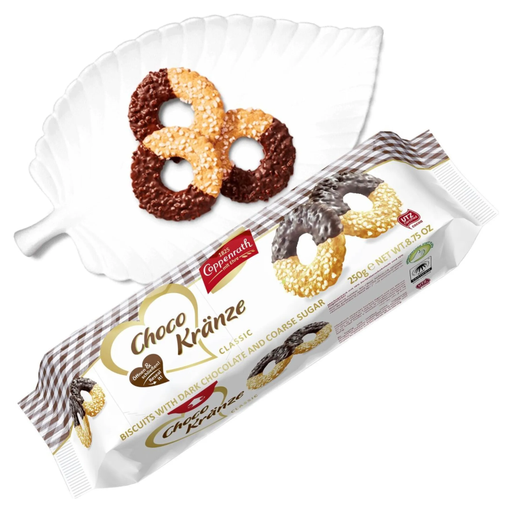 Image unavailable
For an occasional treat when you fancy chocolate shortbread, not as a regular toddler snack.
Wreath-shaped shortbread; pack size: 250 g. Check the ingredients, nutritional information and warnings on the current pack before choosing it for a toddler.
No. It isn’t suitable as an everyday choice, in line with Gesund ins Leben’s recommendation to offer sweets and snack products sparingly to toddlers. If you choose shortbread, treat it as an occasional small treat rather than a regular snack between meals.
No, you can’t assume it’s more suitable for toddlers just because it has a higher cocoa content. According to the German Federal Institute for Risk Assessment, cocoa is a natural source of caffeine; you should also compare the ingredients and nutritional information for the specific biscuit.
No, the word ‘shortbread’ doesn’t tell you which flour has been used. The TIM'S chocolate biscuit described by REWE lists wheat flour, while the Walkers variety described there uses a blend of rice flour, potato starch and maize flour. Check the ingredients and allergen information on every pack; the flour blend alone doesn’t mean it’s suitable for a gluten-free diet.
No. If your child has a relevant nut or peanut allergy, also check the ‘may contain’ warnings on the specific pack. The products described by REWE mention different possible cross-contamination risks: Walkers warns of nuts, while TIM'S mentions tree nuts and peanuts. Follow your doctor’s advice on individual precautions.