
Lieferung heute & morgen

Qualitätsgarantie

Willkommens-Angebote freischalten: KOSTENLOSE Lieferung | Bis zu 80 % RABATT | Kostenlose 30-Tage-JoyPlus-Testphase
App herunterladen
A garden light with a ground spike can be installed in lawns, flower beds or loose soil without any complicated fitting. However, not every outdoor light is suitable for every location. Unclear information about the IP rating, battery life or power supply often means that the lighting no longer serves its intended purpose after a short time.
This buying guide from the Joybuy Product Recommendation Officer explains what homeowners and gardeners in Germany should look out for before buying, and which types of product are suitable for different requirements.
An IP44 garden light is protected against solid foreign objects measuring 1 millimetre or more, as well as splashing water from different directions. However, it is not designed to be immersed in water. For a sheltered position beside a path or in a flower bed, IP44 may be sufficient.
An IP65 garden spotlight is also dust-tight and protected against water jets. This is often more suitable for exposed areas, regular watering or year-round outdoor garden lighting. IP65 still does not mean that the light may be operated underwater.
A solar garden light needs sufficient direct sunlight every day. Beneath trees, against a north-facing wall or in the shadow of a house, charging may take longer. The operating time stated by the manufacturer generally applies under suitable charging conditions. In winter or after several cloudy days, the actual lighting duration may be shorter.
If you need consistently predictable brightness, consider a mains-powered or rechargeable battery-powered garden light instead of a solar light with a ground spike.
An RGB garden light creates colourful accents, but it is not automatically suitable as a garden path light. For steps, driveways or trip hazards, sufficient brightness, suitable light distribution and a stable position are essential. For flower beds, shrubs or seating areas, on the other hand, decorative warm-white garden lighting may create a more pleasant atmosphere.
Solar lights usually use an integrated NiMH battery and switch on automatically when it gets dark. Check the following:
For mains-powered models, cable length, connection type and safe installation outdoors are crucial. A 220-volt light should be connected in accordance with the manufacturer's instructions and local regulations. A qualified electrician should be involved for a permanent connection.
Colour temperature is measured in Kelvin. 2700 Kelvin produces warm-white light, making it suitable for patios, seating areas and decorative flower beds. 6500 Kelvin appears noticeably cooler and whiter. RGB models switch between different colours, while smart models may also be dimmable and able to save scenes.
A smart Wi-Fi garden light usually requires a 2.4 GHz Wi-Fi network. For a Matter garden light, check whether your existing smart home hub supports the Matter standard. App, voice and remote control are practical features, but they involve more set-up than a simple solar light.
The ground spike must be suitable for the condition of the soil. It can usually be inserted directly into soft earth, but a plastic spike may be damaged in very hard or stony ground. Do not hit the light, and pre-drill the soil if necessary.
Also look for:

Why this product suits the profile: This solar light with a ground spike needs no direct mains connection and is designed for simple accent lighting beside paths or in flower beds.
The specifications state a charging time of 4–6 hours and a lighting duration of 8–12 hours under suitable conditions. The IP44 rating makes its usage limitations clear.
Solar power, automatic switching on and off, and 6500 K light. The ground spike allows tool-free installation in soft soil.
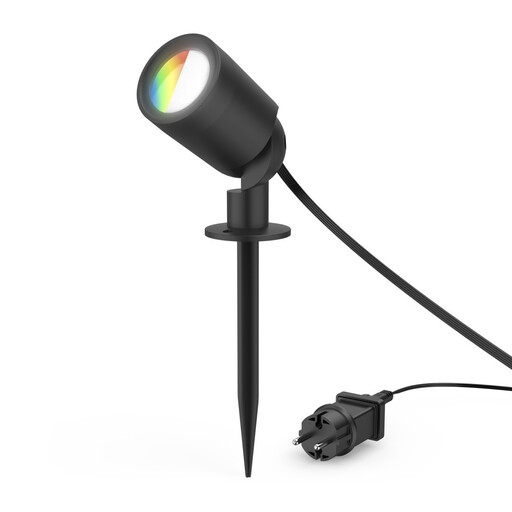
Why this product suits the profile: This mains-powered LED garden spotlight is aimed at users who want to combine brightness, colour selection and smart home control.
IP65 is clearly specified. It is also a standalone 220-volt model, rather than an extension unit.
Matter support, app and voice control, stepless dimming and 16 million colours. The light head is adjustable.
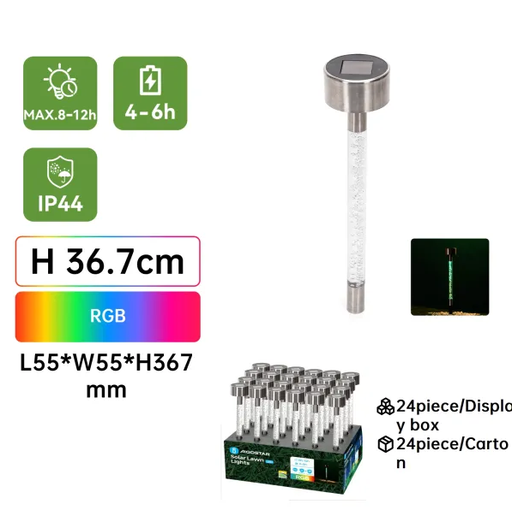
Why this product suits the profile: This RGB garden light is ideal for users who want to create colourful accents on lawns, in flower beds or beside garden paths without cables.
The product specifications explicitly state IP44, a charging time of 4–6 hours and an operating time of 8–12 hours under suitable charging conditions.
RGB lighting, an integrated NiMH battery, a height of 36.7 cm and a low weight of around 80 g. Installation involves inserting the spike into the ground.
Position the solar panel in an area with as little shade as possible and clean it regularly with a soft, damp cloth. Abrasive cleaners can damage the surface. Before use, check the ground spike, housing and cable for visible damage.
A waterproof outdoor light should never be deliberately placed in water. With mains-powered models, the power supply must be disconnected before cleaning or maintenance. Batteries and electronic components should be taken to designated collection points at the end of their service life, not placed in household waste.
We have put together a complete, regularly updated list of products that fully meet these strict selection criteria and the safety regulations applicable in the EU.
Insert the spike into soft soil or a lawn. The solar panel should face upwards and receive several hours of direct sunlight wherever possible. Avoid locations beneath trees, roof overhangs or in permanent shade.
Service life depends on the LED, battery, weather conditions and care. The Aigostar models mentioned state up to 15,000 operating hours for the light source, as well as 8–12 hours of illumination per charging cycle. Actual operating time may vary depending on sunlight and temperature.
Consumption depends on the power rating and daily operating time. A 7-watt LED spotlight running for five hours uses 35 watt-hours in theory. Running costs therefore depend on the wattage, usage time and your individual electricity tariff. Timers and schedules can limit operating hours.