
Lieferung heute & morgen

Qualitätsgarantie

Willkommens-Angebote freischalten: KOSTENLOSE Lieferung | Bis zu 80 % RABATT | Kostenlose 30-Tage-JoyPlus-Testphase
App herunterladen
A dead car battery or a flat tire rarely happens at a convenient time—it's usually on the way to an important meeting or at night on a deserted country road. A jump starter with compressor promises to be the ideal solution for both problems: a single, compact device for the most common breakdowns. But the market is flooded with products making bold claims that often fail to deliver in practice.
As your Joybuy Product Recommendation Officer, I'm here to help you separate the wheat from the chaff. We'll highlight the typical pitfalls of buying one and show you which technical specifications really matter, so you won't be left stranded in an emergency.
Before you invest in a multifunctional roadside emergency kit, you should be aware of the most common marketing traps that lead to disappointment and unnecessary expense.
To avoid a bad purchase, you should carefully examine three core technical areas. These determine whether a device is suitable for your vehicle and your needs.
The most important metric is the peak current, measured in Amps (A). This value must match your vehicle's engine.
Always check the manufacturer's explicit specifications for which engine sizes (petrol and diesel) the device is designed.
Almost every portable car compressor advertises a maximum pressure of 150 PSI (approx. 10.3 Bar). This value is more than enough for car tires. However, far more important for practical use is the airflow rate, specified in litres per minute (L/min).
Also, check if the device has an automatic shut-off feature that allows you to preset the desired target pressure.
The capacity of the internal battery, given in milliamp-hours (mAh), determines how many times you can jump-start a car or charge your smartphone before the device itself needs to be plugged in again. A capacity of over 20,000 mAh provides a good reserve.
Modern safety features are indispensable. Look for terms like 'intelligent clamps' or 'smart clamps'. These typically include protection against:
Instead of making a blanket recommendation, we have selected products that cater to different user profiles and requirements.
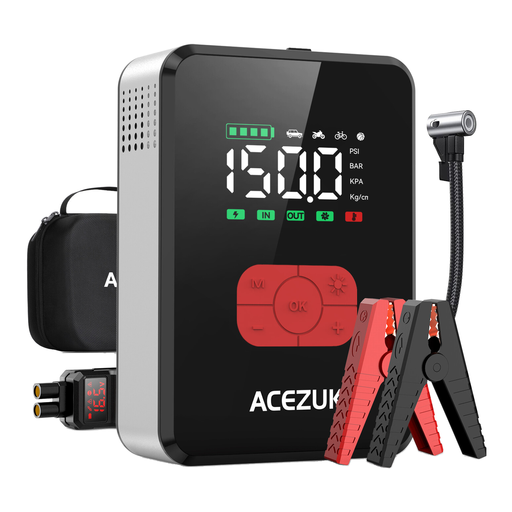
Why it's a match: For drivers seeking a reliable and straightforward all-in-one solution. This device combines a powerful jump starter with a fully-featured compressor, covering the two most common breakdown causes.
It solves the "fake all-in-one" problem by explicitly integrating both core functions—jump-starting and air compression—into one robust unit. The smart clamps with a display also address the safety risk.
True 2-in-1 functionality; patented clamp design with a display to prevent user error; high capacity of 26800 mAh.
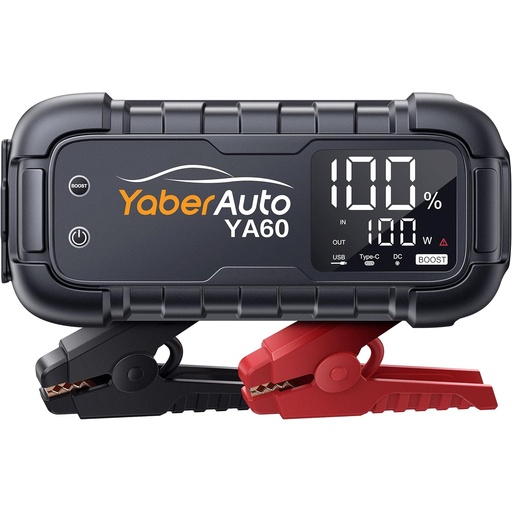
Why it's a match: Ideal for owners of large-displacement vehicles (e.g., SUVs, vans, diesels up to 12.0L) for whom maximum starting power is the top priority. A separate compressor may already be owned or is not needed.
This device avoids the pitfall of insufficient power. It focuses on a single task—jump-starting—and delivers an extremely high 8000 A peak current, promising reliability even for demanding engines.
Very high peak current for large engines; fast 65W two-way charging (recharges itself in approx. 1.5 hours); 150W DC output to power other 12V devices.
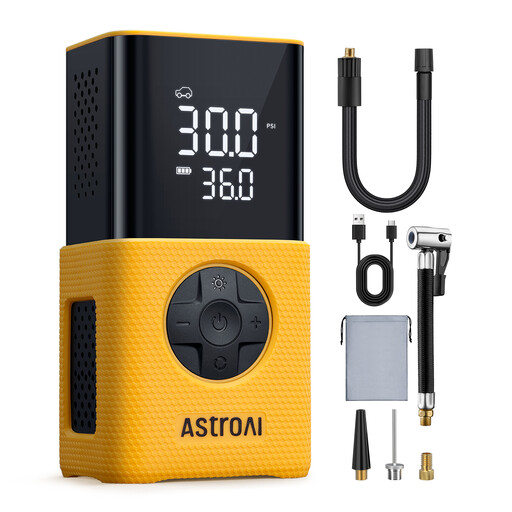
Why it's a match: Perfect for users whose main focus is tire maintenance (car, motorcycle, bicycle) and who need a compact, fast, and precise device. The power bank function is a handy bonus. Note: This device does not offer jump-starting.
It avoids the trap of a mediocre combo device by specialising in one function: inflation. According to AstroAI, it offers 2x faster inflation and high measurement accuracy, which is a weak point in many combination units.
Very compact and lightweight (460 g); high airflow rate (17 L/min) for its size; precise pressure sensor and preset modes for easy operation.
A well-equipped vehicle relies on more than just a jump starter. Reliable lighting is essential for nighttime breakdowns. We've curated a list of products that meet strict selection criteria.
Even when not in use, the internal battery slowly self-discharges. Most manufacturers recommend fully charging the device every 3 to 6 months to maintain battery health and ensure it's ready for an emergency.
Yes, in principle, this is possible. However, it places a high load on the device. The time it takes depends heavily on the compressor's airflow rate and the tire size. For a completely flat tire, the process can take 10-20 minutes or longer. It's advisable to give the device breaks in between to prevent overheating.
Yes, modern, high-quality jump starters with "smart clamps" are safe for vehicle electronics. These clamps have protection circuits that prevent voltage spikes, short circuits, and reverse polarity. Using outdated or very cheap devices without these safety mechanisms on modern vehicles is not recommended.