
Lieferung heute & morgen

Qualitätsgarantie

Willkommens-Angebote freischalten: KOSTENLOSE Lieferung | Bis zu 80 % RABATT | Kostenlose 30-Tage-JoyPlus-Testphase
App herunterladen
A flat car battery is often inconvenient: in a car park, just before setting off on holiday or during a winter trip. A jump starter power bank can provide a mobile alternative to jump leads in these situations. It does not require a second vehicle and can usually also be used as a USB power bank or LED torch.
However, buying decisions should not be based solely on a high amp rating on the packaging. Some figures refer only to the peak current available for a short time. Other products may offer numerous additional features but be unsuitable for your vehicle’s engine or electrical system. The following criteria will help you assess marketing claims objectively.
The figure “2000 A” or “4000 A” usually describes the Peak Current, meaning the maximum current available briefly. When choosing a device, you should also consider the recommended engine sizes and engine type. A device that the manufacturer says is suitable for petrol engines up to 8.0 litres will not automatically be suitable for every diesel engine with the same displacement.
You should therefore check:
Standard 12V jump starters are not designed for lorries, buses or construction machinery with 24 volts.
A bright LED torch, USB-C charging port or LCD display can be useful when you are out and about. For jump-starting a battery, however, other features are more important. These include reverse-polarity protection, short-circuit protection, overcurrent protection, overheating protection and low-spark or spark-free connection technology.
Smart jump leads can indicate an incorrect connection or interrupt the power supply. Even so, the clamps must be connected correctly: red goes to the positive terminal, while black goes to the negative terminal or a suitable earth point as specified in the user manual.
Lithium batteries are sensitive to extreme temperatures. A device left permanently in a heated vehicle may lose performance more quickly. Similarly, a portable jump starter should not be left in the boot for months without checking its charge.
Follow the manufacturer’s storage instructions and recharge the device regularly, depending on the model. Many products recommend checking the charge every two to six months. A device that is damaged, swollen, leaking or cracked must not be used.
Choose the output based not only on the type of vehicle, but also on the specific engine. A small car with a petrol engine will usually need different reserves than an SUV, van, motorhome or diesel vehicle. If you are looking for a jump-starting solution for both petrol and diesel engines, compare the manufacturer’s limits for both types.
For motorbikes, boats, lawnmowers or ATVs, you should also check whether the relevant 12V system is explicitly supported. Electric vehicles with high-voltage batteries cannot be started with these devices; in hybrid vehicles, the specification generally applies only to the additional 12V battery.
Battery capacity is often stated in mAh. This figure alone does not equate to the actual starting power, as voltage, cell technology and electronics also play a role. For longer journeys, being able to perform several starts per charge and having a clear charge indicator can be useful.
USB-A or USB-C ports are important if you want to use the device as a power bank for your car and travels. Check the specific output power if you intend to charge smartphones, tablets, sat-navs or cameras. A fast-charging function can reduce charging times, but it does not replace regular maintenance.
A portable car starter should be easy to reach and safely stored in the vehicle. For daily commuting, a compact model that fits in the glove compartment may be a good choice. For a van or motorhome, on the other hand, a larger device with greater starting reserves may be more suitable.
The package should include, at a minimum, suitable jump leads and a charging cable. A storage bag protects the clamps and casing from dirt. Specifications such as IP65 or “splash-proof” should be understood as specific product features, not approval for use in wet conditions or underwater.
The following models have been assigned to different use profiles based on their stated technical specifications. Details of starting power, engine size and features come from the respective product information.
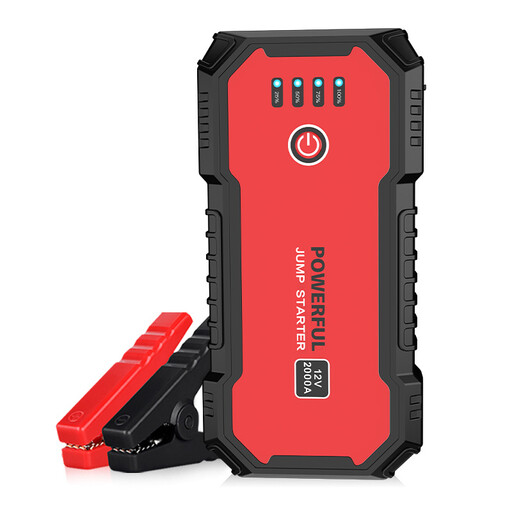
Why this product suits this profile: According to the product information, this compact model is designed for 12V petrol and diesel vehicles and weighs around 430 g. It is suitable for drivers looking for a compact mobile emergency jump starter.
The product data clearly states limits of up to 6.0 l for petrol and 4.0 l for diesel, along with a 12V design. This makes it easier to compare its suitability with your own vehicle.
1500 A peak current, 14000-mAh battery, QC3.0 output and LED light with three modes.
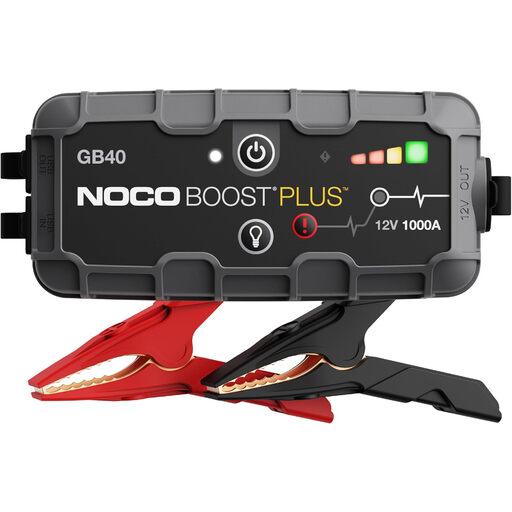
Why this product suits this profile: The specified UltraSafe technology combines reverse-polarity protection with a low-spark connection. The model is designed for petrol engines up to 6.0 l and diesel engines up to 3.0 l.
The engine limits and 12V system are clearly specified. The robust casing is described as IP65 with a rubberised surface.
1000 A peak current, weight of approximately 1.1 kg, USB charging function and LED torch with seven modes.
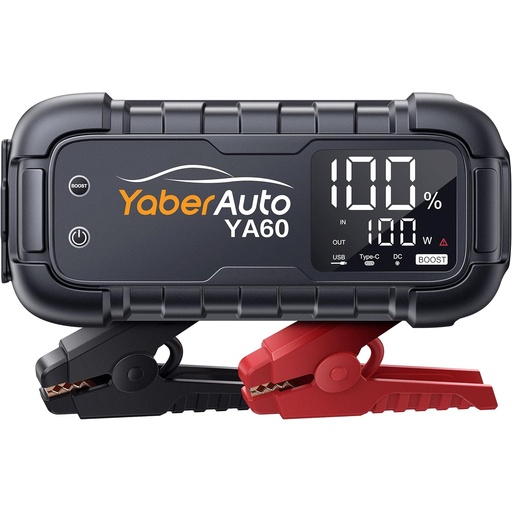
Why this product suits this profile: For large vehicles, campers or users with additional power requirements, the supplier states a peak current of 8000 A, 65-watt charging and a 150-watt DC output.
The specifications explicitly state a limit of up to 12.0 l for diesel, along with ten protection functions. Nevertheless, you should check your vehicle’s specific voltage before buying.
26800-mAh battery, USB-C with 65 W, two USB-A outputs, 150-watt DC output and 600-lumen light.
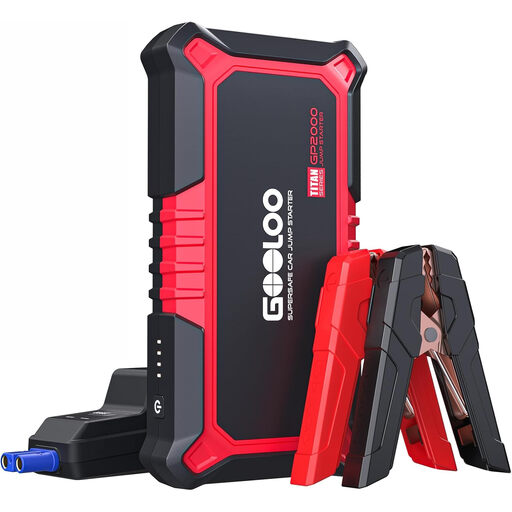
Why this product suits this profile: This device is aimed at households that need smartphone charging and emergency lighting as well as car jump-starting. The specifications state that it is suitable for 12V vehicles with petrol engines up to 8.0 l and diesel engines up to 6.0 l.
The ten listed protection functions and a charge indicator make it easier to check the device before use. According to the specifications, this model is not designed for 24V systems.
2000 A peak current, two USB outputs, USB-C connection and 400-lumen LED light with SOS and flashing modes.
We have put together a complete, regularly updated list of products that fully meet these strict selection criteria and the safety regulations applicable in the EU.
Do not use a jump starter with a visibly damaged, leaking or frozen battery. If the battery repeatedly goes flat, have the vehicle battery checked by a suitable specialist.
Its service life depends on the cell technology, storage conditions, temperature and charging intervals. Checking the charge regularly in accordance with the user manual helps keep it ready for use. Extreme heat inside a vehicle can accelerate battery ageing.
No. The key factors are 12 volts, engine type, engine size and the starting power specified by the manufacturer. 24V vehicles and the high-voltage batteries of electric vehicles are not compatible with standard 12V jump starters.
The electricity used for charging depends on the battery capacity, charger and charge level. With occasional use, the ongoing electricity costs are normally low. More importantly, you should fully recharge the device after use and avoid storing it permanently in extreme heat.