
Lieferung heute & morgen

Qualitätsgarantie

Willkommens-Angebote freischalten: KOSTENLOSE Lieferung | Bis zu 80 % RABATT | Kostenlose 30-Tage-JoyPlus-Testphase
App herunterladen
An LED ambient lighting system for your car interior can beautifully accentuate the dashboard, doors and footwells. However, choosing the right kit isn’t just about the number of colours. An unsuitable power supply, poorly planned cable routing or an ill-conceived light guide design can quickly render a set impractical for everyday use.
This buying guide from the Joybuy Product Recommendation Officer breaks down the key technical specifications and shows which kit suits different needs.
With basic RGB LED strips for cars, the light sources are spaced at intervals. This can create visible hotspots. An acrylic light guide distributes the light along the transparent cover, which can help achieve a more even lighting effect when mounted indirectly on the dashboard or door trim.
The construction is what really matters: acrylic and light guide strips should not be bent sharply. If you bend them too tightly, light transmission can suffer.
A set labelled as universal won’t automatically fit every interior layout. Before you buy, you should measure:
In a van or larger vehicle, a 175-inch set may be tight depending on where you install it. Conversely, any excess strip will need to be cut down properly.
An interior car lighting system with app control uses different applications depending on the variant – for example, “LED LAMP”, “Lotus Lantern”, “LotusLamp X” or “Magic Lantern”. So check before you buy whether the app is available for your iOS or Android device and what features it actually offers.
Bluetooth control, touch button, remote control, timer and voice control aren’t all combined in every model. Music sync for ambient lighting also responds to a microphone signal. The light movement therefore depends on volume, background noise and where the controller is installed.
Many of the sets we’re looking at here are designed as 12 V car ambient lighting. This matches the standard electrical system of cars and many vans, but you should still check the product specification carefully. A higher voltage can damage components; if the voltage is too low, the brightness and reaction speed of the effects may drop.
USB and Type-C variants are suitable for connecting to existing ports. For hardwired installations, electrical integration should only be carried out if your vehicle’s connections and fusing are suitable. A power-off module may be needed if you want the lighting to switch off automatically with the vehicle.
Terms like “10 in 1”, “14 in 1”, “18 in 1” or “22 in 1” usually describe the number of lighting areas and components included. Look at the actual contents:
A dual-zone control lets you adjust the main light guide and the footwell or door areas separately. This is handy if you don’t want all areas to show the same colour or effect at the same time.
Before sticking anything down, connect all components for a test run. The mounting surfaces must be clean and dry. With cuttable acrylic strips, you can’t cut just anywhere. Follow the product instructions and leave enough distance from the resistors, otherwise part of the strip may light unevenly or fail to sync properly.
Route cables away from pedal paths, airbag zones and moving seat rails. The lighting must not obstruct your view, controls or instrument displays. Do not operate the controls manually while driving.
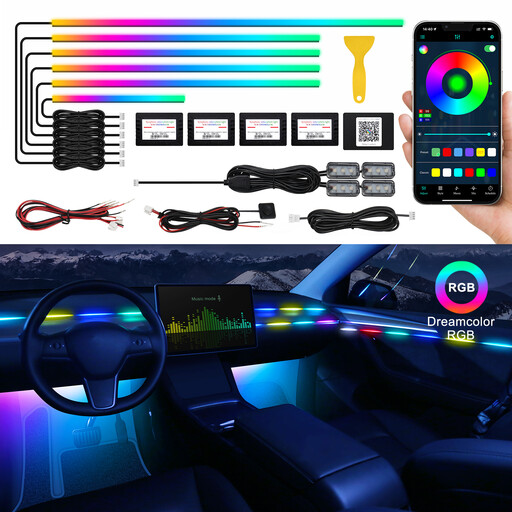
Why this product fits the profile: This set combines six acrylic light strips with four footwell lights, making it a straightforward DIY entry point without door handle or door bin modules.
The stated strip lengths and four footwell lights make planning ahead easier. The light guide is cuttable, but you must follow the instructions about resistor spacing.
593 LEDs, 12 V operation, Bluetooth app control and a sound sensor are included according to the product details.
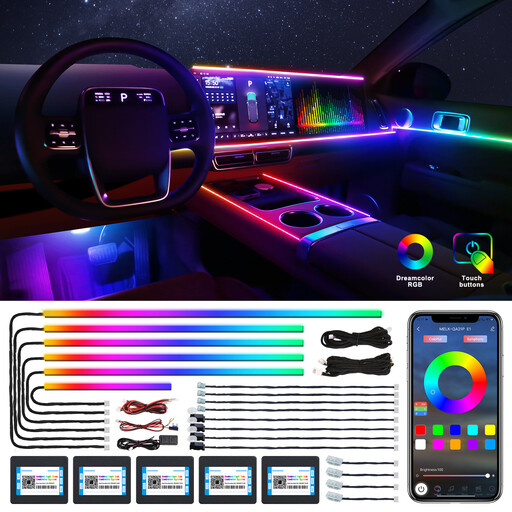
Why this product fits the profile: The kit covers the dashboard, footwell, door handles and door bins. The dual-zone control is ideal for creating a more nuanced interior look.
Multiple controllers allow for distribution around the vehicle. Before final installation, check all connections and the Bluetooth pairing.
600 LEDs, 12 V rating, app and touch control, plus independent zones are specified.
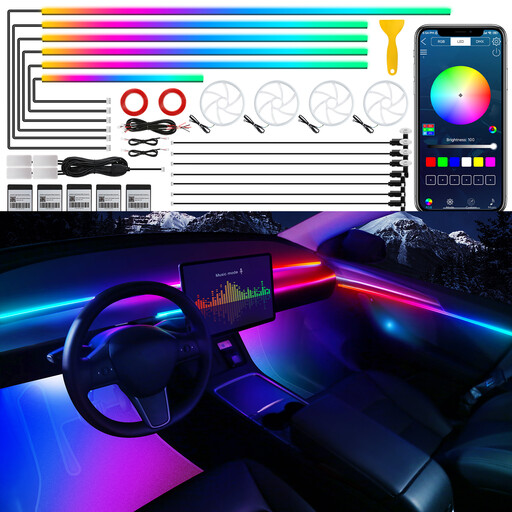
Why this product fits the profile: For users who want to include door handles, door bins and door speakers alongside dashboard and footwell lighting.
The extra secondary controllers reduce long individual cables. Because of the larger scope, careful planning before hiding the cables is especially important.
The 22-in-1 kit includes six acrylic strips, four footwell lights, plus lights for door handles, bins and door speakers, according to the product details.
We’ve put together a full, regularly updated list of products that meet these strict selection criteria and the safety regulations in force across the EU.
Ongoing running costs depend on the power consumption, how long you use the lights and your vehicle’s battery. With low-power lighting, the costs are usually limited compared to large electrical consumers; however, without a specific wattage figure, a general estimate wouldn’t be reliable.
The lighting must not dazzle the driver, obscure any controls or compromise road safety. Visible light sources can be problematic depending on where they’re installed. So check the applicable regulations and choose an indirect mounting position.
The lifespan depends on factors such as temperature, moisture, mechanical stress and the electrical supply. A specific durability period cannot be determined from the product information available. Avoid sharp bends, overheating and voltages outside the specified range.
This depends on the power in watts, daily usage time and your vehicle’s energy consumption. For USB or 12 V sets, check the stated power draw. If the lighting is permanently connected, it’s also important to know whether it switches off automatically with the vehicle.