
Lieferung heute & morgen

Qualitätsgarantie

Willkommens-Angebote freischalten: KOSTENLOSE Lieferung | Bis zu 80 % RABATT | Kostenlose 30-Tage-JoyPlus-Testphase
App herunterladen
A LED cabinet light with a motion sensor can illuminate dark cupboards, drawers and hallways without the need for fixed wiring. For rented homes and spaces where you want to avoid drilling, cordless models with adhesive strips, magnets or hooks are a practical choice. However, products vary considerably in their sensors, battery capacity, light output and installation.
A slim light may fit inside a wardrobe or beneath a shelf, but that doesn’t mean it will automatically illuminate the whole area. The number of LEDs, the length of the casing and the stated light output all affect how evenly a shelf or work surface is lit. A 20 cm light is often sufficient for a narrow cupboard. For longer kitchen wall units, a 30 or 40 cm version may be a better choice.
A PIR sensor detects heat and movement within a certain area and switches the light on automatically. Gesture control works differently: it responds to a hand movement and, depending on the model, may also let you dim the light. So, if you’re looking for an LED under-cabinet light for the kitchen, check which type of control it actually uses.
A rechargeable LED light with an 800 or 1,100 mAh battery can be charged conveniently via USB. However, the actual operating time depends on brightness, how often it switches on and how frequently it’s used. Battery capacity is therefore an important factor, but it doesn’t replace information about actual run time. You should also check that the USB connection is compatible and that the light can be positioned somewhere convenient for charging.
The stated range for the PIR models described here is 3 to 5 metres. This is usually sufficient inside a cupboard. Make sure shelves, clothes or decorations don’t block the sensor. If you’re using an LED motion-sensor night light in a hallway, position it so that people actually pass through its detection area.
For installation without drilling, you can use adhesive strips, magnets or hooks. The adhesive will hold better on a smooth, clean and dry surface. It may come loose on damp, dusty or heavily textured surfaces. If you’re choosing a magnetic cabinet light, also check whether there’s a metal surface to attach it to or whether you’ll need a suitable metal plate.
Choose a casing length that suits the space where you’ll install the light:
The number of LEDs alone doesn’t tell you how bright a light will be overall. For example, the 20 cm light has 21 LEDs, while the 30 cm version has 41 and the 40 cm version has 61. Light distribution, the cover and installation height all matter too.
Not every room calls for the same kind of light. Warm white and cool white light can each be useful in different situations:
An LED sensor light with three colour temperatures gives you more flexibility than a model with just one light colour. In the kitchen, you should also consider how close the light will be to water and steam. According to the product information, the lights described here should be protected from moisture and aren’t intended for use in wet areas.

Why this product suits your needs: This two-pack is ideal for smaller cupboards and shelf compartments, or for lighting both your kitchen and hallway. Its 20 cm design takes up little space and can be fitted with adhesive strips, without drilling.
The product details specify 21 LEDs, a PIR detection range of 3 to 5 metres and three colour temperatures. This makes it easier to understand the sensor type and available lighting options.
Two lights per set, each measuring 200 × 38 × 10 mm, with an 800 mAh battery and USB charging at 5 V and 0.5 A.
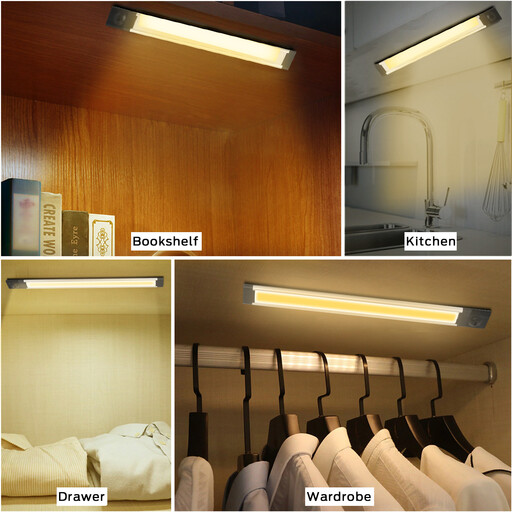
Why this product suits your needs: This model combines gesture control with an aluminium and ABS construction. It’s a good option if you’d like to adjust the brightness and light colour directly on the light.
According to the product description, you control the light with gestures and can dim it smoothly. This sets it apart from a standard PIR sensor.
36 SMD LEDs, a stated output of 400 lm, a colour temperature range of 2,800 to 6,500 K, plus magnetic fixing and hooks.
Why this product suits your needs: At 40 cm long, this light is designed for wide shelves, longer kitchen areas or spacious wardrobes. The two lights let you illuminate separate areas independently.
Its longer design and stated total of 61 LEDs are useful, measurable criteria when choosing a light for a larger area, rather than relying on compact styling alone.
400 × 38 × 10 mm, a PIR sensor with a range of 3 to 5 metres, a 1,100 mAh battery and three adjustable colour temperatures.
Before installation, remove any dust and grease from the surface. If you’re using adhesive strips, position the light carefully first, as moving it later may weaken the adhesive. Install a USB-powered cabinet light where the charging cable won’t get trapped.
A soft, dry cloth is all you need for cleaning. Water, harsh cleaners and abrasive materials can damage the casing, sensor or surface. If you notice any damage, a swollen battery or unusual heat, stop using the light and don’t open it.
We’ve put together a complete, regularly updated list of products that meet these strict selection criteria and fully comply with the safety regulations in force in the EU.
Depending on the model, you can fit the light using adhesive strips, magnets or hooks. Adhesive strips work best on smooth, dry and grease-free surfaces. For magnetic fixing, you’ll need a metal surface or a suitable metal plate.
It’s not possible to give a reliable general run time without specific information from the manufacturer. Battery life depends on factors including battery capacity, brightness setting, sensor activity and how often the light switches on. The models mentioned here have 800 or 1,100 mAh batteries and charge via USB at 5 V.
Neutral or cooler white light is often chosen for kitchen areas, as it makes outlines and contents easier to see. In the bedroom, warm white light at around 2,800 to 3,200 K can feel more comfortable. Models with three colour temperatures let you adjust the light to suit the room and the time of day.