
Lieferung heute & morgen

Qualitätsgarantie

Willkommens-Angebote freischalten: KOSTENLOSE Lieferung | Bis zu 80 % RABATT | Kostenlose 30-Tage-JoyPlus-Testphase
App herunterladen
An LED under-cabinet light with motion sensor can illuminate dark worktops, cupboard interiors or hallways without needing a switch or fixed wiring. For rented flats, families and hard-to-reach areas, cordless models with USB charging are particularly practical. However, products differ significantly in terms of sensor technology, battery capacity, installation and light output.
Many products use the term 'motion sensor' very loosely. A PIR sensor reacts to changes in heat radiation and is suitable for detecting movement within its detection range. Other lights feature a contactless sensor that recognises, for example, a hand gesture from a short distance.
So check the following:
For the LED light strips with PIR sensor described here, the stated range is 3 to 5 metres. This is sufficient for cupboards, shelves and hallways, but should not be equated with full room lighting.
The number of LEDs alone tells you little about the actual brightness. What matters is the luminous flux in lumens, the light distribution, the beam angle and the installation location. A short LED cupboard light may be enough for a shelf, whereas a kitchen worktop needs a more even light distribution.
Colour temperature also affects how you use the light. Cool white light generally feels clearer for tasks, while warm white light is often chosen for bedrooms or nighttime orientation. An LED light strip with selectable colour temperature offers more flexibility than a model with only one fixed light colour.
An under-cabinet light that requires no drilling is usually fixed with adhesive strips. This is practical for rented flats, but it requires a clean, dry and preferably smooth surface. On dusty, greasy or heavily textured surfaces, adhesion may be limited.
With a rechargeable under-cabinet light, you should also look out for the following details:
The actual operating time depends on how long it's switched on, how often the sensor is triggered and the brightness level. A specific runtime should only be taken as a manufacturer's figure unless standardised usage conditions are stated.
For the kitchen, wardrobe and hallway, automatic switching on is helpful when both hands are busy or the light switch is out of reach. Pay attention to whether the sensor reacts most reliably from the front or the side. With an LED night light with motion sensor, the light should not be installed directly at eye level, so that the brightness doesn't cause unnecessary glare at night.
Light colour is given in Kelvin:
A dimmable under-cabinet light allows additional adjustment, but this is not automatically included with every light that offers colour temperature selection. So check both functions separately.
Under wall units or in narrow shelf compartments, a few millimetres can make all the difference. The 30-centimetre models in this selection each measure 300 × 38 × 10 mm, while the shorter variants are 200 × 38 × 10 mm. The shallow depth makes installation easier under shelves or inside cupboards.
A 2-pack can be useful if you want to equip several areas. Still, compare your actual needs: two short lights are not necessarily equivalent to one longer light strip along a kitchen run.

Why this product suits the profile: Two compact lights at 20 centimetres long are ideal for smaller cupboards, shelves or short hallway areas. USB charging and tool-free fixing keep installation straightforward.
The product details specify sensor range, battery capacity and dimensions clearly: PIR detection at 3–5 metres, 800 mAh and 200 × 38 × 10 mm.
21 LEDs, three colour temperatures from 2,800 to 7,000 K, USB charging and adhesive mounting without drilling.
Why this product suits the profile: The longer design with 41 LEDs suits larger cupboard compartments, shelves or areas under wall units where a broader light distribution is needed.
Rather than just advertising with a vague brightness figure, it states the LED count, dimensions, sensor range and a battery capacity of 1,100 mAh.
41 LEDs, three selectable colour temperatures, USB charging at 5 V and 0.5 A, and a 2-pack.
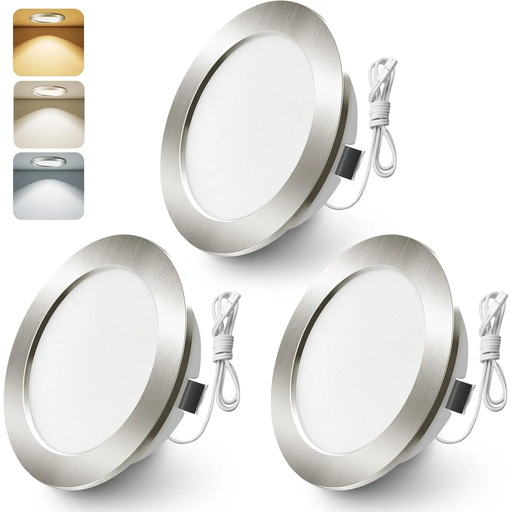
Why this product suits the profile: For users who prefer a mains-powered solution with a contactless sensor and adjustable brightness, this model could be of interest for the kitchen, bathroom or children's room.
The sensor type is described as a contactless sensor that detects hand movements within 10 cm. This makes it clear that it is not a PIR sensor with a 3–5 metre range.
Stated specifications: 780 lm, 10 W, brightness adjustment from 10–100 % and three colour temperatures at 3,000, 4,000 and 6,500 K.
Before installation, the surface should be cleaned of dust and grease. Only fix an adhesive light where the material supports adhesion. With kitchen furniture, also allow sufficient distance from direct steam and splashes. According to the product details, the USB lights described are not intended for damp conditions.
A permanently connected light with a 230-volt mains connection must be operated from a suitable, properly earthed socket. Do not modify the cable, sensor or housing. For cleaning, a soft, dry cloth is sufficient.
We have compiled a complete, regularly updated list of products that fully meet these strict selection criteria and the safety regulations in force in the EU.
Many cordless LED lights are mounted using adhesive strips. The surface should be dry, clean and level. On delicate surfaces, it's advisable to test first in an inconspicuous spot, as adhesive residue or paint lifting cannot be completely ruled out.
This depends on battery capacity, brightness, how often it's switched on and the sensor delay. Models with 800 mAh and 1,100 mAh offer different reserves, but a general operating time cannot be reliably stated without standardised test conditions. Recharge the light via a compatible USB power source as soon as the brightness drops.
LEDs generally require significantly less power in operation than many older light sources. With a battery-powered light, energy is only consumed when recharging. For running costs, the wattage, daily operating time and electricity tariff are the key factors. A 230-volt light with 10 W should be assessed based on its actual usage time, not just its maximum brightness.