
Lieferung heute & morgen

Qualitätsgarantie

Willkommens-Angebote freischalten: KOSTENLOSE Lieferung | Bis zu 80 % RABATT | Kostenlose 30-Tage-JoyPlus-Testphase
App herunterladen
A modern white dresser is more than just furniture—it's a statement of clean design that creates valuable storage space. But the search for the right model can quickly become overwhelming. Online listings often look identical, yet they hide crucial differences in quality. As your Joybuy Product Recommendation Officer, I'll help you separate the wheat from the chaff and make a choice you won't regret.
Many buyers focus on the outward appearance, overlooking critical flaws that only become apparent after a few months. Here are the most common pitfalls:
To avoid a bad purchase, you should focus on objective and verifiable criteria. These three aspects are crucial for the longevity and functionality of your new dresser.
The foundation of any good piece of furniture is its material. Pay attention to the material thickness, especially for the carcass and top panels. A thickness of 16 mm or more is a good indicator of stability. In terms of materials, MDF (Medium-Density Fibreboard) is often a more solid choice than simple particleboard, as it has a higher density and strength.
The surface is crucial for both appearance and maintenance. A melamine resin-coated surface is far more resistant to scratches and moisture than a simple foil finish. This is particularly important if you plan to use the furniture as a bathroom cabinet or in the kitchen. Also, look for the E1 classification of the wood-based material, which signifies low-emission, health-safe manufacturing.
Stable construction is evident in the details. Check if an anti-tip kit for wall mounting is included. This is an essential safety feature, especially in households with children or if the dresser will serve as a narrow hallway cabinet.
Other features of a well-thought-out design include:
A good chest of drawers or a white sideboard adapts to your needs—not the other way around. Adjustable shelves are a must-have here. They allow you to flexibly design the interior and accommodate taller items.
Modern designs often offer additional features that enhance user comfort. A sideboard with LED lighting, for example, can create an ambient atmosphere in the living room. Pay attention to the control options (remote, app) and the type of lighting. Handleless fronts with a push-to-open function underscore a minimalist design, while traditional handles can be more practical.
To make your decision easier, we have selected a few models based on different user profiles and the criteria mentioned above.
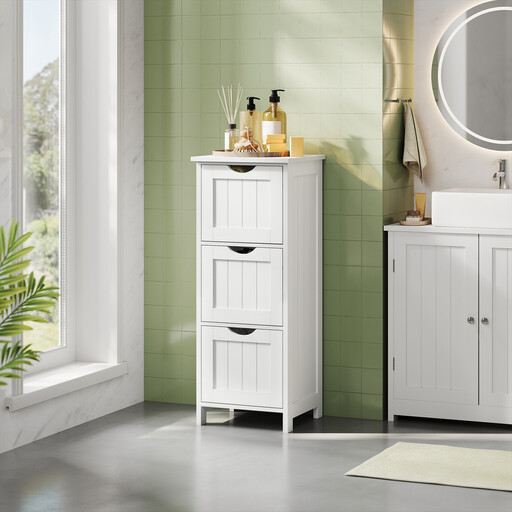
Why This Fits Their Persona: Ideal for a first apartment, small bathrooms, or unused corners. This model focuses on maximum functionality in a minimal footprint without breaking the bank.
It bypasses the instability trap with a compact, purpose-built design. Instead of complex mechanisms, it offers simple yet functional drawers for daily use.
Extremely space-saving dimensions (32x30 cm footprint) and an included anti-tip kit for secure placement.
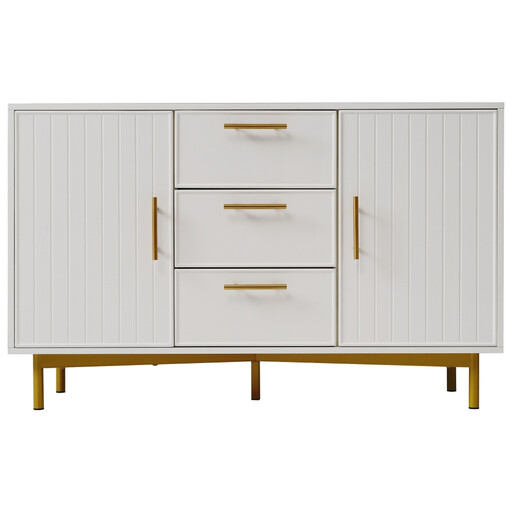
Why This Fits Their Persona: For those seeking a piece of furniture that is more than just storage. The decorative fluted fronts and gold handles make this sideboard a modern centrepiece in the living room or bedroom.
Instead of a fragile high-gloss foil, it features a textured, tactile surface. The additional, adjustable central leg actively counteracts the instability trap.
Unique design with a fluted texture and metal accents. Height-adjustable shelves behind the doors offer flexible storage options.
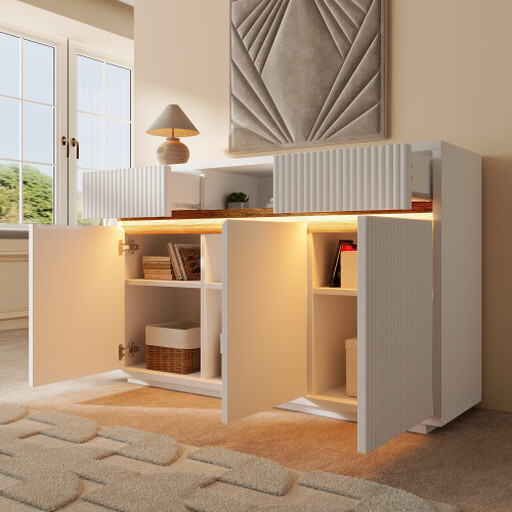
Why This Fits Their Persona: At 140 cm wide, this sideboard offers enormous storage for everything a family needs. The combination of drawers, doors, and an open compartment is ideal for keeping things organised.
It solves the problem of impractical storage with removable and adjustable shelves. The included anti-tip kit directly addresses the safety needs of families.
High load capacity for the top panel (up to 50 kg, according to the manufacturer) and a flexible interior layout. The recessed inner edges of the doors serve as handles, enhancing safety.
We have compiled a complete, up-to-date list of products that fully meet these strict selection criteria and safety standards.
To clean high-gloss surfaces, it's best to use a soft, lint-free cloth (e.g., microfibre) lightly dampened with water and a mild detergent. Absolutely avoid abrasive cleaners or rough sponges, as they can cause micro-scratches. Afterwards, dry the surface with a dry cloth to prevent streaks.
The E1 classification is a European standard for wood-based materials like particleboard or MDF. It certifies that the formaldehyde emissions from the material do not exceed a specific limit. Furniture with this classification is considered safe for health and is especially recommended for use in living rooms and bedrooms.
The level of difficulty depends on the specific model. However, most manufacturers provide clear assembly instructions with illustrated steps and numbered parts. Plan for enough time and, ideally, assemble it with a partner. Before purchasing, check whether the required tools are included or need to be sourced separately. Careful assembly is crucial for the future stability of the furniture.