
Lieferung heute & morgen

Qualitätsgarantie

Willkommens-Angebote freischalten: KOSTENLOSE Lieferung | Bis zu 80 % RABATT | Kostenlose 30-Tage-JoyPlus-Testphase
App herunterladen
A motorcycle lift makes tyre changes, cleaning, chain maintenance and suspension repairs much easier. However, not every model automatically provides a safe or suitable solution. What really matters is the load capacity, lifting range, contact points and the ability to secure the bike against accidental lowering.
Many buyers first look at a high kilogram rating or a low price. In doing so, they overlook important details: a motorcycle lift that is too narrow can be unstable, an unsuitable lifting range may not reach the bike’s frame, and a model without a separate safety lock is not adequate for working underneath the raised vehicle.
The stated load capacity must match the actual weight of your bike. Accessories, luggage, fluids and possible weight distribution should all be taken into account. Furthermore, a high load rating does not automatically mean that every contact surface is suitable for every motorcycle.
For motorcycles, compact motorcycle lift tables or motorcycle jacks with a capacity of several hundred kilograms are often suitable. However, ATVs, heavy adventure bikes or vehicles with a particularly high centre of gravity have different requirements.
A motorcycle lift with too low a minimum height may not slide under the frame. If the maximum height is too low, work on the wheels or suspension will be restricted. Before buying, you should measure the lowest and highest contact points on your own bike.
A hydraulic motorcycle lift often allows comfortable lifting via a foot pedal or lever. A mechanical motorcycle lift with a hand crank, on the other hand, can be operated without hydraulic oil and takes up less space. Both types need a level, hard surface.
Metal contact surfaces can damage paintwork, the frame or the underbody if suitable rubber pads are not fitted. Equally important is a mechanical safety lock, such as a locking pin or a lockable height position.
A motorcycle paddock stand or rear wheel stand usually only lifts a specific part of the bike. It does not replace a full motorcycle lift table or a complete support system in every case.
Compare the lift’s permitted weight with your bike’s weight and consider whether the load is carried centrally or only at one end. With a rear wheel stand, the load on the swingarm or paddock stand is different from that on a central motorcycle repair stand.
For larger SUVs, off-road vehicles or light commercial vehicles, car axle stands are a more suitable addition. The vehicle’s weight must then be distributed across several stable contact points. A single motorcycle lift is generally not intended for these vehicles.
Pay attention to:
A crank or hydraulic function is used for lifting. For longer jobs, the bike should also be mechanically secured. With height-adjustable axle stands, lockable positions and a clear load capacity rating are important.
For the following products, we only state the values given in the respective product information. A suitable, level surface and adherence to the manufacturer’s instructions remain essential.
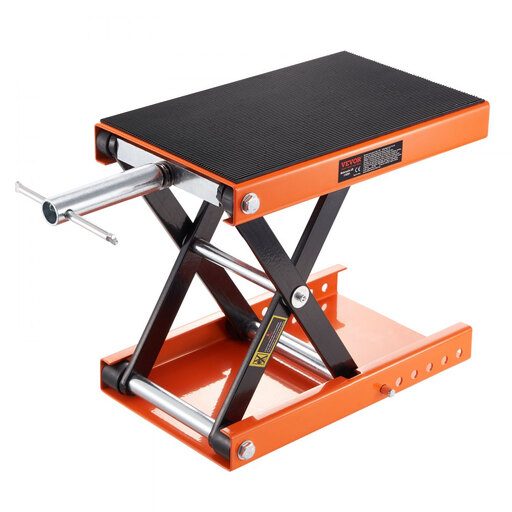
Why this product suits the profile: The mechanical design with a hand crank is ideal for regular maintenance work in your home garage when you don’t need hydraulic equipment.
The 95–350 mm lifting range and the locking pin make the relevant selection points clear. However, the contact points must still match your own motorcycle.
Stated load capacity of 500 kg, hand crank and removable handle. The manufacturer advises not to turn the crank further at the highest point.
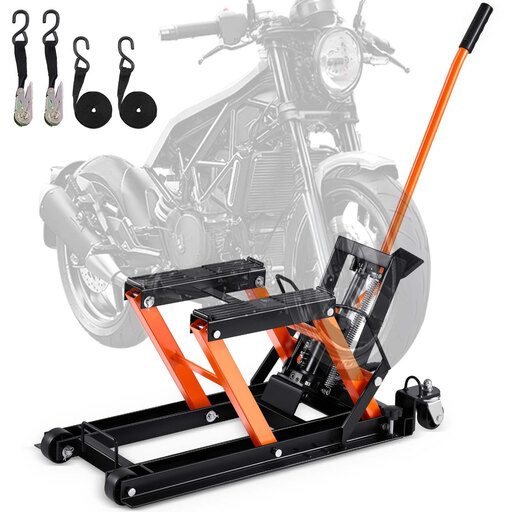
Why this product suits the profile: The hydraulic operation with a long lever and foot pedal is ideal for users who lift frequently and prefer a comfortable experience.
The stated load capacity of 700 kg and the 120–385 mm lifting range make it easy to check before buying. A non-slip platform aids positioning.
Hydraulic lift, non-slip platform and two 360-degree and two directional castors according to the product description.
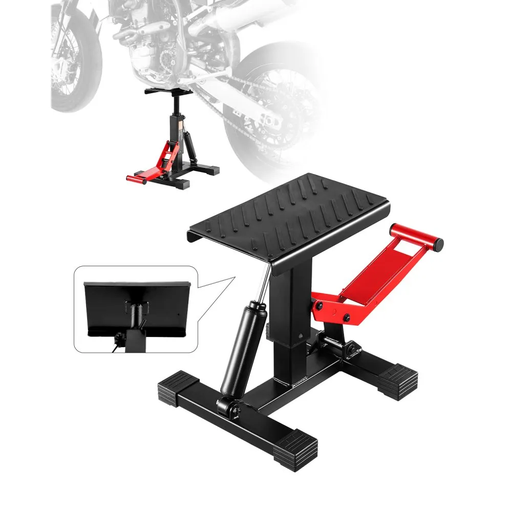
Why this product suits the profile: The stated suitability for motorcycles and ATVs is aimed at users with different vehicle types and varying maintenance tasks.
The combination of 544 kg load capacity and 250–465 mm lifting range shows which vehicle heights the model is designed for. The actual contact points should be checked in advance.
Hydraulic design and explicitly stated use for motorcycles and ATVs.
For work on cars, you might also consider TCE 3 Ton Heavy Duty Car Jack Stands or the height-adjustable TCE 6 Ton Car Jack Stands. According to the product information, these models have EN-1494 certifications or GS marking. Nevertheless, check the vehicle weight, contact points and intended use before use.
We have put together a complete, regularly updated list of products that fully meet these strict selection criteria and the safety regulations in force in the EU.
A motorcycle rear wheel stand is suitable for chain maintenance, wheel cleaning or certain work on the rear wheel. A single rear wheel stand is not sufficient for work underneath the entire vehicle.
That depends on the vehicle weight, centre of gravity and frame design. Compare the load capacity with the actual weight and choose a lifting range that reaches the intended contact points. For heavy machines, a model with a higher load capacity and a wider platform can be a good idea.
A lift is primarily intended for lifting and maintenance work. For longer storage, you should follow the manufacturer’s instructions and use suitable mechanical supports. The hydraulics or crank alone should not be relied upon as the only safety measure.
Remove dirt and moisture after use. With a mechanical model, the threads and central spindle can be lightly lubricated according to the manufacturer’s instructions. Hydraulic systems should be checked for leaks. Damaged pads, locking pins or load-bearing components must not be used again.